Reporting and context on Google, with a closer look at the decisions and developments that matter.
Get AI Secret’s free daily briefing, including Google and the wider AI industry.

At a glance
Google is part of Alphabet. This topic follows its AI research, Gemini models, Google DeepMind, cloud infrastructure and consumer products.
- Focus
- Gemini; Google DeepMind; Google Cloud
- Reference
Sources checked . Selected company background and milestones.
Company milestones
Selected milestones, newest first. Earlier history is available below.
Forms Google DeepMind
Google brings the Brain team and DeepMind together as Google DeepMind.
Source: Google
Show earlier historyHide earlier history · 1 milestones
More than 10 years ago.
The latest on Google
Newest firstRelated reporting
Briefs, articles and relevant sections, newest first. Explore older coverage below.
More coverage
In the hothouse of Silicon Valley’s AI boom, few stories soared as high—or crashed as spectacularly—as Windsurf’s. Born in the crucible of Y Combinator’s 2022 batch, Windsurf quickly became the darling of developers and enterprise CTOs alike. Its core product: a suite of AI-powered programming tools that promised to automate away the grunt work of software development. By mid-2024, the numbers told a story of unambiguous success: $100 million in annual recurring revenue (ARR), over 350 enterprise clients, and a developer community that evangelized the product with almost religious fervor.
Venture capitalists, not known for their patience or humility, lined up to shower Windsurf with funding. The company’s valuation soared, and its founders—Varun Mohan and Douglas Chen—became fixtures on the conference circuit, their every utterance parsed for clues about the future of AI tooling. By the summer of 2024, Windsurf was one of the hottest acquisition targets in Silicon Valley, its fate the subject of fevered speculation on Hacker News and in VC Slack channels.
Act I: The OpenAI Deal Dies on a Friday
The denouement began with a whisper and ended with a bang. In May 2024, OpenAI entered acquisition talks with Windsurf, reportedly offering a staggering $3 billion. The deal, insiders said, was all but done. Employees rehearsed internal announcements. Equity holders, many of whom had traded cushy FAANG salaries for startup stock, daydreamed about generational wealth. The champagne was on ice.
But on Friday, July 11, 2025, the dream evaporated. The OpenAI deal collapsed, sending shockwaves through the company. The proximate cause: Microsoft, OpenAI’s largest partner and investor, reportedly blocked the acquisition over concerns about intellectual property entanglement. Microsoft, ever the careful steward of its own moat, was unwilling to let a core AI tools player slip into the hands of its sometimes-ally, sometimes-rival.
The fallout was immediate and brutal. Employees, blindsided, watched as their paper fortunes turned to dust. “It felt like someone had pulled the rug out from under us,” one engineer posted anonymously on Blind. The mood in the office shifted from euphoria to disbelief in a matter of hours.
Act I: The OpenAI Deal Dies on a Friday
The OpenAI deal collapsed, sending shockwaves through the company. The proximate cause: Microsoft, OpenAI’s largest partner and investor, reportedly blocked the acquisition over concerns about intellectual property entanglement. Microsoft, ever the careful steward of its own moat, was unwilling to let a core AI tools player slip into the hands of its sometimes-ally, sometimes-rival.
Microsoft: Act I: The OpenAI Deal Dies on a Friday
The proximate cause: Microsoft, OpenAI’s largest partner and investor, reportedly blocked the acquisition over concerns about intellectual property entanglement. Microsoft, ever the careful steward of its own moat, was unwilling to let a core AI tools player slip into the hands of its sometimes-ally, sometimes-rival.
Act II: Google Moves In That Same Night
If Friday was a tragedy, Friday night was farce. Even as the OpenAI deal was dying, Google DeepMind swooped in. By midnight, Google had inked a $2.4 billion deal—not to acquire Windsurf outright, but to secure a non-exclusive license to its core technology. The twist: this was less a technology transfer than a “quiet acquihire.” CEO Varun Mohan, cofounder Douglas Chen, and the company’s core technical team were hired by Google, their compensation rumored to be eye-watering even by Valley standards.
The rest of Windsurf’s 250+ employees were left behind, staring at a cap table that had suddenly become a legal fiction. The founders, now richer than ever, were gone. The office Slack channels filled with gallows humor and stunned silence.
Act II: Google Moves In That Same Night
Even as the OpenAI deal was dying, Google DeepMind swooped in. By midnight, Google had inked a $2.4 billion deal—not to acquire Windsurf outright, but to secure a non-exclusive license to its core technology.
Act III: Cognition Cleans Up Over the Weekend
The weekend brought no respite. On Saturday, Windsurf’s head of business was installed as interim CEO, a move that did little to reassure the shell-shocked staff. On Sunday, Cognition—the AI agent company behind the much-hyped Devin—initiated talks to acquire what was left of Windsurf. By Monday morning, a deal was signed: Cognition would pay a few hundred million in cash to acquire the remnants of Windsurf—its IP, its remaining staff, and its considerable mess.
Cognition promised to honor employee options and provide some liquidity, but the upside was gone. The life-changing event employees had expected was replaced by a hasty handoff to another startup, with vague assurances about the future. “We were told to be grateful it wasn’t worse,” one employee later remarked. The irony was not lost on anyone.
The Employee Shock: From Dream to Disillusionment
For many Windsurf employees, this was their first startup job. They had accepted below-market salaries in exchange for equity, betting on the promise of a big exit. Now, they watched as their founders walked away with Google, leaving them to pick up the pieces. The sense of betrayal was palpable.
The internal forums filled with questions: How had this happened? Why were the founders rewarded while the rank-and-file were left with scraps? The answers, such as they were, offered little comfort. The cap table, once a symbol of shared destiny, had become a cruel joke.
The Ecosystem Fallout: Silicon Valley’s Social Contract Frays
The Windsurf debacle did not go unnoticed in the broader ecosystem. Vinod Khosla, never one to mince words, publicly criticized the founders, calling their actions a betrayal of Silicon Valley’s social contract. “Founders are supposed to look out for their teams, not just themselves,” he tweeted, igniting a firestorm of debate.
Others, however, saw the move as shrewd. In a market where cap tables could be wiped out by a single weekend’s events, what was loyalty worth? Windsurf was not the first to play this game. Character.AI, Inflection, and Adept had all executed similar maneuvers, prioritizing founder and investor interests over those of employees.
The message was clear: in the new AI gold rush, the rules had changed. The old narratives of shared risk and collective reward were being rewritten in real time.
The Deeper Shift: When AI Tooling Loses Its Moat
Beneath the drama lay a deeper structural shift. Windsurf’s fate was sealed not by boardroom intrigue, but by the changing dynamics of the AI tooling market. The moment Anthropic cut off Claude access mid-negotiation, Windsurf’s competitive moat vanished. Users, ever pragmatic, migrated to cheaper or more integrated tools. The platform giants—OpenAI, Google, Microsoft—controlled the models, the data, and increasingly, the teams.
Windsurf’s story was a cautionary tale about the perils of building on someone else’s platform. When the platform owner decides to pull the plug, even the most promising startup can find itself adrift.
The Moral Question: Trust, Equity, and the Startup Dream
In the end, Windsurf’s collapse raises uncomfortable questions about the future of Silicon Valley’s startup ethos. When founders are rewarded for extracting value rather than sharing it, when cap tables become fiction, what happens to trust? To equity? To the entire startup dream?
Was Windsurf a failure of business strategy, or of ethics? The answer, perhaps, is both. The founders played the game as it is now written, not as it once was. The employees, for their part, learned a hard lesson about the new realities of the AI boom.
As the dust settles, one thing is clear: in Silicon Valley, fortunes can be made and lost in a single weekend. The only constant is change—and, perhaps, the enduring power of irony.

Welcome to AI Secret Growth Map June 2025 Report
The AI landscape shows no signs of slowing down. Just one month later, we’re witnessing not only sustained momentum—but a broadening of AI adoption across verticals. From video generation and enterprise AI to dev tools and go-to-market automation, every corner of the ecosystem is being reshaped in real-time.
At AI Secret, we’ve partnered with leading industry sources and analyzed real traffic data across millions of users to compile the June 2025 Growth Rankings. This report goes beyond hype and headlines—highlighting the tools actually winning attention, adoption, and user trust.
Whether you’re an early-stage founder, product manager, or builder, the rankings below offer an inside look at where AI attention is flowing—and which products are leading the movement.
Let’s explore the latest signals in the surge. 👇
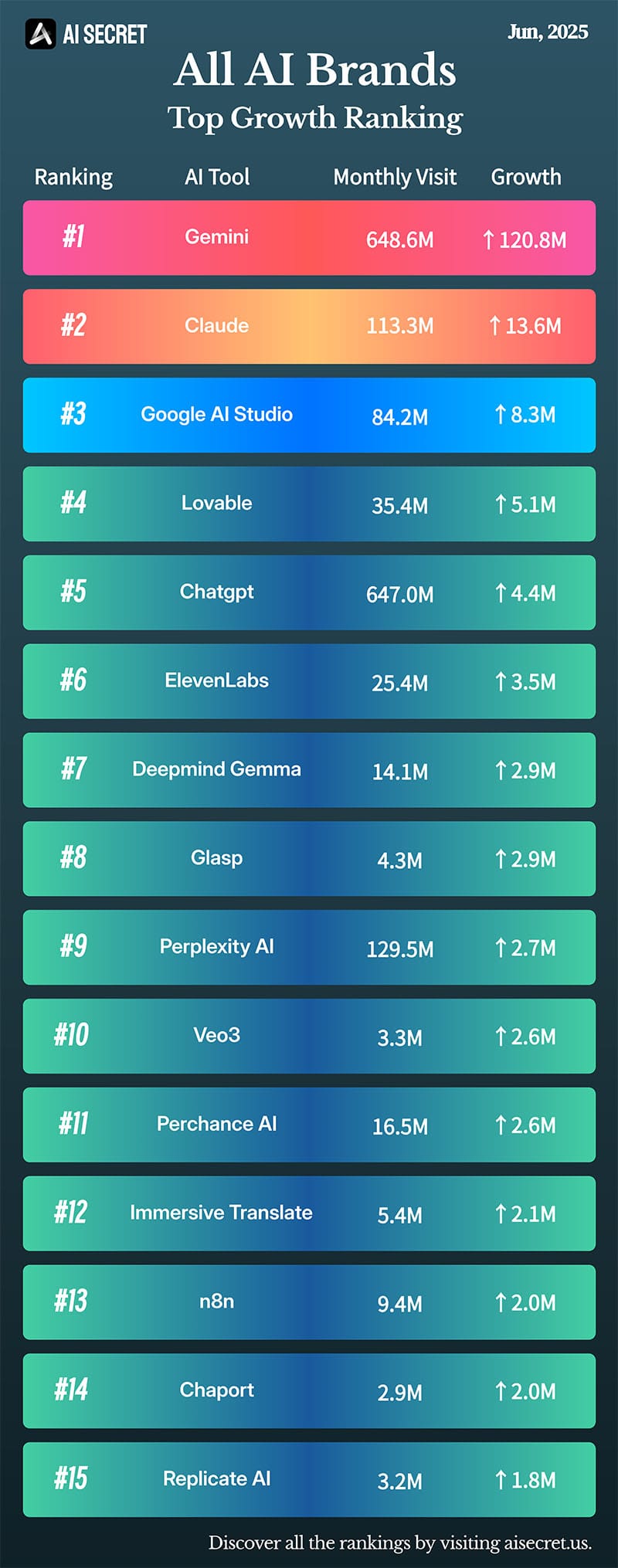
🧠 All AI Brands – Titans Hold, Vibe Coders Rise
Gemini leads with a commanding +120.8M new visits, surpassing 648.6M monthly traffic—a clear sign it's becoming the default AI interface within Google’s expanding ecosystem.
Claude (+13.6M) and Google AI Studio (+8.3M) followed, with the latter making waves among builders and prompt engineers.
But the real energy came from tools enabling non-developers to build.
Lovable (+5.1M), Perchance AI (+2.6M), and n8n (+2.0M) continue to push the Vibe Coding movement forward—AI-native creation tools that feel more like collaboration than coding.
Meanwhile, Chaport (+2.0M) stood out as a GTM-focused AI chat tool finding traction in sales pipelines.
🛎️ Key takeaway: Gemini dominates the infrastructure layer—but growth is happening at the edges, where creation and conversion are getting radically easier.
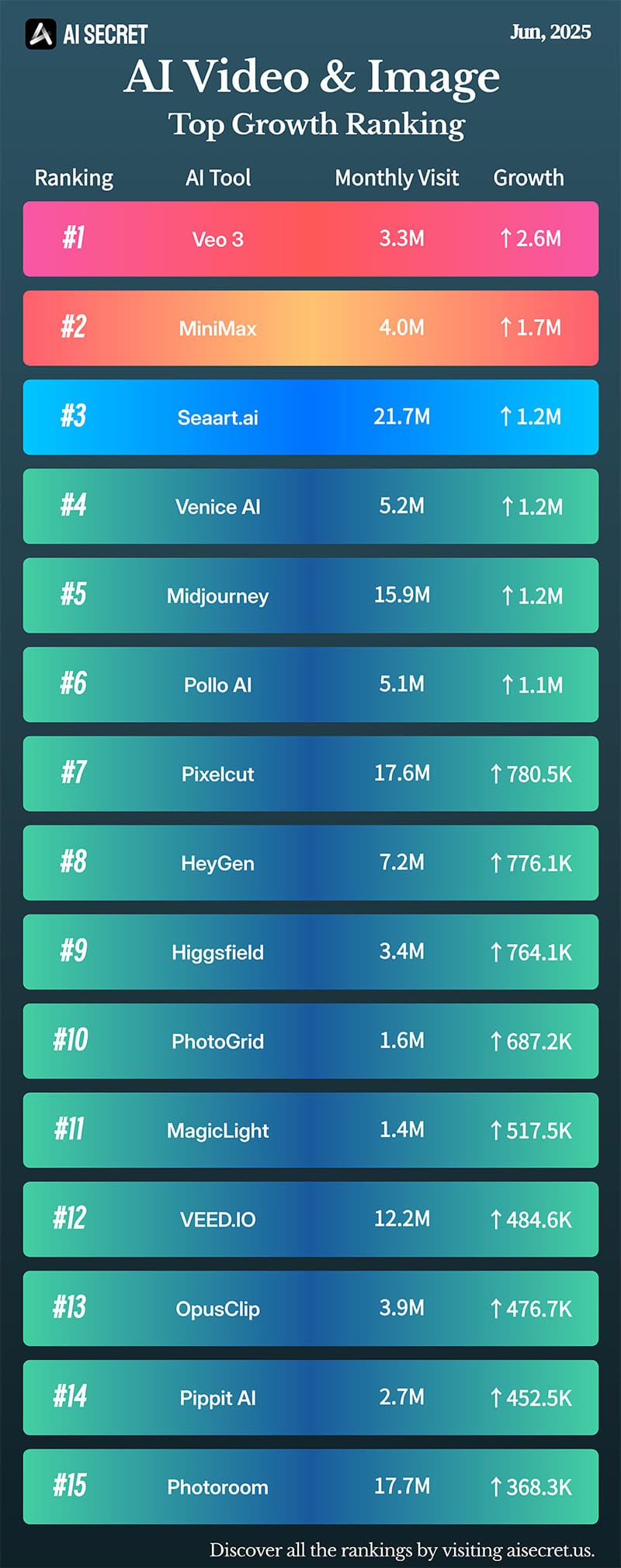
🎬 AI Video & Image – Veo 3 Takes the Spotlight
Visual AI continues its vertical climb. Veo 3 leads this month’s Video & Image rankings with +2.6M in growth, riding buzz around cinematic-style video generation. Close behind, MiniMax (+1.7M) is becoming a go-to for generative visual workflows.
Seaart.ai, Venice AI, and Midjourney each gained +1.2M, proving that aesthetic quality and usability are driving adoption. Pollo AI and Pixelcut also saw healthy gains—particularly among e-commerce creators and mobile-first designers.
Legacy players like HeyGen (+776.1K) and Higgsfield (+764.1K) held ground, while newcomers like MagicLight, PhotoGrid, and OpusClip continued to build niche loyalty.
🛎️ Key takeaway: The race in AI visual tools is now about differentiation. Cinematic quality, mobile editing, and TikTok-ready workflows are separating leaders from laggards.
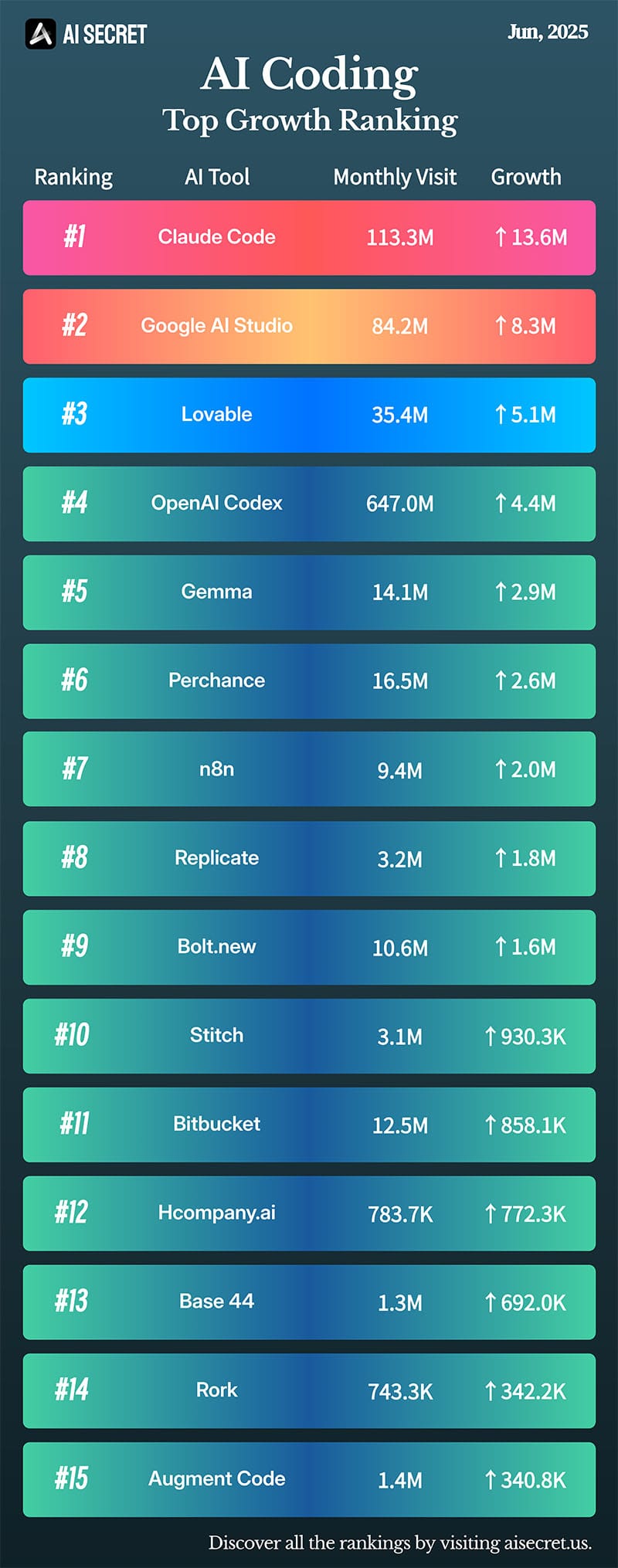
👨💻 AI Coding – The Rise of Vibe Coders
Claude Code (+13.6M) and Google AI Studio (+8.3M) dominate the traditional side of AI development, but the real story lies deeper.
Lovable (+5.1M), Perchance AI, and n8n are redefining who gets to code—lowering the barrier for anyone to automate, generate, or create logic flows.
Bolt.new (+1.6M) continues its fast rise after last quarter’s breakout, while
Stitch and Bitbucket show steady traction among dev teams.
🛎️ Key takeaway: A new developer class is emerging—non-coders building with AI-native logic blocks, interfaces, and prompts.
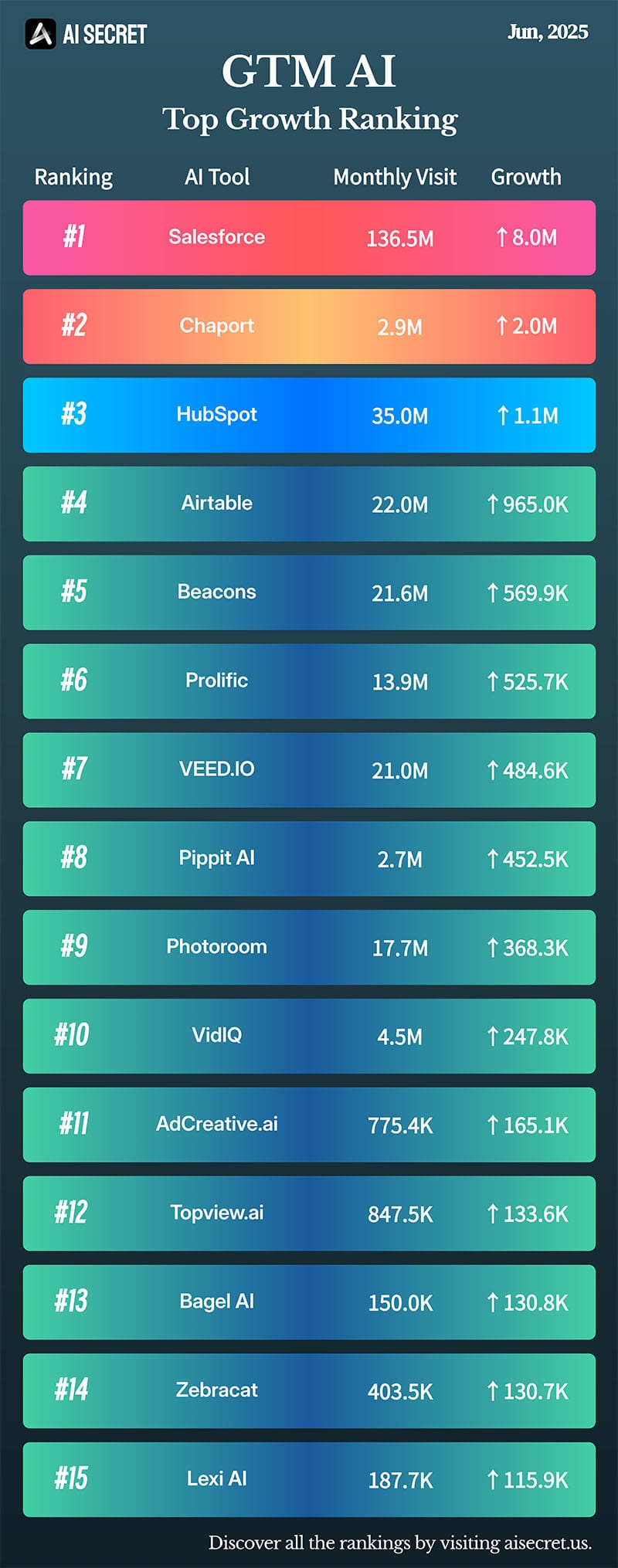
🚀 GTM AI – The Rise of AI-Driven Growth Engines
This month’s GTM AI chart shows one thing clearly: AI is taking over the growth stack.
Salesforce (+8.0M) remains the category anchor, but it’s the AI-native GTM tools rising below that are reshaping how growth happens.
HubSpot (+1.1M) surges with Breeze Agents — AI workers for support, outreach, and content. It’s no longer just CRM; it’s an autonomous GTM engine.
Airtable (+965.0K) climbs with its AI-native app platform, turning data into automations, interfaces, and agents. Perfect for no-code teams scaling fast.
Chaport (+2.0M) leads in real-time AI chat and lead capture.
Prolific, Beacons, and Pippit AI focus on creator-led GTM and async sales motions.
🛎️ Key takeaway: From CRMs to chatbots, GTM is now programmable—and AI is doing the heavy lifting.
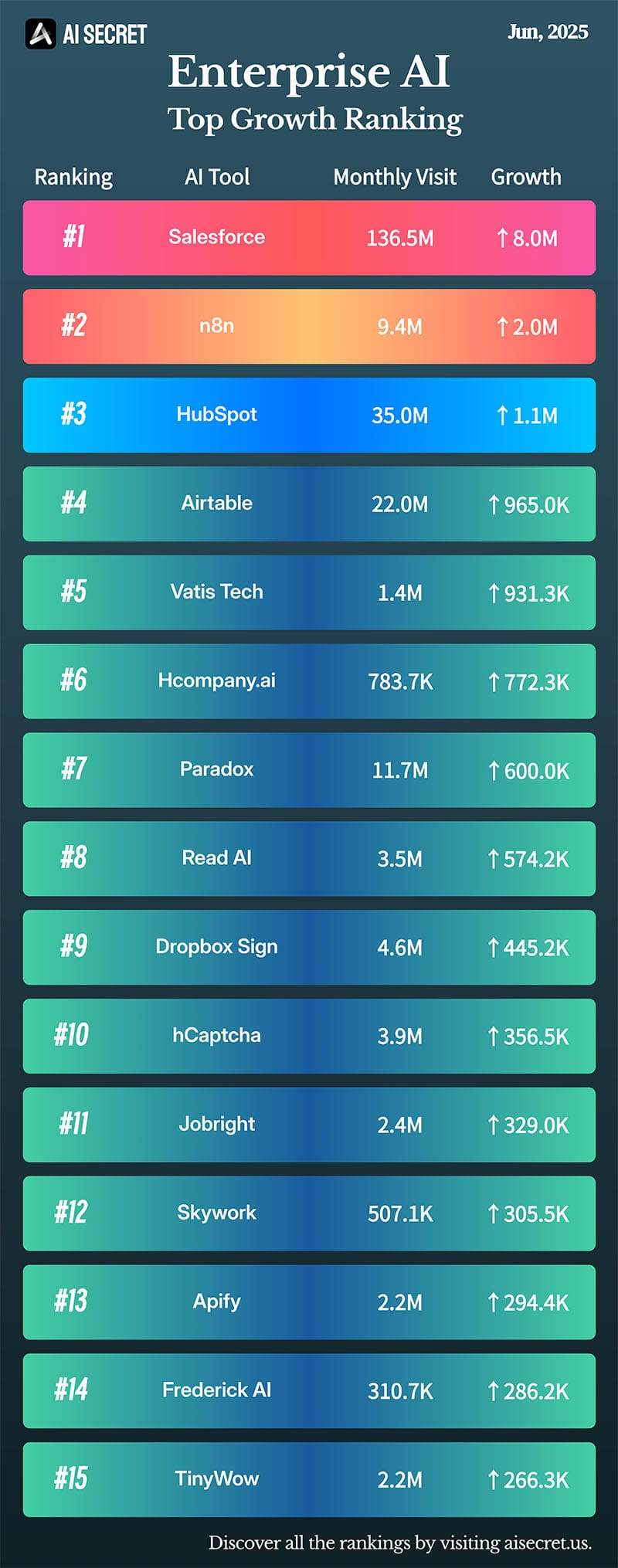
🏢 Enterprise AI – The Stack Goes Internal
Salesforce again leads, but n8n (+2.0M), HubSpot (+1.1M), and Airtable (+965K) stand out as flexible automation layers within companies.
Vatis Tech, Paradox, and Read AI reveal increasing appetite for vertical-specific copilots—from voice to hiring to meeting intelligence.
Smaller tools like Apify, and TinyWow quietly climbed as they embedded into internal workflows.
🛎️ Key takeaway: The real AI adoption in enterprises isn’t flashy—it’s quiet, workflow-native, and often invisible to end users.
🔚 Final Thoughts – From Infrastructure to Interface
June’s rankings reveal a deeper shift: AI adoption is no longer top-down—it’s edge-first. The momentum isn’t just with foundational models, but with tools that feel useful, look accessible, and act fast.
What stood out across categories?
- Gemini is solidifying its role as the OS layer of AI, but it’s the new interface tools—like Lovable, Perchance, and Veo 3—that are changing how users engage daily.
- Video & image AI is no longer hype—it’s utility. With Veo 3 at the top, we’re entering an era of cinematic creation at prompt speed.
- Vibe Coding tools are scaling fast, led by platforms that let non-coders build automation, logic, and experiences—without writing a line of code.
- GTM and Enterprise AI are maturing rapidly. Tools like Chaport, Airtable, and n8n are embedding into real business operations—not experiments, but pipelines.
- Microtools are winning macro share. Tools with clear value props—whether for clip editing, contract signing, or chatbot integration—are finding fast, loyal audiences.
The landscape is getting more diverse, more practical, and more creative.
This isn’t about a single killer app—it’s about AI becoming the new interface layer of modern work.
Google: 🔚 Final Thoughts – From Infrastructure to Interface
Gemini is solidifying its role as the OS layer of AI, but it’s the new interface tools —like Lovable, Perchance, and Veo 3—that are changing how users engage daily.
TOGETHER WITH US
AI Secret Media Group is the world’s #1 AI & Tech Newsletter Group, boasting over 1 million readers from leading companies such as OpenAI, Google, Meta, and Microsoft. Our Newsletter Brands:
- AI: AI Secret
- Tech: Bay Area Letters
- Futuristic: Posthuman
We've helped promote over 500 Tech Brands. Will yours be the next?
Email our co-founder Mark directly at [email protected] if the button fails.
Related Stories
 Magna
Magna Magna
Magna Magna
Magna

Windsurf’s Weekend Wipeout: Anatomy of a Silicon Valley Collapse
In the hothouse of Silicon Valley’s AI boom, few stories soared as high—or crashed as spectacularly—as Windsurf’s. Born in the crucible of

🛎️ OpenAI Wins Google’s Math
More Stories: MIT’s Robots Self-Aware, ChatGPT Hits 2.5B Daily
Who’s Teaching Your Kids—Teachers or Tech Giants?
In the not-so-distant past, the phrase “the dog ate my homework” was the go-to excuse for students. Fast forward to 2025, and it’s more likely

🛎️ Grok Plays No Rules
More Stories: Google Talks Now, OpenAI’s GPU Polyamory
🛎️ Coding’s Next Home
More Stories: Publishers Mute Again, Mistral Targets OpenAI
🛎️ Surf, Eat, Die
Meta AI Closed, Windsurf Final Ride, Claude Eating Canva
🛎️ Soul For Sale
Google acquihires Windsurf, Claude's Pro Move, OpenAi's Missing Model
AI Secret Growth Map: June 2025
From Gemini’s 120M surge to the rise of vibe coders and video AI
Inside Gemini’s Viral June Surge
According to the AI Secret Top Growth Ranking Report – June 2025, Gemini—Google’s flagship AI platform—pulled off what can only be described as the