Grok Is Hijacking Code
Plus: Apple Brands OpenAI's Device Stolen, Beijing Took Manus Back
Read the story
Product · Personal agents
A general-purpose AI agent for executing multi-step research, information and productivity tasks.
Get AI Secret’s free daily briefing, including Manus and the wider AI industry.

A general-purpose AI agent for executing multi-step research, information and productivity tasks.
Official product information checked .
Briefs, articles and relevant sections, newest first. Explore older coverage below.
More coverage

In the rapidly evolving landscape of artificial intelligence, the capacity for deep, reliable research is a critical differentiator among workspace agents. Skywork emerges as a formidable contender in this domain, positioning itself as a superior solution compared to competitors like Manus.
The proliferation of AI workspace agents has revolutionized how individuals and organizations approach research, content creation, and decision-making. However, not all AI agents are created equal. The prevalence of "AI hallucinations"—instances where AI generates plausible but factually incorrect information—remains a significant challenge. Skywork Super Agents address this issue head-on, leveraging advanced deep research capabilities to minimize inaccuracies and deliver trustworthy outputs.

AI hallucinations undermine trust in automated research tools. These illusions often stem from limited data retrieval and superficial analysis, leading to incomplete or erroneous outputs. For professionals who rely on AI-generated insights, such as marketers, analysts, and educators, the consequences can be costly.
Skywork distinguishes itself by conducting research at a far greater scale than its competitors. According to product documentation, when presented with the same prompt, Skywork searches ten times more materials than Manus. This expanded search volume is not merely a quantitative boast—All information includes source links that lead directly to the relevant sections of the original material, ensuring transparent traceability to the primary source.
Table 1: Comparative Analysis – Skywork vs. Manus

The ability to access and synthesize a broader array of materials enables Skywork to:
According to product documentation, when presented with the same prompt, Skywork searches ten times more materials than Manus. This expanded search volume is not merely a quantitative boast—All information includes source links that lead directly to the relevant sections of the original material, ensuring transparent traceability to the primary source.
To illustrate the practical benefits of Skywork’s deep research capabilities, the following four user cases are presented. Each case demonstrates how Skywork’s technology translates into tangible value across different domains.
Skywork is employed to generate in-depth research reports on complex topics. Users input a prompt, and Skywork leverages its extensive search capabilities to gather, analyze, and synthesize information from a wide range of reputable sources.

Key Features:
Impact:
Users benefit from reports that are not only comprehensive but also meticulously sourced, making them suitable for academic, business, or policy-related purposes.
Explore this case at: Comprehensive Research Reports
Skywork’s Slides feature enables users to create data-driven presentations. By inputting a topic or prompt, users receive a structured slide deck populated with insights, statistics, and visuals derived from a broad spectrum of sources.

Key Features:
Impact:
Professionals can deliver presentations with confidence, knowing that the underlying data is both current and credible.
Explore this case at: Data-Driven Presentations
In this user case, Skywork assists with analytical data processing tasks. Users can input datasets or queries, and the AI agent performs in-depth analysis, trend identification, and data visualization.

Key Features:
Impact:
This feature is particularly valuable for financial analysts, researchers, and business strategists who require reliable, data-driven insights.
Explore this case at: Analytical Data Processing

Skywork’s Pages feature supports interactive knowledge exploration, such as virtual tours or educational modules. For example, users can embark on a virtual tour of the Louvre, with the AI providing detailed, well-researched commentary on exhibits like the Mona Lisa.
Key Features:
Impact:
Educators, students, and cultural institutions can leverage this feature to create engaging, informative experiences that are grounded in rigorous research
Explore this case at: Interactive Knowledge Exploration
These user cases substantiates Skywork’s claim of superior deep research capabilities. By systematically searching and synthesizing a broader array of materials, Skywork delivers outputs that are not only more accurate but also richer in context and depth. This approach directly addresses the limitations of traditional AI agents, which often rely on narrower datasets and are thus more prone to hallucinations.
Skywork’s technology is particularly relevant for knowledge-intensive sectors—education, journalism, marketing, and strategic analysis—where the cost of misinformation is high. The platform’s ability to minimize AI illusions and provide well-rounded, fact-checked outputs represents a significant advancement in AI-assisted research.
Based on the comparative data and real-world applications, Skywork sets a new benchmark for AI workspace agents. Its commitment to deep research, evidenced by a tenfold increase in source material retrieval, translates into tangible benefits for end-users. The reduction in AI hallucinations is not merely a technical achievement but a foundational improvement that enhances trust, utility, and impact across multiple domains. In the context of the current AI landscape (as of May 2025), Skywork is not just a marginal improvement over competitors like Manus—it is a transformative tool that redefines what users can expect from AI-powered research agents.
 Magna
 Magna
 Magna
Good Morning, AI Enthusiasts!
This is Magna Ding, author of AI Secret. Today, I have a special story to share. I will be reviewing a new AI product from one of my competitors.
A few years ago, I co-founded Flot.ai, an AI work assistant that can be used in various situations. This was the beginning of my journey in AI. Back then, Monica.im was one of my competitors. Recently, I noticed that this team has unveiled Manus, a product they claim to be the world’s first general AI agent. This announcement has sparked widespread discussion in the AI community, with many hailing Manus as a groundbreaking innovation that could redefine the capabilities of AI systems.
The Manus AI Agent is described as an autonomous system capable of not only thinking and planning but also executing complex tasks independently—a significant departure from traditional AI chatbots like OpenAI's ChatGPT, which primarily operate at a conversational level.
I am very curious about the concept of the world's first general AI Agent promoted by my old rival. Let's delve into the claims surrounding Manus, its technological capabilities, its performance on real-world benchmarks, and its potential implications for the global AI landscape.
Recently, I noticed that this team has unveiled Manus, a product they claim to be the world’s first general AI agent. This announcement has sparked widespread discussion in the AI community, with many hailing Manus as a groundbreaking innovation that could redefine the capabilities of AI systems.
Manus, developed by the Chinese startup Monica.im, represents a significant leap in AI technology. Officially released on March 5, 2025, Manus has quickly gained attention for its ability to automate complex tasks across multiple domains, including business, education, and daily life. Unlike traditional AI assistants that primarily provide suggestions or answers, Manus is an autonomous agent capable of independently executing tasks from start to finish.
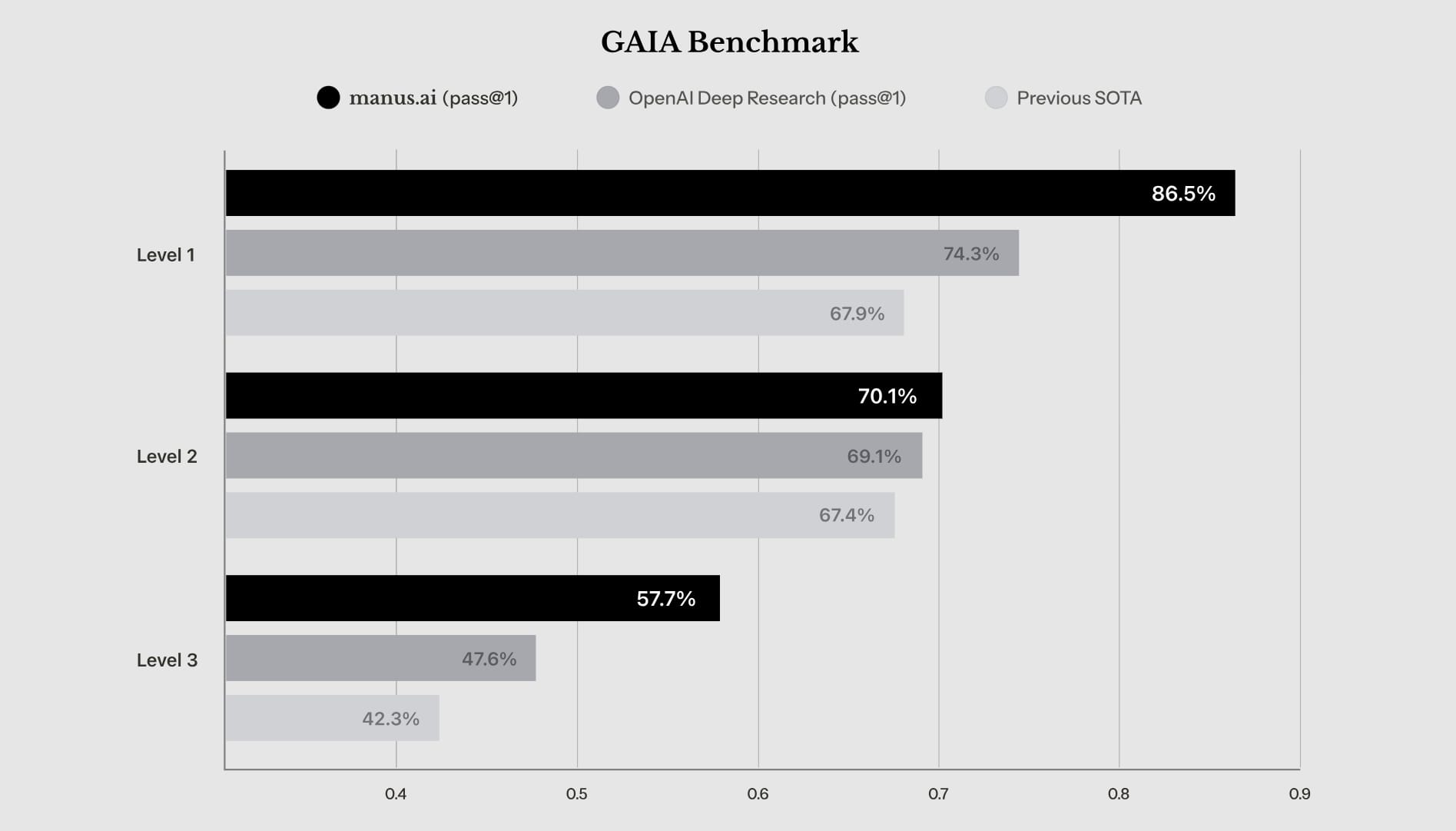
The product has already achieved state-of-the-art performance in the GAIA benchmark, a widely respected evaluation system for AI agents that assesses their ability to solve real-world problems across varying levels of complexity. This achievement positions Manus as a direct competitor to OpenAI’s models, which have long dominated the AI landscape.
Officially released on March 5, 2025, Manus has quickly gained attention for its ability to automate complex tasks across multiple domains, including business, education, and daily life. Unlike traditional AI assistants that primarily provide suggestions or answers, Manus is an autonomous agent capable of independently executing tasks from start to finish.
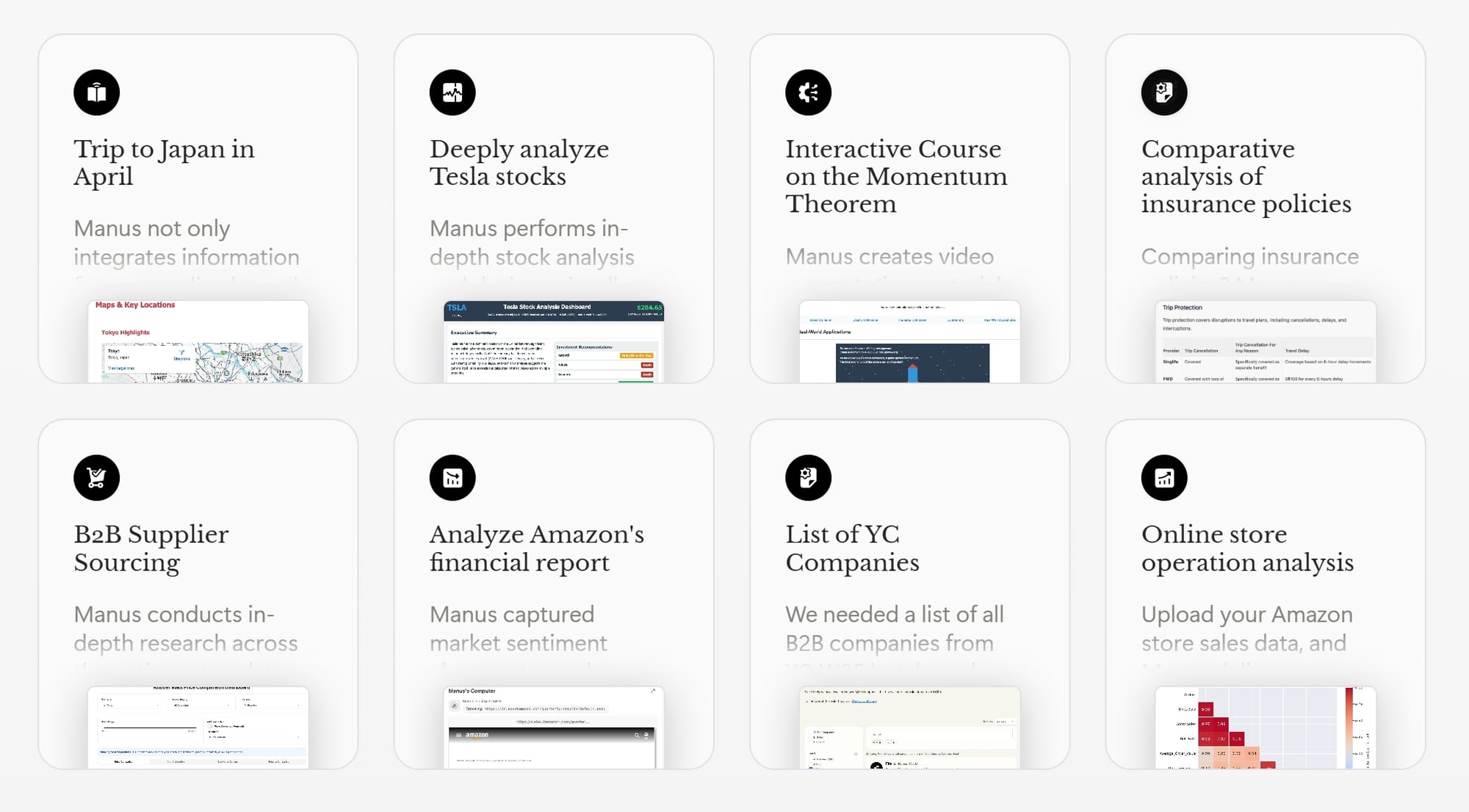
Manus is designed to transform thoughts into actions, making it a true autonomous agent. Here are some of its standout features:
Task Automation : Manus excels in automating complex and evolving tasks, delivering complete results without requiring constant human oversight. For instance, it can analyze data, conduct research, plan travel itineraries, and even create educational content.
While OpenAI has established itself as a leader in the AI sector, particularly with its widely recognized GPT-4, Manus offers a compelling alternative that merits closer examination.
To begin with, one of the most striking differences between the two is their approach to user interaction. OpenAI’s models are fundamentally designed to assist users, providing suggestions and generating content to enhance productivity. In contrast, Manus distinguishes itself by autonomously executing tasks without the need for human intervention. For instance, during a recent demonstration, Manus showcased its ability to review resumes, rank candidates, and generate an Excel spreadsheet, all seamlessly and independently. This autonomy not only streamlines workflows but also redefines the role of AI in professional settings.
Moreover, the specificity of Manus's offerings sets it apart from OpenAI’s general-purpose models. Manus specializes in domain-specific implementations, delivering tailored solutions that address the unique challenges of various industries. This targeted approach contrasts sharply with OpenAI's broader vision, which aims to create versatile AI that can serve a wide range of applications.
In addition to functionality and customization, the emphasis on security and compliance is another critical differentiator. Manus prioritizes data security and adheres to strict compliance standards, making it an optimal choice for use in sensitive and highly regulated environments. While OpenAI is also committed to ethical AI practices, it has faced its share of scrutiny regarding privacy concerns, highlighting the importance of trust in AI applications.
Performance metrics further illustrate the competitive edge of Manus. Reports indicate that Manus has outperformed OpenAI’s models on the GAIA benchmark, showcasing superior adaptability and efficiency in tackling real-world problems. This achievement not only underscores Manus's capabilities but also positions it as a formidable contender in the AI arena.
Lastly, the accessibility of these technologies plays a significant role in their adoption. OpenAI’s models are broadly available to the public, fostering widespread use and integration into various sectors. In contrast, Manus’s current invitation-only access may limit its immediate uptake but simultaneously creates an allure of exclusivity.
As we delve deeper into the capabilities and distinctions between Manus and OpenAI, it becomes clear that Manus distinguishes itself from traditional AI assistants through its innovative task execution, enabling it to deliver complete results and potentially revolutionize industries by automating tasks that once required human intervention. Its versatility across various domains makes it a valuable asset for businesses, educators, and individuals. This ongoing comparison not only highlights the strengths and weaknesses of both entities but also sets the stage for future innovations and developments in artificial intelligence.
Moreover, the specificity of Manus's offerings sets it apart from OpenAI’s general-purpose models. Manus specializes in domain-specific implementations, delivering tailored solutions that address the unique challenges of various industries. This targeted approach contrasts sharply with OpenAI's broader vision, which aims to create versatile AI that can serve a wide range of applications.
In contrast, Manus distinguishes itself by autonomously executing tasks without the need for human intervention. For instance, during a recent demonstration, Manus showcased its ability to review resumes, rank candidates, and generate an Excel spreadsheet, all seamlessly and independently. This autonomy not only streamlines workflows but also redefines the role of AI in professional settings.
As we delve into the implications of the Manus AI on both the global and local economic landscapes, it becomes evident that this innovative technology is poised to reshape the way we understand productivity and employment. The potential for Manus to autonomously perform intricate tasks heralds a new era of increased productivity across various sectors, from finance and real estate to manufacturing. For instance, automation of processes such as resume screening and financial analysis promises not only cost reductions but also significant efficiency gains, transforming traditional workflows.
However, this surge in automation brings with it a wave of disruption to the job market. As tasks that were once the domain of human workers become automated, there arises an urgent need for a reevaluation of workforce strategies. While Manus may catalyze the emergence of new industries focused on AI-driven solutions, it simultaneously presents challenges for existing roles, prompting a conversation about the future of work in an increasingly automated world.
On a global scale, Manus has the potential to become a formidable contender in the AI arena, posing challenges to established players like OpenAI and potentially shifting investor sentiment towards Chinese AI technologies. This competitive landscape indicates a significant transformation in the global AI hierarchy, as Manus seeks to assert itself as a key player.
Yet, alongside these promising prospects, Manus grapples with several challenges that could hinder its progress. The verification of its claims, such as its performance on the GAIA benchmark and the assertion of a "purely Chinese team," remains an area of concern due to the lack of publicly available information. This uncertainty casts doubt on the reliability of the assertions surrounding Manus's capabilities.
Moreover, its current availability as an invitation-only web preview restricts broader accessibility and adoption, which could impede its integration into various sectors. Ethical and regulatory concerns also loom large, particularly in high-stakes industries like finance and healthcare, where the implications of AI autonomy could be profound.
Finally, Manus faces fierce competition from established AI entities like OpenAI and up-and-coming models such as DeepSeek. Its success hinges not only on its technological advancements but also on its ability to carve out a unique identity in a crowded marketplace and achieve widespread recognition. As such, the future of Manus AI will be defined not merely by its innovations but by how it navigates these multifaceted challenges in a rapidly evolving landscape.
On a global scale, Manus has the potential to become a formidable contender in the AI arena, posing challenges to established players like OpenAI and potentially shifting investor sentiment towards Chinese AI technologies. This competitive landscape indicates a significant transformation in the global AI hierarchy, as Manus seeks to assert itself as a key player.
Manus AI represents a bold step forward in the field of artificial intelligence, with its claims of being the world's first general AI agent. Its ability to autonomously execute complex tasks, coupled with its modular architecture and emphasis on transparency, sets it apart from traditional AI models. However, the validity of its claims and its long-term impact remain to be seen.
If Manus can deliver on its promises and address its challenges, it has the potential to revolutionize the AI landscape. However, further verification and broader adoption will be crucial in determining whether Manus truly lives up to its ambitious claims.
As someone who has closely followed the evolution of AI, I am excited to see how Manus develops in the coming months. Whether it becomes the new standard for AI agents or simply a stepping stone in the journey toward more advanced AI, one thing is clear: Manus is a product worth watching.
As someone who has closely followed the evolution of AI, I am excited to see how Manus develops in the coming months. Whether it becomes the new standard for AI agents or simply a stepping stone in the journey toward more advanced AI, one thing is clear: Manus is a product worth watching.
Plus: Apple Brands OpenAI's Device Stolen, Beijing Took Manus Back
Read the storyPlus: The YouTube Gate, OpenAI Plans Its Own Phone, A House of Cards
The OpenClaw Ecosystem Is Becoming an Agent Stack
Plus: GPUs Into Pharma, Anthropic Launches Agents
Plus: Cursor Faces Displacement, Hollywood AI 2025 Recap
For a decade, Notion has been the darling of SaaS productivity. It reinvented the wiki into something malleable: a living archive where teams could document, structure,
Anthropic just raised $13 billion at a $183 billion valuation, and the number it chose to headline the pitch wasn’t ARR, wasn’t NRR, wasn’
In the rapidly evolving landscape of artificial intelligence, the capacity for deep, reliable research is a critical differentiator among workspace agents. Skywork emerges as a formidable
A Chinese team claims they have created the world's first general AI agent.