Meta
Reporting and context on Meta, with a closer look at the decisions and developments that matter.
Get AI Secret’s free daily briefing, including Meta and the wider AI industry.

At a glance
Technology company behind Facebook, Instagram and other social platforms. This topic includes Meta AI within the broader company, covering products, research and business decisions.
- Focus
- Social platforms; Meta AI
- Reference
- Meta
Sources checked . Selected company background and source references.
Company milestones
Selected milestones, newest first. Earlier history is available below.
Introduces the Meta company brand
The company brings its apps and technologies under the Meta name.
Source: Meta
Show earlier historyHide earlier history2004–2004 · 1 milestones
More than 10 years ago.
Facebook launches
The social platform begins the business that later adopts the Meta name.
Source: Meta
The latest on Meta
Newest firstRelated reporting
Relevant sections from the articles on this page. Explore older coverage below.
More coverage

Good Morning, AI Enthusiasts!
What began as a quiet talent war has now turned into full-blown Soup Wars, a symbolic skirmish where gestures matter as much as salaries.

TALENT
The AI Talent War Just Boiled Over Into a Literal Soup Fight
👀 What’s happening: OpenAI’s Chief Scientist Mark Chen revealed that Meta’s Mark Zuckerberg personally hand-delivered soup to OpenAI researchers in an attempt to recruit them. OpenAI, refusing to be outcharmed, began sending soup back to Meta recruits. What started as salary wars and GPU budgets has descended into the “Soup Wars,” an emotional arms race for the minds building AGI.
🔥 How this hits reality: The message is clear and every gesture now counts. When $10 billion hiring budgets can’t guarantee loyalty, companies resort to human warmth, literally. The battlefield has shifted from compensation spreadsheets to kitchen tables. In a market where 500 researchers hold the keys to the next intelligence leap, empathy is the new currency, and a well-timed bowl of broth can tilt the odds.
🛎️ Key takeaway: The AI talent war is no longer just about who pays more; it now begins with who cares enough to show up, sometimes with a bowl of hot soup
OpenAI: The AI Talent War Just Boiled Over Into a Literal Soup Fight
👀 What’s happening: OpenAI’s Chief Scientist Mark Chen revealed that Meta’s Mark Zuckerberg personally hand-delivered soup to OpenAI researchers in an attempt to recruit them. OpenAI, refusing to be outcharmed, began sending soup back to Meta recruits. What started as salary wars and GPU budgets has descended into the “Soup Wars,” an emotional arms race for the minds building AGI.
Meta: The AI Talent War Just Boiled Over Into a Literal Soup Fight
👀 What’s happening: OpenAI’s Chief Scientist Mark Chen revealed that Meta’s Mark Zuckerberg personally hand-delivered soup to OpenAI researchers in an attempt to recruit them. OpenAI, refusing to be outcharmed, began sending soup back to Meta recruits. What started as salary wars and GPU budgets has descended into the “Soup Wars,” an emotional arms race for the minds building AGI.
TOGETHER WITH FELO
Stop Working FOR Your Documents, Make Them Work FOR You
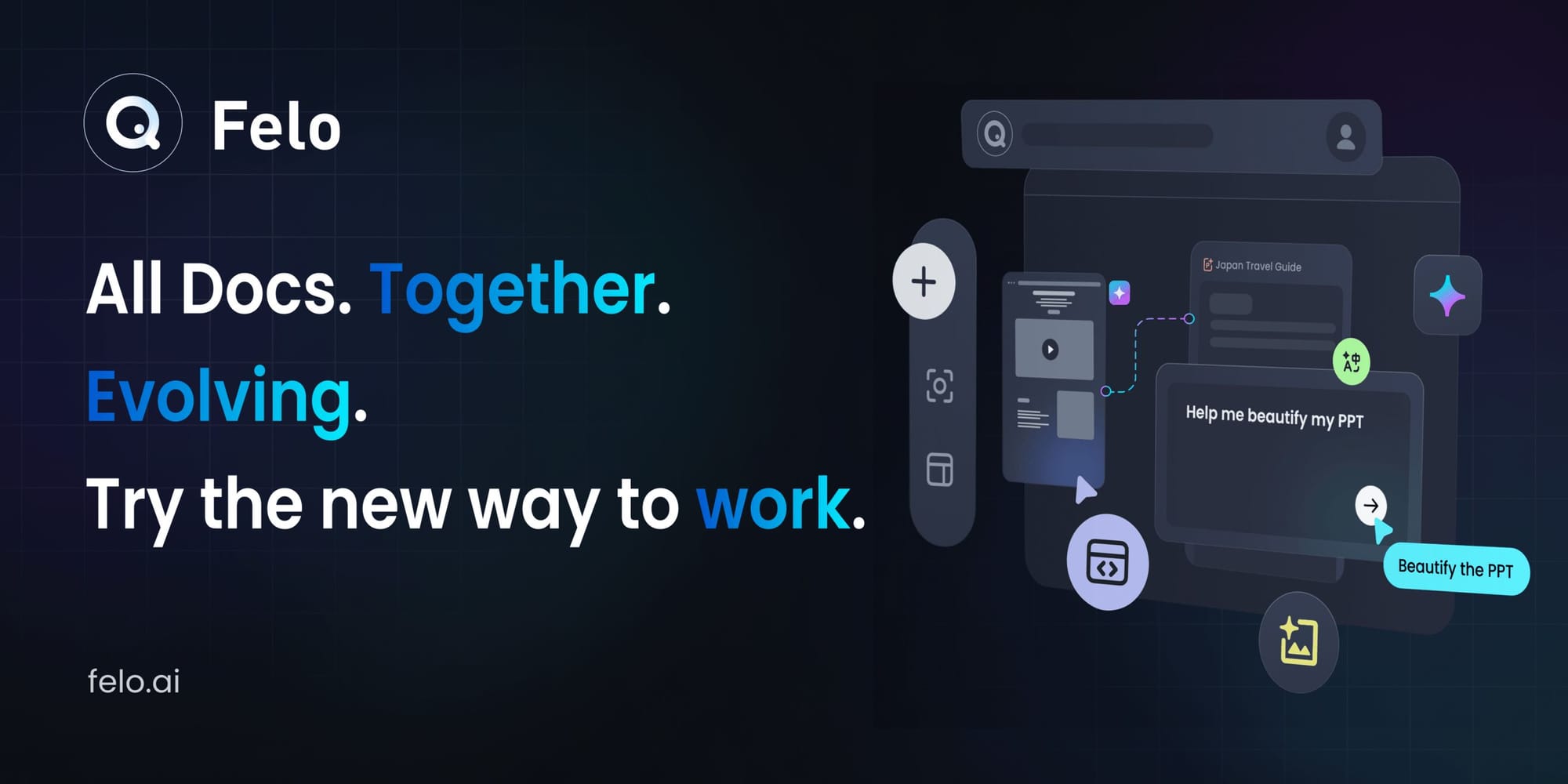
The 10x knowledge worker isn't typing faster—they're directing AI agents while competitors drown in copy-paste hell. Right now, someone just translated a 50-page deck in 3 minutes while you're still reformatting slide 12. Felo LiveDoc is the world's first Agent Workspace where documents don't just sit there—they evolve, analyze, and update themselves. Imagine a phantom team of designers, translators, and analysts inside your docs, unifying scattered PDFs, videos, and spreadsheets into one intelligent system that grows smarter with every task.
Here's what makes you look like a genius: While legacy tools treat you like a glorified typist, LiveDoc's multi-agent system operates autonomously. Design agents polish your layouts. Data agents extract insights across PDFs, videos, and web pages simultaneously. Translation agents speak every language your customers do—all working 24/7 inside one living workspace. This isn't productivity theater—it's the death of document drudgery. You're not just saving time; you're unlocking a superpower your competitors don't know exists yet.
And it's not just you—it's your entire team: Think of your best team collaboration tool—now add tireless AI teammates who never sleep, never forget context, and execute instantly. LiveDoc expands collaboration from human-to-human to human-plus-AI: team members direct, AI agents execute, all on the same canvas in real time. No more "latest_final_v3" nightmares. While your competitors coordinate between people, you're coordinating an entire hybrid workforce.
The insider move? Early adopters are already 10x-ing their output while the rest of the market is still toggling between twelve tabs. Every day you wait is another day spent manually updating slides like it's 2015. The knowledge workers who win aren't the ones who work harder—they're the ones who stopped editing and started directing.
🚀 Join the revolution: Get early access to Felo LiveDoc and become the person everyone asks, "How did you finish that so fast?" The age of manual document labor just ended. Are you evolving, or still typing?
NEW LAUNCH
Mistral Drops Ten Models

👀 What’s happening: France’s Mistral just launched its Mistral 3 family with one frontier multimodal model and nine smaller, fine-tunable versions spanning 14B, 8B, and 3B parameters. Each comes in Base, Instruct, and Reasoning variants. Instead of chasing GPT-5‘s brute force, Mistral built a menu: ten open-weight options tailored for real-world deployment, not leaderboard glory.
🔥 How this hits reality: This isn’t model inflation; it’s infrastructure strategy. Mistral is betting on a revived distributed ecosystem where intelligence lives locally, in cars, factories, banks, drones, or laptops, not locked behind a cloud API.It’s a strategic rebellion against scale worship, turning efficiency and ownership into Europe’s competitive edge.
🛎️ Key takeaway: Mistral just turned “small” into a strategy, reclaiming AI from the cloud and giving it back to those who build with it.
Mistral Drops Ten Models
👀 What’s happening: France’s Mistral just launched its Mistral 3 family with one frontier multimodal model and nine smaller, fine-tunable versions spanning 14B, 8B, and 3B parameters. Each comes in Base, Instruct, and Reasoning variants. Instead of chasing GPT-5‘s brute force, Mistral built a menu: ten open-weight options tailored for real-world deployment, not leaderboard glory.
STARTUPS
Yoodli Lands $40M to Turn AI Roleplay Into Corporate Training Gold

👀 What’s happening: Seattle-based Yoodli just raised a $40 million Series B led by WestBridge Capital, barely six months after its last round. The “AI conversation coach” now reports 900% revenue growth and triple the headcount, selling roleplay simulators to SAP, Google, and Snowflake that train employees' competence in real-world conversations.
🔥 How this hits reality: Forget slide decks and e-learning portals. Yoodli is building an AI batting cage for communication. Its models let teams rehearse feedback talks, sales calls, or crisis meetings with AI personas tuned to their company’s tone. In a market obsessed with replacing humans, Yoodli profits from improving them. That flips the L&D budget from compliance cost to performance ROI, cornering the “AI upskilling” segment before corporate trainers even wake up.
🛎️ Key takeaway: Yoodli is training the ones left to sound irreplaceable.
QUICK HITS
- Apptopia reports ChatGPT referrals to retail apps rose 28% on Black Friday, though the traffic remains small and is dominated by Amazon and Walmart.
- Amazon is offering early-stage startups a free year of Kiro Pro+ credits to help its AI coding tool break into an already crowded developer market.
- Amazon and Nvidia launched “AI Factories” enabling organizations to run AWS AI systems directly inside their own data centers.
- OpenAI is acquiring Neptune to strengthen its model-training tracking tools and reinforce its core R&D infrastructure.
- Wikipedia is pursuing additional AI licensing deals to ensure tech firms pay for the heavy server costs generated by training-related scraping.
Amazon: 🛎️ Soup Wars
Amazon is offering early-stage startups a free year of Kiro Pro+ credits to help its AI coding tool break into an already crowded developer market.
TRENDING
Daily AI Launches
- Aha has launched v2.0, an automated influencer marketing platform for AI companies where you simply review and approve campaigns.
- TrueFoundry has launched the AI Gateway, a production-ready control plane for experimenting with, monitoring, and governing AI agents.
- Fellow has released v5.0, adding flexible bot/botless recording options, custom AI recaps, and an integrated MCP Server.
- beLow has launched a tool that automatically optimizes C/C++ embedded code for specific hardware to reduce energy and execution time.
Featured AI Tools
- 🧠 TRAE (The Real Al Engineer) is the most price-competitive coding agent.
- 🎥 KaraVideo unites all AI video models in one place.
- 📚 Heardly is the Fast Way to read Best Book.
- 🤖 Momen AI bridges the gap from vibe to viability, powering Lovable apps without code.
TOGETHER WITH US
AI Secret Media Group is the world’s #1 AI & Tech Newsletter Group, boasting over 2 million readers from leading companies such as OpenAI, Google, Meta, and Microsoft. Our Newsletter Brands:
- AI: AI Secret
- Tech & Business: Bay Area Letters
- Robotics: Robotics Herald
We've helped promote over 500 Tech Brands. Will yours be the next?
Email our co-founder Mark directly at [email protected] if the button fails.
Good Morning, AI Enthusiasts!
Washington is turning its attention toward Qwen, signaling a new phase in the global AI power shuffle.

LLM
Silicon Valley Is Quietly Building on Qwen

📌 What’s happening: Bloomberg’s latest pieces reveal the awkward truth that China’s Qwen models are topping global developer downloads inside Silicon Valley, even as DC accuses Alibaba of brushing shoulders with the PLA. Meanwhile, Meta’s “open-source will save us” crusade is stalling — adoption isn’t matching the press-release swagger, and Qwen is eating the long-tail developer market Meta thought it owned.
🧠 How this hits reality: Dev teams love Qwen’s performance-per-dollar, but CTOs hate the geopolitical blast radius. Startups quietly prototype on Qwen, then scrub the commit logs before fundraising. Meta, once the patron saint of open AI infrastructure, now watches Chinese models out-download Llama in the very ecosystem it tried to dominate. Governance risk is now the only thing slowing Qwen — not capability.
🛎️ Key takeaway: Qwen is becoming Silicon Valley’s guilty pleasure that everyone’s using it, no one’s admitting it — and Meta’s “open wins” thesis is bleeding in silence.
Meta: Silicon Valley Is Quietly Building on Qwen
Meanwhile, Meta’s “open-source will save us” crusade is stalling — adoption isn’t matching the press-release swagger, and Qwen is eating the long-tail developer market Meta thought it owned.
Silicon Valley Is Quietly Building on Qwen
🧠 How this hits reality: Dev teams love Qwen’s performance-per-dollar, but CTOs hate the geopolitical blast radius. Startups quietly prototype on Qwen, then scrub the commit logs before fundraising. Meta, once the patron saint of open AI infrastructure, now watches Chinese models out-download Llama in the very ecosystem it tried to dominate.
TOGETHER WITH TRAE
The Smartest Way To Build With AI

The Best AI Coding tool TRAE has officially released SOLO Mode on November 12th and is completely free for everyone now! TRAE SOLO is defined as "The Responsive Coding Agent", which is the only coding agent with a comprehensive GUI, bringing autonomous coding to an interactive visual workspace.
TRAE provides two ways for you to build with AI. IDE mode preserves your existing workflow when you need to maintain hands-on control, while SOLO mode lets AI take the lead to drive the entire development processes.
SOLO Coder - Deep understanding for complex work
Start with a plan. Work with sub-agents to break complex challenges into focused tasks. Iterate, refactor, and optimize with full codebase context and precise execution.
SOLO Builder - Idea to Launch, Faster than Ever
For every idea worth shipping. Go from vision to end-to-end product without the usual overhead. PRD → Tasks → Code → Preview → Deploy. One flow, infinite possibilities. Ship what you imagine.
Coding agents in TRAE now work together, like a coordinated team—sharing context, avoiding conflicts, and delivering cohesive results. You can orchestrate everything through the visual workspace.
STARTUP
Bindwell Takes the Fight Straight to Syngenta

👀 What’s the move: Bindwell, founded by 18-year-old Tyler Rose and 19-year-old Navvye Anand, just raised $6M from General Catalyst, A Capital, and Paul Graham to rebuild the pesticide industry from the molecule up. Instead of selling AI tools to legacy agrochemical firms, the duo built a vertically integrated stack — Foldwell (protein structure prediction), PLAPT (protein-ligand modeling), and APPT (protein-protein interaction for biopesticides) — trained on billions of known compounds and fine-tuned with agricultural protein data. These models don’t just predict what works; they flag what data is missing, feed new lab results back into the loop, and continuously refine the search for pest-specific targets.
🧠 How this hits reality: Bindwell’s real play isn’t AI; it’s owning the molecule IP pipeline. By generating and validating new compounds in-house, then licensing the patents directly, the company skips the SaaS trap and positions itself as a “digital-first agrochemical lab.” Each new discovery strengthens its proprietary dataset, tightening a flywheel traditional players can’t easily replicate. If this model scales, it could shift the entire $60 billion pesticide market from chemical manufacturing toward data ownership — where the most valuable assets aren’t factories or formulas, but protein maps and training sets.
🛎️ Key takeaway: When teenagers start out-innovating Syngenta, you know the moat has shifted from land and labs to models and data.
LLM
OpenAI Is Building a Legal Perimeter at Warp Speed
📌 What’s happening: With AI law stuck in early-access mode, OpenAI has shifted from pure execution to legal infrastructure. Its expanding legal and policy arm is countering NYT’s push for 20M user chats, parrying Musk–Meta discovery demands, and managing multi-front copyright battles—all while racing regulators to define the rules that don’t exist yet.
🧠 How this hits reality: OpenAI now treats legal strategy like core engineering— scaled, iterative, and deeply integrated into product risk. Expect slower rollouts, tighter guardrails, and a world where legal viability becomes part of the launch checklist. Competitors still shouting “move fast” are discovering OpenAI already cordoned off half the map.
🛎️ Key takeaway: In an industry with no rulebook, OpenAI stopped waiting for clarity; it’s writing the first draft while everyone else refreshes the terms-of-service.
OpenAI Is Building a Legal Perimeter at Warp Speed
🧠 How this hits reality: OpenAI now treats legal strategy like core engineering— scaled, iterative, and deeply integrated into product risk. Expect slower rollouts, tighter guardrails, and a world where legal viability becomes part of the launch checklist. Competitors still shouting “move fast” are discovering OpenAI already cordoned off half the map.
QUICK HITS
- OpenAI says ChatGPT can now avoid using em dashes when instructed, fixing a persistent punctuation-control issue.
- Databricks co-founder warns the US is losing AI leadership due to closed research and declining academic exchange.
- Anthropic outlined how it keeps Claude politically neutral and released an open-source tool that scores the model’s even-handedness.
- LinkedIn launched an AI feature that lets users find people through natural-language descriptions, rolling out first to US Premium members.
- Google is adding Deep Research to NotebookLM and expanding supported file types so users can run deeper research within one workflow.
TRENDING
Daily AI Launches
- Swytchcode has launched a platform that turns static API docs into an interactive AI playground for developers.
- 2pr v.2.0 has launched as an all-in-one LinkedIn content system that analyzes viral posts, pulls trends, and generates content in your voice.
- RBD has launched as a platform and open-source community to celebrate and acknowledge the work of indie makers.
- Koyal has launched a platform that agentically turns any audio into a complete cinematic video with a consistent storyline and characters.
Featured AI Tools
- 🧠 TRAE (The Real Al Engineer) is the most price-competitive coding agent.
- 🎥 KaraVideo unites all AI video models in one place.
- 📚 Heardly is the Fast Way to read Best Book.
- 🤖 Momen AI bridges the gap from vibe to viability, powering Lovable apps without code.
TOGETHER WITH US
AI Secret Media Group is the world’s #1 AI & Tech Newsletter Group, boasting over 2 million readers from leading companies such as OpenAI, Google, Meta, and Microsoft. Our Newsletter Brands:
- AI: AI Secret
- Tech & Business: Bay Area Letters
- Robotics: Robotics Herald
We've helped promote over 500 Tech Brands. Will yours be the next?
Email our co-founder Mark directly at [email protected] if the button fails.
Good Morning, AI Enthusiasts!
The industry as a whole tightens its grip on compute as if the future depends on who can build fastest and scale longest.

NEW LAUNCH
World Labs Just Shipped the First Real World Model
📌 What’s happening: Feifei Li's World Labs pushed Marble out of beta and into the wild, giving anyone a web interface that turns text, images, or rough layouts into full 3D worlds — with a tiered plan that starts free and tops out at ninety-five dollars a month. This isn’t another research demo; it exports meshes and Gaussian splats that drop straight into game engines, VFX pipelines, and robotics simulators. For the first time, a “world model” is not a paper, a teaser, or a NeRF viewer — it’s a product.
🧠 How this hits reality: This is the milestone everyone quietly waited for, a world model that is creative-grade, editable, composable, and pipeline-ready. Game studios just got a level editor that eats their photogrammetry workflow. VFX houses get instant pre-viz without weeks of scanning. Robotics teams get synthetic environments without writing Unity scenes from scratch. And any competitor still stuck in research mode — including Google’s still-not-shipping Genie line — just got leapfrogged by the founder of modern visual AI herself.
🛎️ Key takeaway: The first real world model just arrived, and it turns “spatial intelligence” from a keynote slide into a platform shift, the kind that will quietly rewires every industry that depends on 3D reality.
TOGETHER WITH BYTEPLUS
Seedance 1.0 Pro Fast — Ultra-Fast, Pro-Quality AI Video Generation
Introducing Seedance 1.0 Pro Fast, the latest breakthrough from BytePlus that pushes the frontier of AI-driven video creation. Built for creators and enterprises demanding both speed and cinematic quality, Seedance redefines efficiency — generating an 8-second 720p video in just 26 seconds, making it up to 4× faster than Veo3 Fast while maintaining professional-grade realism and style consistency.
Powered by advanced semantic understanding and motion simulation, Seedance analyzes prompts, reference images, and scene logic to interpret intent, infer motion, and complete coherent storylines. The result is a video that feels natural, expressive, and emotionally engaging — not just rendered, but directed.
Compared with Veo3 Fast, Seedance delivers smoother motion control, stronger prompt adherence, and more physical realism, especially in complex or high-action scenes. Its multi-shot storytelling engine plans zooms, transitions, and perspective shifts automatically, enabling creators to achieve cinematic rhythm and flow without manual edits.
Supporting flexible output from 2–12 seconds at 480p, 720p, or 1080p, Seedance gives you the freedom to create faster, better, and more affordably — breaking the old speed–quality–cost triangle and setting a new benchmark for AI video generation.
NEOCLOUD
Meta Follows Microsoft Down the Neocloud Rabbit Hole

📌 What’s happening: After unveiling its six-hundred-billion dollar AI infrastructure plan, Meta finally realized it cannot shoulder that capex without turning its compute ambition into a quasi–subprime financing scheme. The problem is obvious: Microsoft already locked up the premium neocloud vendors. So Meta is now eating the scraps, signing a three-billion dollar deal with Nebius — a company whose Q3 numbers look like a margin call waiting for a reason.
🧠 How this hits reality: This is the new hierarchy of AI power. Microsoft gets first pick of neocloud capacity; Meta gets whatever’s left, even if it comes wrapped in a one-billion-dollar quarterly capex bill and a hundred-million-dollar loss. The deal doesn’t validate Nebius; it validates Meta’s desperation. And by piling more demand onto the shakiest balance sheet in the sector, both sides inflate a bubble neither can afford to stop feeding.
🛎️ Key takeaway: Meta isn’t leading the compute race; it’s scavenging it. And when second-choice suppliers become systemically critical, you know the bubble is running the show.
Meta Follows Microsoft Down the Neocloud Rabbit Hole
Microsoft gets first pick of neocloud capacity; Meta gets whatever’s left, even if it comes wrapped in a one-billion-dollar quarterly capex bill and a hundred-million-dollar loss. The deal doesn’t validate Nebius; it validates Meta’s desperation. And by piling more demand onto the shakiest balance sheet in the sector, both sides inflate a bubble neither can afford to stop feeding.
Meta Follows Microsoft Down the Neocloud Rabbit Hole
Microsoft gets first pick of neocloud capacity; Meta gets whatever’s left, even if it comes wrapped in a one-billion-dollar quarterly capex bill and a hundred-million-dollar loss. The deal doesn’t validate Nebius; it validates Meta’s desperation. And by piling more demand onto the shakiest balance sheet in the sector, both sides inflate a bubble neither can afford to stop feeding.
NEOCLOUD
Anthropic Rebrands Its Neocloud Dependency as National Security
📌 What’s happening: Anthropic announced a fifty-billion plan to build U.S. data centers with Fluidstack, framed as helping Trump’s AI Action Plan and “maintaining American leadership.” The locations are Texas and New York, with a tidy jobs number bundled in for political optics. Strip away the flag-waving and you just see Fluidstack, a neocloud supplier upgraded into Anthropic’s bespoke datacenter assembler.
🧠 How this hits reality: This isn’t national industrial policy. It’s Anthropic locking in a dedicated compute factory while giving Washington a narrative it can sell on cable news. Just as Meta embraced Nebius to secure supply, Anthropic is elevating its own neocloud partner into a first-tier contractor, wrapped in stars-and-stripes messaging to avoid scrutiny over vendor concentration and capex burn.
🛎️ Key takeaway: U.S. AI giants are rebranding their neocloud dependencies as patriotism.
Anthropic Rebrands Its Neocloud Dependency as National Security
It’s Anthropic locking in a dedicated compute factory while giving Washington a narrative it can sell on cable news. Just as Meta embraced Nebius to secure supply, Anthropic is elevating its own neocloud partner into a first-tier contractor, wrapped in stars-and-stripes messaging to avoid scrutiny over vendor concentration and capex burn.
QUICK HITS
- Amplitude launched AI Feedback, a proprietary LLM tool that unifies scattered customer feedback into actionable insights across its platform.
- Google upgraded Gemini with smarter shopping features, from personalized picks to automated buying and Duplex store calls ahead of Black Friday.
- Spotify introduces an AI audiobook recap feature while continuing to address quality and transparency issues around AI-generated content on its platform.
- Gartner says AI will not trigger a jobs apocalypse but a patchwork of four human–AI work models that businesses must be ready to support.
- AI coding startup Cursor has raised 2.3 billion dollars, boosting its valuation to 29.3 billion dollars, nearly 12 times the value the company had in January.
Cursor: 🛎️ First Real World Model
AI coding startup Cursor has raised 2.3 billion dollars, boosting its valuation to 29.3 billion dollars, nearly 12 times the value the company had in January.
TRENDING
Daily AI Launches
- Documenso 2.0.0 has launched with enterprise-grade e-signature features and a powerful new editor.
- Willow has launched an iOS custom keyboard offering dictation that is 3x more accurate than Apple's.
- Avaturn Live has launched, offering instant, human-like AI avatars that respond with real-time emotion.
- The Nomad Care Map has launched as the first global directory of doctor reviews for digital nomads.
Featured AI Tools
- 🧠 TRAE (The Real Al Engineer) is the most price-competitive coding agent.
- 🎥 KaraVideo unites all AI video models in one place.
- 📚 Heardly is the Fast Way to read Best Book.
- 🤖 Momen AI bridges the gap from vibe to viability, powering Lovable apps without code.
TOGETHER WITH US
AI Secret Media Group is the world’s #1 AI & Tech Newsletter Group, boasting over 2 million readers from leading companies such as OpenAI, Google, Meta, and Microsoft. Our Newsletter Brands:
- AI: AI Secret
- Tech & Business: Bay Area Letters
- Robotics: Robotics Herald
We've helped promote over 500 Tech Brands. Will yours be the next?
Email our co-founder Mark directly at [email protected] if the button fails.
Good Morning, AI Enthusiasts!
The Turing Legend has finally walked out of Meta’s crumbling empire, signaling the end of a long-running faith in pure research.

META
LeCun Walks Out of Meta and Takes an Era With Him

📌 What’s happening: After months of humiliation, internal purges, and power plays from Meta’s new AI czar Alexander Wang, Yann LeCun — the company’s AI founding father and a Turing Award winner — has finally decided to quit. The man who once made Meta a temple of open AI research is now leaving to build his own startup. Meta’s stock instantly shed $20 billion in value, reflecting market doubts about the company’s AI direction without its founding scientist.
🧠 How this hits reality: LeCun’s exit isn’t just a personnel change; it’s a coup completed. FAIR’s open-science ethos has been executed in broad daylight to make room for Zuckerberg’s fast-lane pursuit of “superintelligence.” Meta’s shift from research patience to product panic leaves a vacuum no GPU cluster can fill. The question now isn’t who replaces LeCun; it’s whether Meta’s new empire can stand without its philosopher-engineer.
🛎️ Key takeaway: LeCun’s fall marks the end of Meta’s long game that the age of science gives way to the age of spin. Whether it’s a renaissance or a civil war, we’ll soon find out.
LeCun Walks Out of Meta and Takes an Era With Him
📌 What’s happening: After months of humiliation, internal purges, and power plays from Meta’s new AI czar Alexander Wang, Yann LeCun — the company’s AI founding father and a Turing Award winner — has finally decided to quit. The man who once made Meta a temple of open AI research is now leaving to build his own startup.
TOGETHER WITH TAVUS
AI that sees you, hears you, and acts for you. Meet the PALs

PALs are AI humans that read your body language, understand your tone, and reach out first. They remember what you said you'd do three days ago, reschedule meetings autonomously, and execute your tasks with ease. Move between text, voice, and video chat. This is what AI was always supposed to be.
COMPUTE
AI Datacenters Are Draining Latin America and Its People

📌 What’s happening: As the AI boom expands south, Chile, Brazil, and Uruguay are welcoming Big Tech with open wallets and shut eyes. Governments desperate for foreign capital are offering tax breaks and fast-tracked permits for massive datacenters — many built in regions already suffering historic droughts. When locals asked how much water Google’s Uruguay site would consume, officials refused to say, citing “corporate secrecy.” The community had to sue the state — and win — just to learn how much of their own water was being sold off.
🧠 How this hits reality: The clash isn’t just about water; it’s about power, in every sense. When residents in Montevideo can’t shower while Google pumps millions of liters for cooling, “AI infrastructure” stops being an abstract debate and becomes a matter of survival. Governments crave foreign capital; citizens demand transparency. The result: lawsuits invoking the Escazú Agreement just to see how much water an algorithm drinks. The social license for AI’s physical footprint is evaporating as fast as the aquifers beneath it.
🛎️ Key takeaway: AI may be infinite, but water isn’t — and the next compute bottleneck won’t be silicon, it’ll be human thirst.
Google: AI Datacenters Are Draining Latin America and Its People
When residents in Montevideo can’t shower while Google pumps millions of liters for cooling, “AI infrastructure” stops being an abstract debate and becomes a matter of survival. Governments crave foreign capital; citizens demand transparency. The result: lawsuits invoking the Escazú Agreement just to see how much water an algorithm drinks.
TREND
Indosat Blocks 200M Scam Calls

📌 What’s happening: In just three months, Indonesia’s Indosat Ooredoo Hutchison has used its AI-powered Anti-Spam and Anti-Scam system to block over 200 million fraud attempts without users installing a single app. The feature, part of Indosat’s AIvolusi5G initiative, merges AI and 5G to detect scams at the network core. The timing isn’t random: Google’s GTIG report recently warned that AI-powered attacks are mutating faster than human defenses can respond.
🧠 How this hits reality: The cybersecurity map is flipping. After a year of generative AI hype, the money is quietly moving to AI counterintelligence — models that defend, not create, and early pilots like Indosat’s are already delivering measurable wins. As scams, deepfakes, and synthetic phishing accelerate, telcos, banks, and governments are racing to build “defensive AIs” at the infrastructure layer. For investors, this isn’t just risk mitigation — it’s a new market frontier.
🛎️ Key takeaway: AI defense isn’t a cost center anymore; it’s the next trillion-dollar moat.
Google: Indosat Blocks 200M Scam Calls
The feature, part of Indosat’s AIvolusi5G initiative, merges AI and 5G to detect scams at the network core. The timing isn’t random: Google’s GTIG report recently warned that AI-powered attacks are mutating faster than human defenses can respond.
LIMITED DROP FROM QODER
💥 Price Crash: Qoder Pro Just $2 (First Month)

We spotted something worth your attention — Qoder quietly dropped its Pro plan from $10 to $2 for the first month.
That $2 gets you the full stack:
- Frontier models
- Advanced context engine
- 100K-file codebase search
- Repo Wiki + Quest Mode
- 2,000 credits
If you’ve been curious about Qoder’s AI coding engine, this is probably the best time to try it.
QUICK HITS
- Google Photos now integrates its Nano Banana model to deliver advanced AI editing and photo-to-video tools, marking its most significant upgrade in years.
- Google launched open-source tools like Agent Sandbox and GKE Pod Snapshots to secure AI environments and cut large model startup times.
- OpenAI and Google’s agentic AIs that can buy tickets directly are disrupting the ticketing industry and accelerating its move away from traditional platforms.
- A German court ruled that ChatGPT violated copyright law by training on song lyrics without permission.
- Israel-based Wonderful has raised $134 million across two rounds in just four months, rapidly scaling its multilingual-first enterprise AI agents worldwide.
TRENDING
Daily AI Launches
- Talo has launched a real-time voice translation platform for video calls, live events, and streaming broadcasts via an app or API.
- Emma has launched an AI app that reads any food label in any language to instantly identify hidden sugars, additives, and allergens.
- YouArt has launched a creative agent that orchestrates AI models and tools into reusable workflows for "vibe-driven" designers.
- Thesys has launched the C1 Artifacts API, allowing your users to generate interactive, on-brand slides and reports from prompts within your AI app.
Featured AI Tools
- 🔐 Rubrik Okta brings immutable recovery to the multi-IdP world beyond backup.
- 🎥 KaraVideo unites all AI video models in one place.
- 📚 Heardly is the Fast Way to read Best Book.
- 🤖 Momen AI bridges the gap from vibe to viability, powering Lovable apps without code.
TOGETHER WITH US
AI Secret Media Group is the world’s #1 AI & Tech Newsletter Group, boasting over 2 million readers from leading companies such as OpenAI, Google, Meta, and Microsoft. Our Newsletter Brands:
- AI: AI Secret
- Tech & Business: Bay Area Letters
- Robotics: Robotics Herald
We've helped promote over 500 Tech Brands. Will yours be the next?
Email our co-founder Mark directly at [email protected] if the button fails.
Good Morning, AI Enthusiasts!
When DeepSeek casually open-sourced a 3B-parameter OCR model that compresses text into images with near-lossless fidelity, it wasn’t just another AI drop, it was a shot fired at how machines read the world.
🛎️ DeepSeek Drops OCR Bomb
When DeepSeek casually open-sourced a 3B-parameter OCR model that compresses text into images with near-lossless fidelity, it wasn’t just another AI drop, it was a shot fired at how machines read the world.

NEW LAUNCH
DeepSeek Drops a 3B Parameter OCR Bomb
📌 What’s happening: DeepSeek has open-sourced DeepSeek-OCR, a 3B-parameter model that achieves up to ten-fold lossless text compression through an “optical mapping” technique. The model, created by three former GOT-OCR2.0 researchers, combines a custom DeepEncoder and MoE decoder to treat visual tokens as a new form of language. It already outperforms GOT-OCR2.0 and MinerU2.0 on major benchmarks while using only one-tenth of their tokens and one-fifth of their GPU cost.
🧠 How this hits reality: This is not a simple OCR upgrade. It is a new way for AI to see text and retain more information while computing less. If visual encoding becomes the next layer of language compression, long-context models will no longer be constrained by memory or token limits. The implications for cloud cost, model architecture, and training efficiency are enormous.
🛎️ Key takeaway: DeepSeek did not just build another OCR model. It built a Trojan horse that hides language inside vision, quietly reshaping the economics of AI memory.
DeepSeek Drops a 3B Parameter OCR Bomb
📌 What’s happening: DeepSeek has open-sourced DeepSeek-OCR, a 3B-parameter model that achieves up to ten-fold lossless text compression through an “optical mapping” technique. The model, created by three former GOT-OCR2.0 researchers, combines a custom DeepEncoder and MoE decoder to treat visual tokens as a new form of language.
TOGETHER WITH FRASE
Optimize for Both Google and AI Search Today
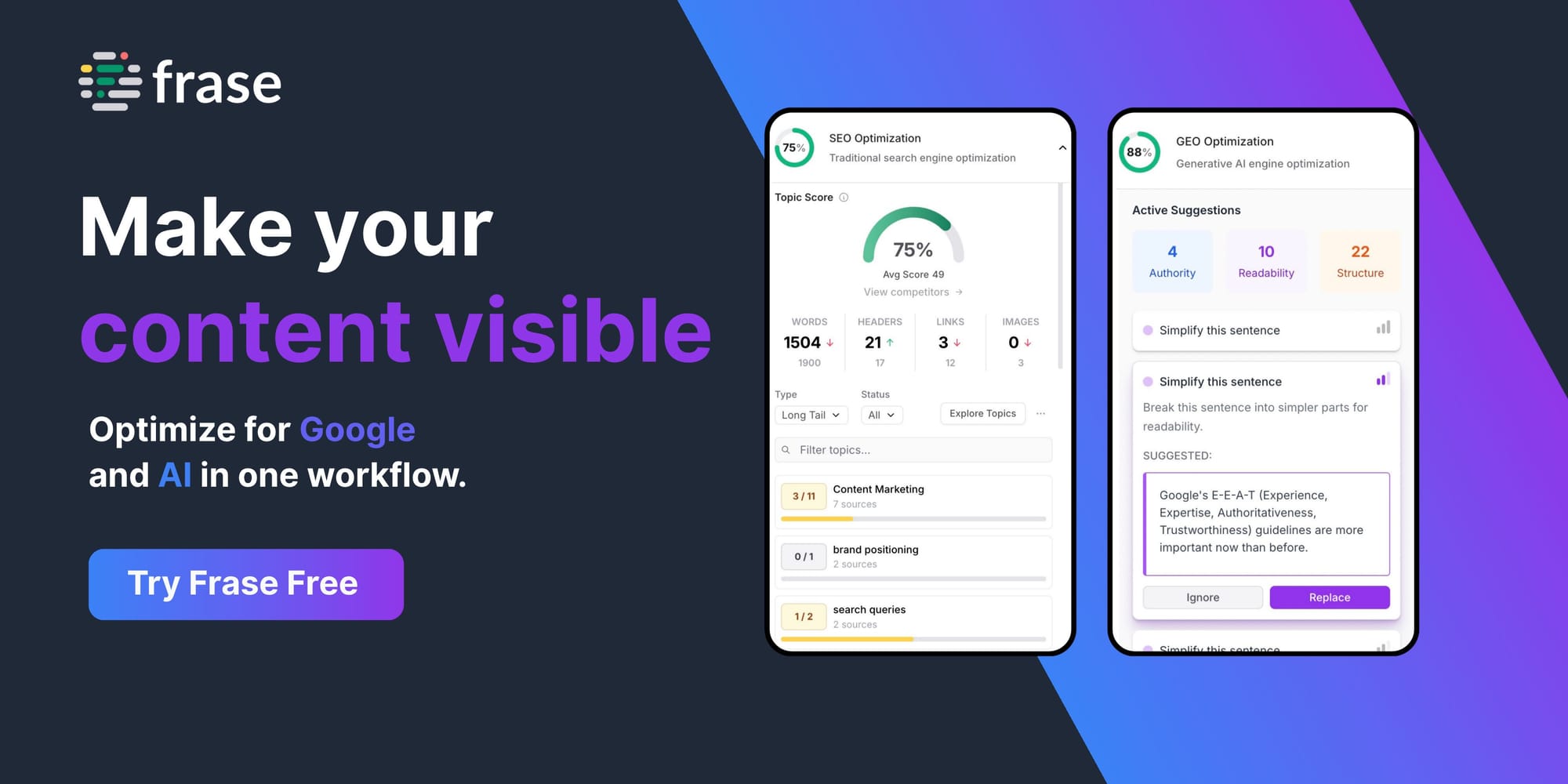
Google still owns 89% of search, but user habits are changing fast. ChatGPT’s search traffic jumped 740% year-over-year, and 77% of Americans now use it like a search engine. The future of visibility isn’t Google or AI—it’s both.
Frase helps you rank across both worlds. Unlike traditional SEO tools that optimize only for Google, Frase gives you dual optimization: Google SEO + AI Search GEO.
- Get two scores, one workflow
- Fix both channels at once
- Publish once, rank everywhere
Content with a high GEO score sees a 70% higher chance of AI citation — and one SaaS customer saw 30% traffic lift by adding AI optimization to their existing Google SEO.
MONOPOLY
Meta Bans Bots That Don’t Pay

📌 What’s happening: WhatsApp quietly updated its business API rules to remove all general-purpose chatbots such as OpenAI’s ChatGPT, Perplexity, and Luzia by January 2026. Only business-specific assistants like customer service bots will remain. Meta explained that these chatbots “burdened the system” and “fell outside its strategic focus,” yet the real reason is clearer: they do not contribute to the message-based fees that keep WhatsApp profitable.
🧠 How this hits reality: This move is not about safety; it is about revenue control. WhatsApp’s API has become Meta’s next major income stream, and independent AI assistants were using its massive audience without paying Meta a share. By banning them, Meta regains control over 3 billion chat users and transforms WhatsApp into an exclusive channel for its own Meta AI. This decision signals a shift from open collaboration to tight ecosystem control similar to Apple’s model.
🛎️ Key takeaway: Meta just turned WhatsApp from a messaging network into a gated AI estate, and every other assistant just lost its invitation.
Meta Bans Bots That Don’t Pay
WhatsApp’s API has become Meta’s next major income stream, and independent AI assistants were using its massive audience without paying Meta a share. By banning them, Meta regains control over 3 billion chat users and transforms WhatsApp into an exclusive channel for its own Meta AI.
Apple: Meta Bans Bots That Don’t Pay
By banning them, Meta regains control over 3 billion chat users and transforms WhatsApp into an exclusive channel for its own Meta AI. This decision signals a shift from open collaboration to tight ecosystem control similar to Apple’s model.
PHARMA
Anthropic Goes Full Pharma Mode
📌 What’s happening: Anthropic just rolled out Claude for Life Sciences, a tailored version of its flagship Claude Sonnet 4.5 model aimed at biotech workflows, from reading lab protocols to drafting regulatory submissions. It plugs directly into platforms like Benchling, 10x Genomics, PubMed, and Synapse, letting researchers run drug discovery loops without the data-wrangling nightmare. Deloitte, KPMG, and Caylent are already onboard as consulting partners to integrate Claude into enterprise labs.
🧠 How this hits reality: This is Anthropic’s first real vertical play, and it’s a shot across the bow at BioGPT, NVIDIA’s BioNeMo, and Recursion’s in-house LLMs. Unlike open-weight bio models that optimize for accuracy, Claude’s edge is workflow capture: it doesn’t just “read papers,” it syncs with the systems where science actually happens. That’s what gets it inside regulated R&D budgets and out of the sandbox.
🛎️ Key takeaway: Anthropic isn’t selling AI to scientists; it’s selling time to pharma. Whoever owns the workflow, owns the lab.
Anthropic Goes Full Pharma Mode
📌 What’s happening: Anthropic just rolled out Claude for Life Sciences, a tailored version of its flagship Claude Sonnet 4.5 model aimed at biotech workflows, from reading lab protocols to drafting regulatory submissions. It plugs directly into platforms like Benchling, 10x Genomics, PubMed, and Synapse, letting researchers run drug discovery loops without the data-wrangling nightmare.
QUICK HITS
- SK Telecom offered voluntary retirement weeks after launching its AI unit to streamline teams and advance its AI strategy.
- OpenAI partnered with Hollywood groups to strengthen Sora 2’s safeguards against unauthorized voice and likeness generation.
- Ex-Scale AI exec Bilal Abu-Ghazaleh raised $9M for 1001 AI to bring decision-making AI to key MENA industries.
- New Yorkers protested the “Friend AI” pendant, chanting “Get real friends,” while founder Avi Schiffmann joined and called it a meaningful exchange.
- A study found that readers prefer fine-tuned ChatGPT imitations over human-written ones, prompting scholars to question whether AI training still qualifies as fair use.
TRENDING
Daily AI Launches
- Fish Audio has launched S1, an emotionally rich TTS model that can realistically clone any voice in 10 seconds.
- Replymer has launched a service that uses human-written replies in online conversations to authentically grow your brand.
- Logic, Inc. has launched a platform that automates recurring business decisions from processes written in plain English.
- Voice Gecko has launched an instant desktop dictation tool that lets you press a shortcut, speak, and get accurate text on your clipboard.
Featured AI Tools
- 🥇 Frase optimizes for Google and AI search with the only dual scoring system.
- ⚡ ChatPlayground.ai runs one prompt across models, compare instantly, optimize fast.
- 🎥 KaraVideo unites all AI video models in one place.
- 💡 Pokee AI handles your tasks end-to-end across all apps.
- 📚 Heardly is the Fast Way to read Best Book.
TOGETHER WITH US
AI Secret Media Group is the world’s #1 AI & Tech Newsletter Group, boasting over 2 million readers from leading companies such as OpenAI, Google, Meta, and Microsoft. Our Newsletter Brands:
- AI: AI Secret
- Tech: Bay Area Letters
- Robotics: Robotics Herald
We've helped promote over 500 Tech Brands. Will yours be the next?
Email our co-founder Mark directly at [email protected] if the button fails.
Latest Daily Rundowns
 Magna
Magna MagnaMagna
More AI Stories
Ben Magna
Magna Ben
Ben
Good Morning, AI Enthusiasts!
Human judgment is being outsourced to code, whether it’s denying treatment, matching couples, or naming and shaming industries.

MEDICARE
Medicare Turns to Insurer AI Tactics

📌 What’s happening: Starting January 2026, Medicare will pilot WISeR, an AI system that screens requests for certain procedures and can deny those deemed “low-value” or wasteful. This mirrors private insurers’ playbook, where AI-driven prior authorization already decides much of what gets covered. Traditionally, Medicare leaned on limited human review and avoided heavy prior authorization, leaving doctors with more discretion.
🧠 How this hits reality: The shift signals Medicare moving from a trust-based oversight model to a denial-by-default filter. For patients, this could mean faster clearance on routine care but harsher pushback on costly procedures. For providers, the risk is more friction: appeals, delayed treatments, and pressure to practice medicine inside algorithmic boundaries. Unlike older compliance checks, this approach weaponizes automation—scaling both savings and denials.
🛎️ Key takeaway: Medicare swapping human oversight for insurer-style AI means less fraud, maybe, but also a future where coverage depends less on your doctor’s call and more on a model’s threshold.
TOGETHER WITH QODER
Milestone Special: The Sharpest Growth Curve in AI Coding History
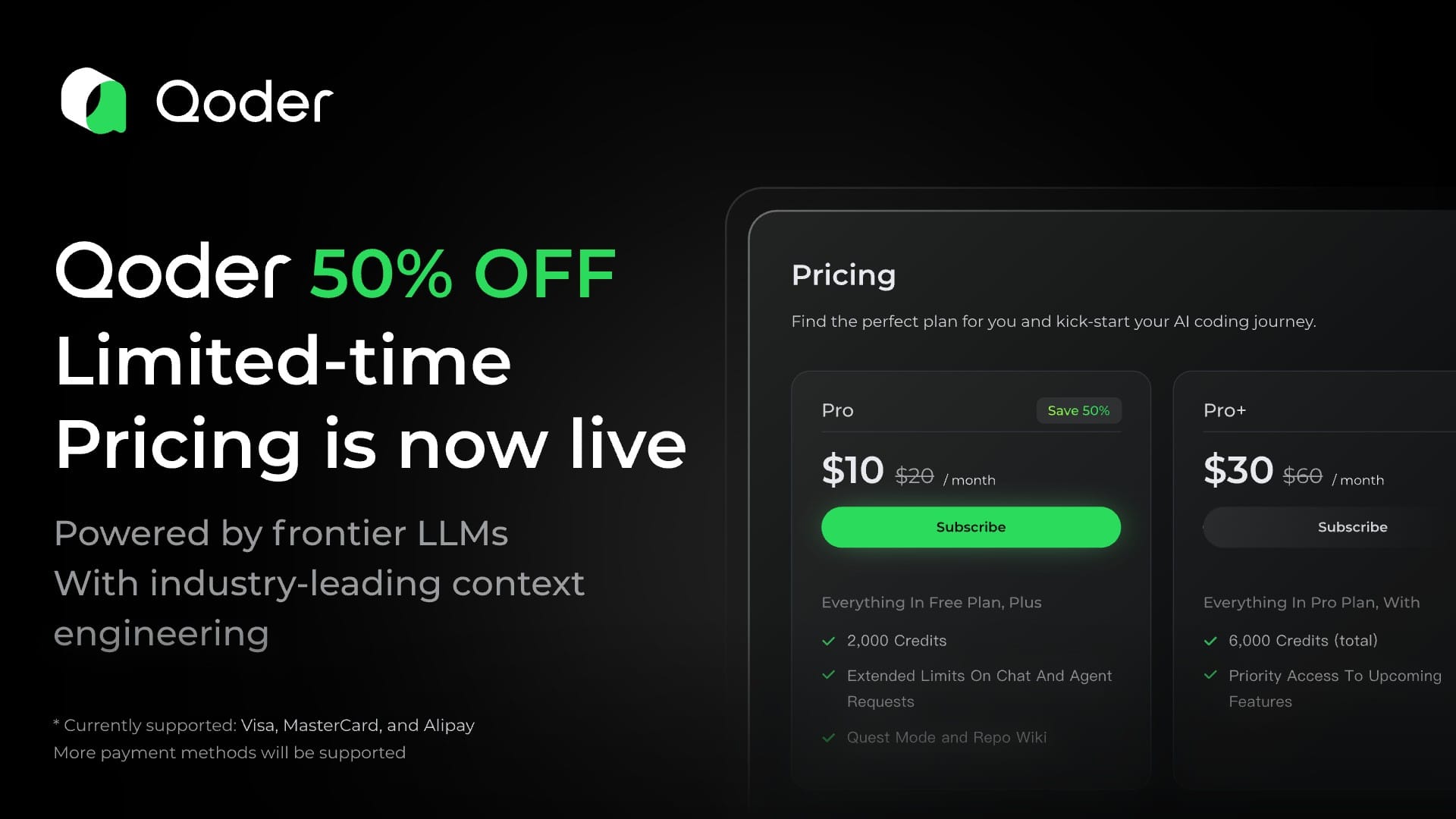
Qoder isn’t just another coding assistant—it’s an agentic coding platform built for real-world software development. In just five days, over 100,000 developers have joined, signaling a shift from “vibe coding” toward project-level engineering intelligence.
Its flagship Repo Wiki turns hidden knowledge into team assets: automatically generating architecture maps, reference graphs, and technical specs that stay in sync with your code. Add context with manual edits, export to Markdown or PDF, and share instantly across teams.
Meanwhile, Smart Context Control puts developers in charge of credits. With “Compact Chat,” Qoder intelligently summarizes conversations, cutting token use while keeping essential context—delivering efficiency and sustainability for long projects.
To celebrate this milestone, Qoder is offering a limited-time 50% discount on Pro and Pro+ plans (new signups and renewals) for AI Secret Readers. A 2-week free trial with 1,000 credits is also included, making it easier than ever to experience the future of coding.
DATING
Meta’s AI Dating Move Lands Flat
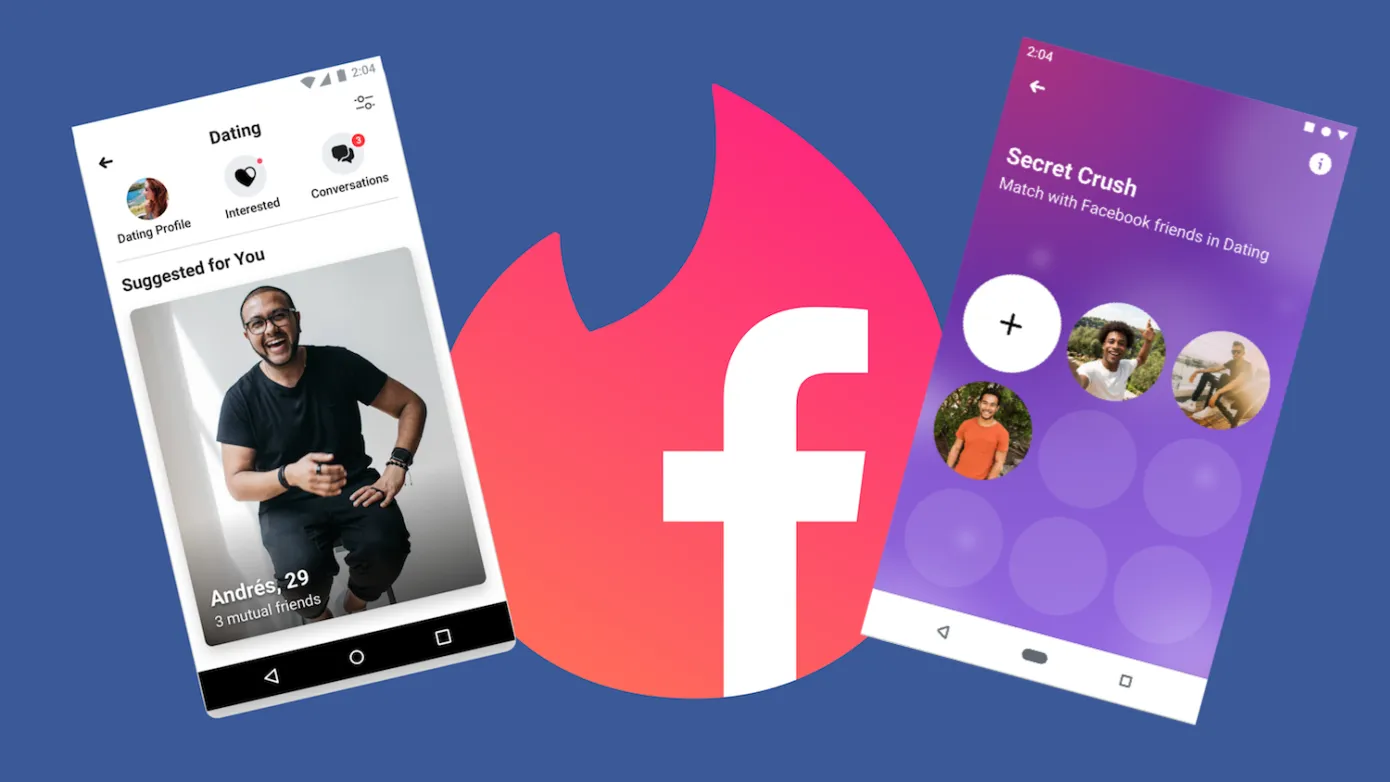
📌 What’s happening: Meta just injected AI into Facebook Dating with two updates. One is a chatbot “dating assistant” that helps refine matches, like suggesting a “Brooklyn girl in tech.” The other is “Meet Cute,” a weekly algorithmic blind date. It’s pitched as an antidote to swipe fatigue, but OkCupid, one of the most well-known US dating platforms, tested the same play a decade ago.
🧠 How this hits reality: Technically, the move shows Meta leaning on LLM-style query matching and recommendation personalization. The assistant doubles as both a search engine for partners and a gamified profile optimizer. Yet instead of cultural cachet, it highlights Meta’s awkwardness: deploying the same AI that powers spam moderation into your love life. It’s not influence—it’s overreach.
🛎️ Key takeaway: Meta isn’t ending swipe fatigue—it just automated the cringe.
Meta’s AI Dating Move Lands Flat
🧠 How this hits reality: Technically, the move shows Meta leaning on LLM-style query matching and recommendation personalization. The assistant doubles as both a search engine for partners and a gamified profile optimizer. Yet instead of cultural cachet, it highlights Meta’s awkwardness: deploying the same AI that powers spam moderation into your love life.
CLIMATE
Gore’s AI Map Exposes 660M Polluters

📌 What’s happening: Al Gore’s nonprofit Climate Trace has launched an AI-powered tool that tracks fine particulate pollution from more than 660 million sources worldwide, including power plants, refineries, steel mills, shipping lanes, and more. Such scale would have been unimaginable with manual monitoring, but by fusing satellite imagery, ground sensors, and emissions databases, the AI models now generate visual maps of pollution sources and plumes, refreshing almost in real time or at set intervals.
🧠 How this hits reality: Traditional monitoring relied on sparse sampling sites, easy for corporations to dodge or delay. Climate Trace’s AI system integrates massive, heterogeneous data into a global, dynamic tracking layer. Regulators, the public, and capital markets can now see emissions truth at scale. For heavy industry, energy giants, and local governments, this level of transparency is an upgraded strike—compliance or noncompliance is instantly visible.
🛎️ Key takeaway: AI has transformed pollution monitoring from blind sampling into a global radar, and the old order may now be nearing collapse.
QUICK HITS
- Google is expanding its AI mode to Spanish users worldwide, further accelerating its global AI rollout against OpenAI’s ChatGPT.
- Snowflake and partners launched Open Semantic Interchange to standardize business data definitions across analytics and AI.
- Google has launched Mixboard, an experimental Gemini AI tool that creates and edits Pinterest-style moodboards for design ideas.
- Figma expanded its MCP server to let AI agents remotely access and reuse design code in Figma Make, making its tools more AI-friendly.
- Google Photos now lets Android users edit images by talking or texting instructions to Gemini AI, with added support for AI content credentials.
TRENDING
Daily AI Launches
- Sprinto has launched an AI tool that answers security questionnaires in minutes by generating accurate answers from your trained knowledge base.
- Manna 2.0 has been launched as a major update to the Bible study app, adding a "pet companion," improved AI chat, and support for more languages on iOS and Android.
- Memories.ai has launched Video Marketer, an AI platform described as "perplexity for videos" that analyzes why videos go viral and predicts future trends.
- Conduit AI has launched a platform for building conversational AI agents that handle all business communications in a unified inbox and continually improve over time.
Featured AI Tools
- 🤩 Pine AI is your AI assistant for customer service headaches.
- 📚 Heardly is the Fast Way to read Best Book.
- 🪶 CopyOwl is the First AI Research Agent, deep research on any topic in one click.
- 🦾 Flot AI writes, reads, and remembers across any apps and webs.
TOGETHER WITH US
AI Secret Media Group is the world’s #1 AI & Tech Newsletter Group, boasting over 1 million readers from leading companies such as OpenAI, Google, Meta, and Microsoft. Our Newsletter Brands:
- AI: AI Secret
- Tech: Bay Area Letters
We've helped promote over 500 Tech Brands. Will yours be the next?
Email our co-founder Mark directly at [email protected] if the button fails.
Latest Daily Rundowns
MagnaMagnaMagnaMore AI Stories
Ben Magna
Magna Magna
Magna
🛎️ White House Targets Qwen
Plus: Bindwell Redefines Pesticides, OpenAI's Legal Perimeter

🛎️ First Real World Model
Plus: Meta Downed the Rabbit Hole, Anthropic's National Security

🛎️ Turing Legend Escapes
Plus: AI Eats Latin Water, The Next AI Boom

🛎️ DeepSeek Drops OCR Bomb
Plus: Meta Bans Competitors, Claude for Life Sciences
Zuckerberg’s Silent Infiltration of Mira Murati’s Thinking Machines Lab
Meta struck just days after Tinker went live.
🛎️ Medicare Adopts AI Denials
Plus: Meta’s AI Dating, AI Maps 660M Polluters
Meta’s Trojan Horse: Why Ray-Ban Display Aims Beyond iPhone
At first glance, it looks like a pair of Ray-Ban Wayfarers. The same silhouette that has sat on noses since James Dean. But this version costs

From Models to Experiments: OpenAI’s Real Plan Behind the $1.1B Statsig Deal
On paper, it looked like an overpriced SaaS deal. OpenAI spent $1.1 billion in stock to acquire Statsig, a company best known for feature flags
The Next AI Breakthrough Will Happen Behind a Firewall
In the age of artificial intelligence, everyone wants to be the next OpenAI, Google DeepMind, or Anthropic—chasing the holy grail of artificial general intelligence (AGI)