🛎️ Musk Thinks AGI Is Brute Force
Plus: A Corporate Guillotine, DeepSeek Finally Needs Money
Read the story Subscribe
Foundation-model company developing text, video, speech and music systems and AI-native applications.
Get AI Secret’s free daily briefing, including MiniMax and the wider AI industry.
Foundation-model company developing text, video, speech and music systems and AI-native applications.
Sources checked . Selected company background and milestones.
Selected milestones, newest first.
More than 10 years ago.
Relevant sections from the articles on this page. Explore older coverage below.
More coverage

Good Morning, AI Enthusiasts!
Today’s AI race looks less like software and more like heavy industry.
AGI
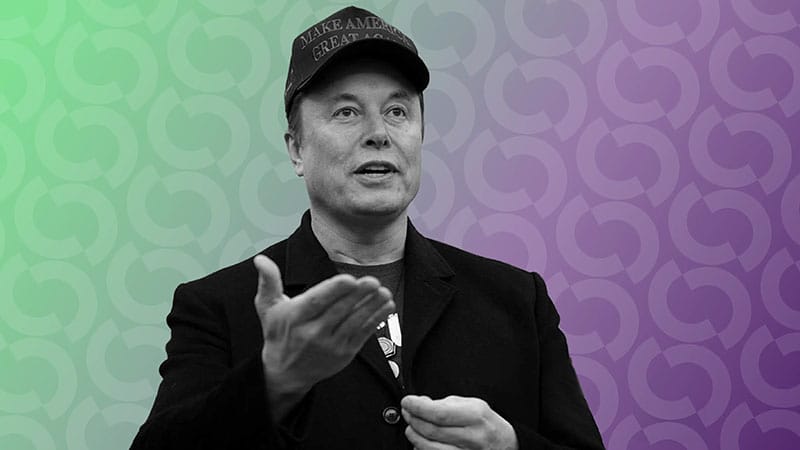
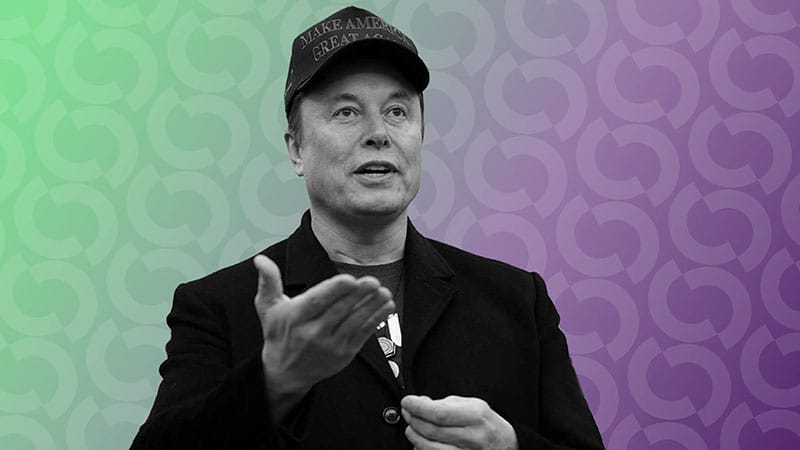
👀 What’s Happening: Elon Musk is now openly treating AGI like an industrial construction project. Grok 4.4 is expected in early May, Grok 4.5 by the end of the month, and Grok 5 is already training behind them. The logic is simple: build bigger clusters, add more chips, spend more electricity, and intelligence will eventually fall out of the machine.
🌍 How This Hits Reality: xAI’s Colossus system reportedly already uses more than 550,000 GPUs and around 2 gigawatts of electricity, enough to power a city of 1.5 million people. That is why Musk’s AGI strategy increasingly feels less like computer science and more like building a nuclear plant. More land, more chips, more cooling, more power. OpenAI and Anthropic are both spending heavily too, but nobody else is scaling this aggressively.
🛎️ Key Takeaway: Maybe Musk is right and AGI really does emerge from brute force. Or maybe he is just building the world’s most expensive autocomplete machine. Either way, the future of AI now looks a lot more like heavy industry than software.
👀 What’s Happening: Elon Musk is now openly treating AGI like an industrial construction project. Grok 4.4 is expected in early May, Grok 4.5 by the end of the month, and Grok 5 is already training behind them. The logic is simple: build bigger clusters, add more chips, spend more electricity, and intelligence will eventually fall out of the machine.
CORPORATE

👀 What’s Happening: A fintech company with more than 60 employees woke up to find every Claude account dead at once. No warning. No human explanation. Just an automated email and a Google form. An entire company lost access to coding, support, analysis, and internal workflows because one model provider decided something “looked suspicious.” Fifteen hours later the accounts came back. Anthropic never explained what happened.
🌍 How This Hits Reality: Claude is starting to behave less like enterprise software and more like a corporate guillotine hanging over every customer’s neck. Build your workflows around it, connect your documents, train your staff, wire your operations into it, then wait for one invisible moderation trigger to erase everything overnight. No hotline. No account manager. No real appeal process. Just a faceless safety system deciding whether your company gets to function today.
🛎️ Key Takeaway: Claude is becoming too unstable to trust as a core business layer. A company that builds entirely on Claude is not building on infrastructure. It is building on the mood swings of a black box.
🛎️ Key Takeaway: Claude is becoming too unstable to trust as a core business layer. A company that builds entirely on Claude is not building on infrastructure. It is building on the mood swings of a black box.
LEAK
👀 What’s Happening: DeepSeek is reportedly seeking outside funding for the first time, targeting at least $300 million at a valuation above $10 billion. That is a major shift for a company that built its reputation on staying independent and refusing investor pressure. The timing is not random. V4 has already been delayed multiple times, and rumors keep circulating that access to high-quality distillation targets from rivals like OpenAI and Anthropic has become harder. DeepSeek suddenly looks less like a lean research lab and more like a company running out of cheap shortcuts.
🌍 How This Hits Reality: DeepSeek grew fast because distillation is faster and cheaper than training from scratch. But distillation only works when someone else has already spent billions building the frontier model first. Once those companies tighten access, rate limits, or legal pressure, the shortcut breaks. That is the ugly truth here. DeepSeek cannot expect to keep climbing forever by copying reasoning traces and outputs from models it did not build. At some point the company has to pay for its own compute, its own researchers, and its own original breakthroughs.
🛎️ Key Takeaway: DeepSeek is reaching the point where imitation is no longer enough. V4 now has to prove the company can build a frontier model with its own ideas, its own infrastructure, and eventually its own hardware stack. Otherwise it risks becoming the smartest follower in a race that only rewards leaders.
👀 What’s Happening: DeepSeek is reportedly seeking outside funding for the first time, targeting at least $300 million at a valuation above $10 billion. That is a major shift for a company that built its reputation on staying independent and refusing investor pressure. The timing is not random.
OPENSOURCE
👀 What’s Happening: MiniMax changed the license on M2.7 after release. The weights are still downloadable and researchers can still run, fine tune, and modify the model. But any serious commercial use now needs written approval, and some deployments must visibly say “Built with MiniMax M2.7.” The bigger problem is that MiniMax kept calling it “Modified-MIT” even though MIT explicitly allows unrestricted commercial use. Developers immediately saw this as bait and switch.
🌍 How This Hits Reality: This is worse than simply going closed source. At least companies like Meta are now upfront about where the boundaries are. MiniMax wants the credibility, goodwill, and developer adoption of open source while quietly removing one of the main freedoms that made open source matter in the first place.
🛎️ Key Takeaway: Once you need lawyers, approvals, and branding requirements before shipping a product, it stops being open source and starts becoming a controlled ecosystem with a free trial attached.
But any serious commercial use now needs written approval, and some deployments must visibly say “Built with MiniMax M2.7.” The bigger problem is that MiniMax kept calling it “Modified-MIT” even though MIT explicitly allows unrestricted commercial use. Developers immediately saw this as bait and switch.
TOGETHER WITH MYCLAW

A personal AI shouldn’t feel generic. MyClaw lets you install skills that adapt to your preferences from the start, so your assistant feels relevant on day one. Behind the scenes, OpenClaw provides the agent power. What you see is a simpler way to put it to work.
If you’re serious about OpenClaw, don’t run it halfway. Run it the way it was meant to be run — fast, secure, and production-ready by default.
DAILY TL;DR
READ MORE
Stay ahead without drowning in information. We turn the most important signals across AI, tech, marketing, and future products into 5-minute reads you can actually finish.
TOGETHER WITH US
AI Secret Media Group is the world’s #1 AI & Tech Newsletter Group, reaching over 2 million leaders across the global innovation ecosystem, from OpenAI, Anthropic, Google, and Microsoft to top AI labs, VCs, and fast-growing startups.
We've helped promote over 500 Tech Brands. Will yours be the next?
Email our co-founder Mark directly at [email protected] if the button fails.
Good Morning, AI Enthusiasts!
I was half asleep when the barrage of comments on X woke me up: yet another Chinese giant model had joined the fray.

NEW LAUNCH
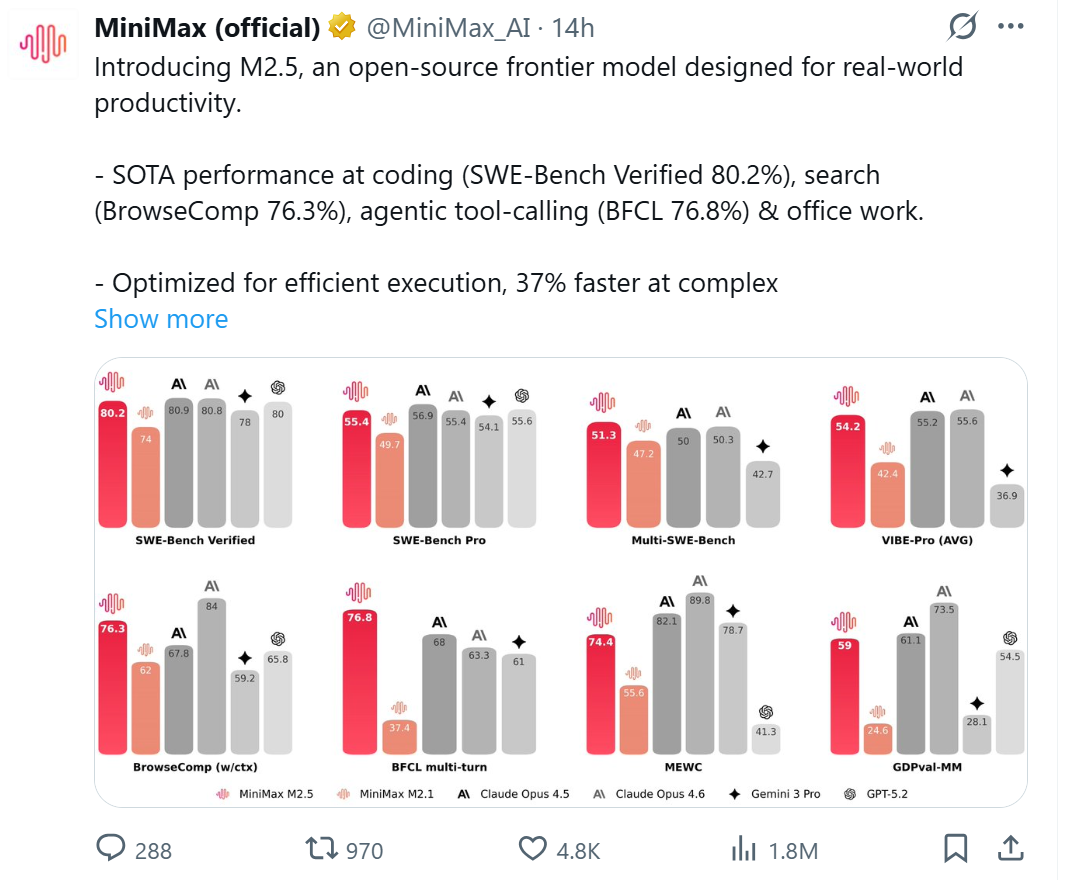
👀 What’s happening: MiniMax released M2.5 in the early hours, positioning it as an open source frontier model built for real productivity. Within minutes, benchmark screenshots spread across X. Posts citing 80.2 percent on SWE Bench Verified and strong search and agent scores flooded timelines. In a few hours, the conversation passed 1.8 million views and dominated tech feeds.
🌍 How this hits reality: The reaction was not just about performance. It was about price and speed landing at the same time. M2.5 claims 37 percent faster execution and pricing near one dollar per hour at 100 tps. That shifts the economics of long running agents for startups watching burn rates and API bills more closely than ever.
🛎️ Key takeaway: If the numbers hold in production, agent deployment moves from experiment to baseline infrastructure. The real race shifts to orchestration, distribution, and who captures developer mindshare while attention is still hot.
👀 What’s happening: MiniMax released M2.5 in the early hours, positioning it as an open source frontier model built for real productivity. Within minutes, benchmark screenshots spread across X. Posts citing 80.2 percent on SWE Bench Verified and strong search and agent scores flooded timelines.
TOGETHER WITH QODER
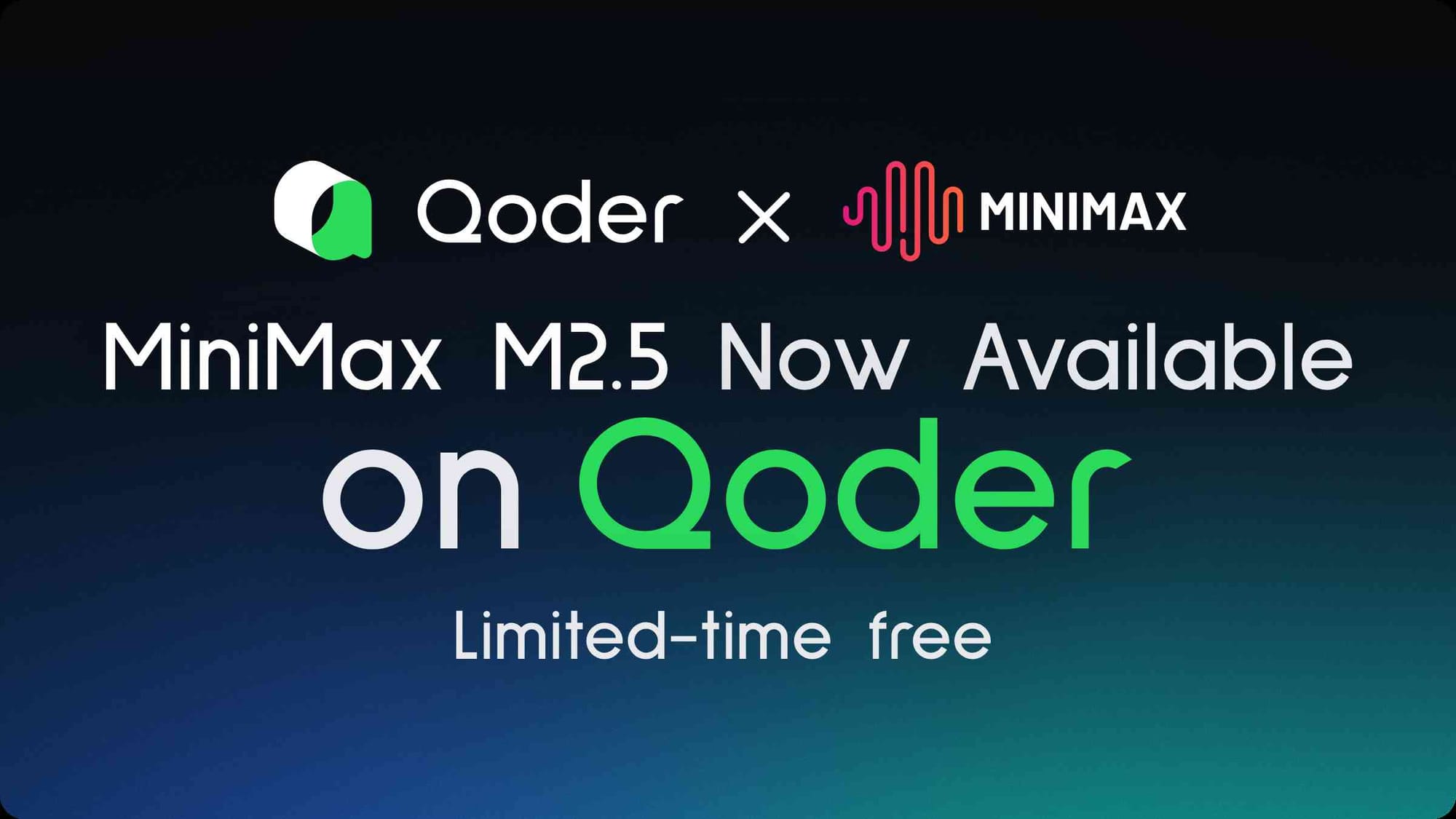
MiniMax-M2.5 just launched — the fastest agentic model among mainstream LLMs. Built natively for agent workflows, it runs 3x faster than Opus at a fraction of the cost.
Qoder is offering 3 days of free access to celebrate the launch. No credit card required.
If you're building AI agents or want to test something beyond Claude, this is your window.
CODING

👀 What’s happening: Elon Musk says programming dies this year. Not evolves. Dies. By December, AI will soon skip coding languages and compilers and generate machine instructions directly. No writing syntax. No debugging scripts. Just describe what you want and the system builds it. Linked with Neuralink, he calls it imagination to software.
🌍 How this hits reality: Software runs in layers. Humans write Python or C++, which compiles into the machine instructions CPUs actually execute. Tools like Lovable still sit inside that stack, generating traditional code under the hood, yet they have already accelerated delivery by orders of magnitude. If AI skips the human readable layer entirely and moves straight from intent to optimized machine instructions, the compression would be extreme. What feels fast now would look primitive.
🛎️ Key takeaway: If intent replaces syntax, the leverage shifts from engineers to those who define problems clearly. The bottleneck moves upstream. AI infra and chip efficiency become the real choke points, not coding talent.
👀 What’s happening: Elon Musk says programming dies this year. Not evolves. Dies. By December, AI will soon skip coding languages and compilers and generate machine instructions directly.
TOGETHER WITH MYCLAW
If you’ve been watching the benchmarks on X, now is the time to test it in the real world.
MyClaw.ai lets you safely run OpenClaw with new MiniMax M2.5 model in the cloud that stays online 24/7. No local setup. No fragile environments. Just plug in, deploy your agent, and see how M2.5 performs on actual workflows.
Coding, search, long running tasks. Try it under real load, not just screenshots.
Spin up your OpenClaw with M2.5 on MyClaw and experience the difference yourself.
MISTRAL
👀 What’s happening: Mistral’s annualized revenue surged from $20 million to over $400 million within a year, with a stated goal of reaching $1 billion in recurring revenue by year end. More than 100 enterprise clients, including ASML and TotalEnergies, now rely on it. Around 60 percent of revenue comes from Europe as local governments and boardrooms push for digital sovereignty.
🌍 How this hits reality: The EU still sources over 80 percent of its digital services from foreign, mostly American providers. That dependency is now viewed as geopolitical exposure. Mistral is committing 1.2 billion euros to Swedish data centers with EcoDataCenter, starting with a 23 megawatt site. Infrastructure runs customer workloads by day and trains models at night. This is a real try at sovereign vertical integration, not just scale.
🛎️ Key takeaway: If procurement shifts from performance to jurisdiction, regional AI stacks gain structural advantage. Expect more capital into local compute, tighter data residency rules, and mounting pressure on US hyperscalers across Europe.
👀 What’s happening: Mistral’s annualized revenue surged from $20 million to over $400 million within a year, with a stated goal of reaching $1 billion in recurring revenue by year end. More than 100 enterprise clients, including ASML and TotalEnergies, now rely on it.
PENTAGON
👀 What’s happening: The Pentagon is pressing OpenAI, Anthropic, Google and xAI to deploy frontier models onto classified military networks, with fewer built in restrictions than civilian users face. Officials say they want AI operating across all classification levels, including mission planning and potentially weapons related systems.
🌍 How this hits reality: Classified networks handle targeting data, operational plans and sensitive intelligence. Generative models can synthesize massive data flows faster than human teams, which matters when millions of defense personnel already use AI on unclassified systems. But model errors inside mission environments carry consequences measured in lives, not bug reports.
🛎️ Key takeaway: This is a dual constraint game. The military wants speed and dominance. AI firms want boundaries and control. Whichever side yields defines how frontier models integrate into sovereign war infrastructure.
DAILY TL;DR
TRENDING
READ MORE
Stay ahead without drowning in information. We turn the most important signals across AI, tech, marketing, and future products into 5-minute reads you can actually finish.
TOGETHER WITH US
AI Secret Media Group is the world’s #1 AI & Tech Newsletter Group, reaching over 2 million leaders across the global innovation ecosystem, from OpenAI, Anthropic, Google, and Microsoft to top AI labs, VCs, and fast-growing startups.
We've helped promote over 500 Tech Brands. Will yours be the next?
Email our co-founder Mark directly at [email protected] if the button fails.
Plus: A Corporate Guillotine, DeepSeek Finally Needs Money
Read the storyPlus: Musk Says Intent Will End Coding, Mistral Into AI Hedge