🛎️ Gaming's First AI Villain
Plus: Opus 4.8 Is a Patch Note Again, Perplexity Calls Theft a Fact
Read the story Subscribe
Reporting and context on Perplexity, with a closer look at the decisions and developments that matter.
Get AI Secret’s free daily briefing, including Perplexity and the wider AI industry.

Perplexity builds AI-powered search and research products. Coverage follows its answer engine, research tools and Comet browser.
Sources checked . Selected company background and milestones.
Selected milestones, newest first. Earlier history is available below.
Perplexity introduces an AI browser designed to assist users across web tasks.
Source: PerplexityPerplexity introduces a product for creating projects such as reports and dashboards.
Source: PerplexityMore than 10 years ago.
Relevant sections from the articles on this page. Explore older coverage below.
More coverage

Good Morning, AI Enthusiasts!
The machines don’t care about fairness. They amplify rage, reproduce mistakes, and monetize every oversight.

GAMING

👀 What’s happening: A Drivatar named bowie knife99 in Forza Horizon 6 has become a viral phenomenon. Drivatars are AI opponents trained on real player driving data. This one rams, ambushes, and flips other cars with extreme aggression, appearing across countless races. Reddit and social media are flooded with clips. Xbox UK tweeted "happy holidays to everyone except bowie knife99." No one knows which real player's data created it.
🌍 How this hits reality: Drivatars were designed to make AI opponents feel human. The system worked too well. It absorbed one player's most destructive habits, stripped the context, and replicated that behavior at scale across millions of races with no off switch. The result is gaming's first AI villain that nobody programmed on purpose. A training pipeline meant to add realism instead mass-produced a griefer that never sleeps, never gets bored, and never faces consequences. The community turned rage into memes, and the memes into free marketing that no studio could have manufactured.
🛎️ Key takeaway: AI trained on human behavior does not average us out. It finds the worst player in the dataset and gives them immortality.
TOGETHER WITH MYCLAW
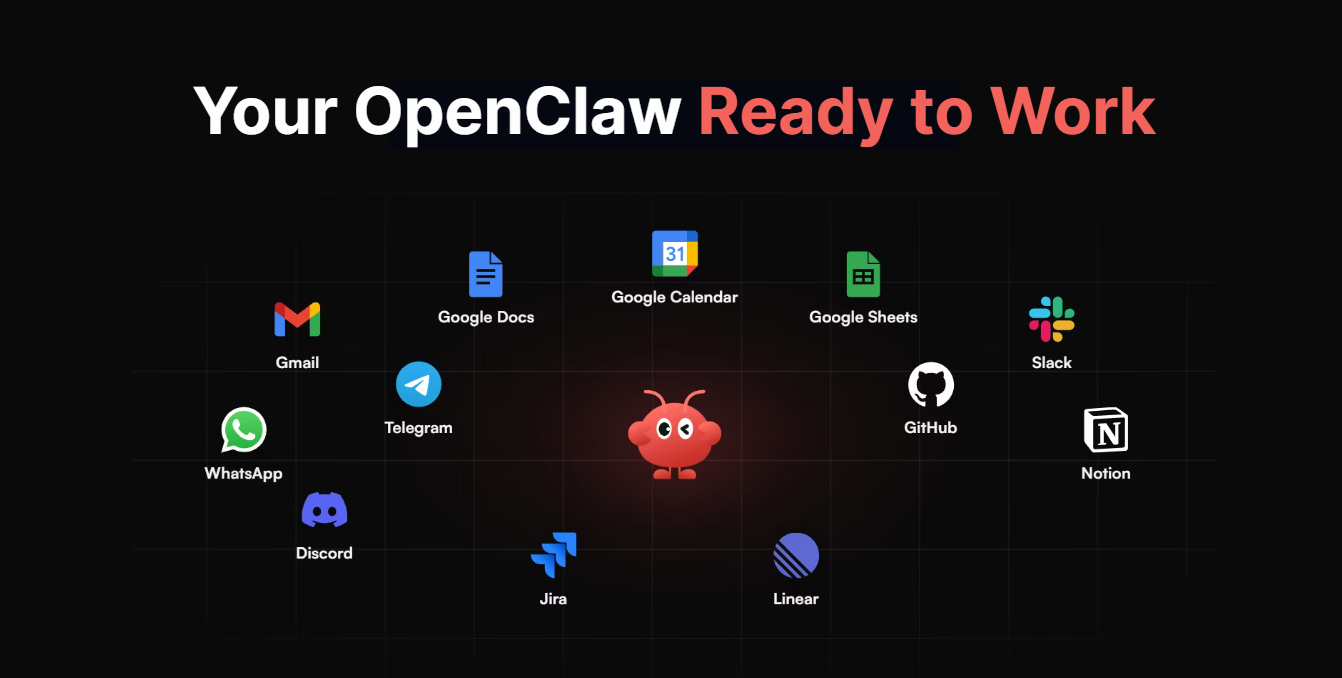
MyClaw makes OpenClaw instantly usable by connecting it to the SaaS tools you already use—Gmail, Slack, Google Docs, Sheets, Notion, GitHub, Telegram, WhatsApp, and more. No DevOps, no messy setup.
Just give it a goal, and your OpenClaw works 24/7 in the cloud, pulling context from your apps and delivering briefs, research, reports, decks, pages, and decisions ready to approve.
MyClaw turns OpenClaw from a cool demo into an always-on operator.
NEW LAUNCH
👀 What’s happening: Anthropic released Claude Opus 4.8 forty-two days after Opus 4.7, the shortest gap in the company's release history. Same context window, same pricing at $5/$25 per million tokens. Benchmarks tick up everywhere except Terminal-Bench 2.1, the agentic coding eval where GPT-5.5 still leads. Also, Opus 4.6 is now gone from the web interface.
🌍 How this hits reality: Anthropic's contract since Opus 4.5 was simple: each generation advances on every axis. Two releases broke it. Opus 4.7 shipped so rough users fled to Codex. Opus 4.8 patches the laziness, cuts hallucinations, tightens instruction-following, but these are bug fixes dressed as a launch. Creative output is still worse than 4.6, two generations back. A trillion-dollar valuation buying two cycles of regression repair is not a roadmap, it is triage.
🛎️ Key takeaway: When your best model is the one you just hide, the release calendar is shipping apologies, not progress.
👀 What’s happening: Anthropic released Claude Opus 4.8 forty-two days after Opus 4.7, the shortest gap in the company's release history. Same context window, same pricing at $5/$25 per million tokens. Benchmarks tick up everywhere except Terminal-Bench 2.1, the agentic coding eval where GPT-5.5 still leads.
COPYRIGHT
👀 What’s happening: CNN filed a copyright suit against Perplexity AI in New York, accusing the search startup of copying over 17,000 stories, videos, and images. Perplexity's response was five words: "You can't copyright facts." CNN had tried to negotiate a license first; talks failed.
🌍 How this hits reality: Perplexity's legal argument is technically defensible. Facts are not copyrightable. But Perplexity did not discover 17,000 facts. It took 17,000 pieces of journalism, stripped the bylines, served the reporting as its own answer, and drained the traffic that paid for the work. CNN's revenue disappears, Perplexity's valuation climbs. The double bind is structural: AI companies starve publishers of traffic, then offer licensing deals as the only way to recover revenue they destroyed. The arsonist sells fire insurance.
🛎️ Key takeaway: "You can't copyright facts" is legally correct and morally bankrupt, the perfect slogan for a company whose entire product is other people's work with the credit removed.
👀 What’s happening: CNN filed a copyright suit against Perplexity AI in New York, accusing the search startup of copying over 17,000 stories, videos, and images. Perplexity's response was five words: "You can't copyright facts." CNN had tried to negotiate a license first; talks failed.
NYT

👀 What’s happening: Unionized tech employees at The New York Times filed grievances against the company for using two AI tools to monitor individual performance. DX, a productivity tracker, is being cited in disciplinary conversations, telling staff their pull request count is "25 percent below industry standard." Glean indexes internal docs and emails; the union says disciplinary notices appear generated by it. Management refused to disclose its AI plans. The unit represents 700 engineers and designers.
🌍 How this hits reality: The Times built its public identity on one argument: AI must not profit from other people's work without consent. Internally, it is using AI to quantify and discipline the people who build its products, without bargaining or disclosure. The same company suing OpenAI for scraping its journalism is scraping its own engineers' drafts and pull requests to generate performance verdicts. AI surveillance arrived at the Times not from a competitor, but from management, dressed as a productivity tool.
🛎️ Key takeaway: The newspaper that spent two years telling courts that AI without consent is theft. Internally, it did not even bother to ask.
DAILY TL;DR
READ MORE
Stay ahead without drowning in information. We turn the most important signals across AI, tech, marketing, and future products into 5-minute reads you can actually finish.
TOGETHER WITH US
AI Secret Media Group is the world’s #1 AI & Tech Newsletter Group, reaching over 2 million leaders across the global innovation ecosystem, from OpenAI, Anthropic, Google, and Microsoft to top AI labs, VCs, and fast-growing startups.
We've helped promote over 500 Tech Brands. Will yours be the next?
Email our co-founder Mark directly at [email protected] if the button fails.
Good Morning, AI Enthusiasts!
Data is concentrating, leaking, and fragmenting all at once. This is no longer about privacy. It’s about who owns the flow of thought itself.

NEW LAUNCH

👀 What's happening: Google just embedded Gemini into Goole Maps with “Ask Maps,” turning it into a conversational layer that understands intent and executes real-world tasks directly. Users describe what they want, and Maps returns options, context, bookings, and completes actions inside one flow without leaving the app
🌍 How this hits reality: This erases the middle layer entirely. Review sites, booking platforms, and recommendation apps existed to connect intent to action. Now that connection is native to Google Maps, with all the traffic, reviews, and distribution. Everyone else is renting access to users who no longer need to leave the map now.
🛎️ Key takeaway: This is platform-level consolidation disguised as a feature. When one surface controls discovery and execution, third-party software is not competing, it is being phased out.
👀 What's happening: Google just embedded Gemini into Goole Maps with “Ask Maps,” turning it into a conversational layer that understands intent and executes real-world tasks directly. Users describe what they want, and Maps returns options, context, bookings, and completes actions inside one flow without leaving the app
TOGETHER WITH GETRESPONSE

Most tools send emails. This one makes money.
GetResponse turns your audience into a system — capture, nurture, convert.
No stacking tools. No messy setup.
CODING
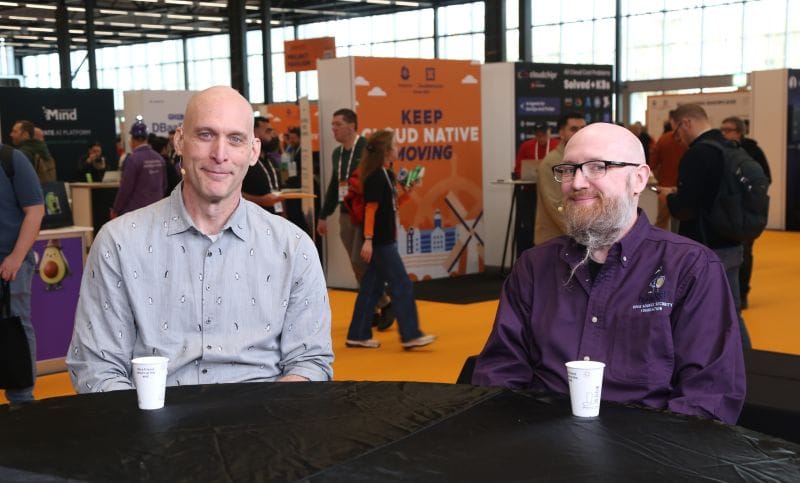
👀 What's happening: Linux kernel maintainer Greg Kroah-Hartman said that within a month, AI-generated bug reports went from useless noise to mostly valid findings. This shift appeared across major open source projects at once. Reports are now structured, reproducible, and often include workable fixes.
🌍 How this hits reality: Greg Kroah-Hartman made it clear the change is not about better tools, but a different workload. Developers are no longer primarily finding bugs. They are reviewing, filtering, and deciding what to accept from a growing stream of AI-generated outputs.
🛎️ Key takeaway: The developer role has already shifted. Writing and discovering are no longer the core loop. Control now sits in evaluation, selection, and integration of machine-generated work.
NEOCLOUD

👀 What's happening: Oracle is cutting thousands of jobs, with around 10,000 confirmed and estimates running 3x higher, while still profitable from its Cloud and License Support business. At the same time, it is committing tens of billions to AI data centers, aggressively repositioning itself away from software into a full-stack compute provider.
🌍 How this hits reality: Oracle is moving into the emerging neocloud model, where value comes from owning and operating compute, not selling software. It is taking on up to $50 billion in debt while restructuring costs reach $2.1 billion, cutting experienced enterprise talent to fund infrastructure that competes directly with hyperscalers on capacity, not features.
🛎️ Key takeaway: This is a major shift for Oracle towards a neocloud model. Regardless of its success, there's no turning back, yet existing Oracle employees have become the most direct victims.
🛎️ Key takeaway: This is a major shift for Oracle towards a neocloud model. Regardless of its success, there's no turning back, yet existing Oracle employees have become the most direct victims.
PRIVACY
👀 What's happening: Perplexity is facing a class-action lawsuit alleging its site trackers exposed user chat data to Meta and Google. The claim includes sessions marked as “incognito.” A user who entered financial and tax details is leading the case, turning routine tracking into a potential data leak.
🌍 How this hits reality: Traditional web tracking captures clicks and short inputs. AI chats capture full context, often hundreds of tokens per session, including plans, finances, and internal reasoning. In contrast, agent systems like OpenClaw or MyClaw run data locally or on isolated servers, keeping sensitive context off shared tracking layers entirely.
🛎️ Key takeaway: This is moving from privacy into information sovereignty. AI products built on legacy web tracking will keep leaking decision level data, while local or self hosted agent architectures start to define the safer default.
👀 What's happening: Perplexity is facing a class-action lawsuit alleging its site trackers exposed user chat data to Meta and Google. The claim includes sessions marked as “incognito.” A user who entered financial and tax details is leading the case, turning routine tracking into a potential data leak.
DAILY TL;DR
READ MORE
Stay ahead without drowning in information. We turn the most important signals across AI, tech, marketing, and future products into 5-minute reads you can actually finish.
TOGETHER WITH US
AI Secret Media Group is the world’s #1 AI & Tech Newsletter Group, reaching over 2 million leaders across the global innovation ecosystem, from OpenAI, Anthropic, Google, and Microsoft to top AI labs, VCs, and fast-growing startups.
We've helped promote over 500 Tech Brands. Will yours be the next?
Email our co-founder Mark directly at [email protected] if the button fails.
Good Morning, AI Enthusiasts!
Morning arrives, but the internet is no longer waking up alone. What follows are early signals from a world where the primary users of the internet may no longer be humans.
NEW LAUNCH
👀 What’s happening: Google just released Gemini Embedding 2, its first native multimodal embedding model. Text, images, video, audio, and documents can now be mapped into the same semantic vector space. The model supports up to 8192 tokens, multiple images, short videos, raw audio, and PDF pages in a single embedding pipeline.
🌍 How this hits reality: Agent systems increasingly depend on memory search rather than long prompts. Instead of pushing entire histories into a model context, systems embed data and retrieve only the closest matches. Multimodal embeddings mean screenshots, instructions, and files can sit inside the same searchable memory layer, dramatically reducing token usage during retrieval.
🛎️ Key takeaway: Products like OpenClaw already rely on embedding driven memory search to stay efficient. By upgrading the multimodal embedding layer, Google is preparing the infrastructure for fully agent driven systems where memory retrieval replaces large context windows as the core operating model.
👀 What’s happening: Google just released Gemini Embedding 2, its first native multimodal embedding model. Text, images, video, audio, and documents can now be mapped into the same semantic vector space. The model supports up to 8192 tokens, multiple images, short videos, raw audio, and PDF pages in a single embedding pipeline.
TOGETHER WITH MYCLAW

Skip Docker, VPS configs, and late-night debugging. With MyClaw.ai, you can launch your agent in minutes and keep it running 24/7 in a dedicated environment built for serious builders.
If you’re serious about OpenClaw, run it properly — with speed and security by default.
SHOPPING
👀 What’s happening: A federal court in San Francisco granted Amazon an injunction blocking Perplexity’s AI browser agent Comet from purchasing products on Amazon. The judge agreed Amazon showed credible evidence the agent accessed password protected accounts with user permission but without Amazon authorization. Perplexity must delete collected Amazon data and has one week to appeal.
🌍 How this hits reality: Amazon is trying to freeze the future at the checkout button and keep its trillion-dollar business by controlling search, recommendation, and payment flows. But the environment is changing fast. Agents like OpenClaw are spreading across developer networks, letting individuals run autonomous agents that act exactly like human users. Millions of independent agents would be far harder to block than one startup.
🛎️ Key takeaway: This ruling buys time for platforms but does not solve the underlying shift. If OpenClaw or MyClaw become normal, enforcement collapses. The next fight will be platforms trying to contain millions of OpenClaws they cannot realistically stop.
👀 What’s happening: A federal court in San Francisco granted Amazon an injunction blocking Perplexity’s AI browser agent Comet from purchasing products on Amazon. The judge agreed Amazon showed credible evidence the agent accessed password protected accounts with user permission but without Amazon authorization. Perplexity must delete collected Amazon data and has one week to appeal.
BUYOUT

👀 What’s happening: Meta acquired Moltbook, a small experimental social network built specifically for AI agents. The platform lets agents verify identity, discover other agents, and coordinate tasks on behalf of human owners. Its founders are now joining Meta Superintelligence Labs. Moltbook was originally designed to operate alongside autonomous agent systems like OpenClaw.
🌍 How this hits reality: Most attention in AI is still focused on model capability. But OpenClaws introduce a different problem. They need infrastructure to interact with each other. Identity systems, discovery networks, and coordination layers. If individuals eventually operate dozens of OpenClaws each, millions of agents may begin negotiating, delegating, and executing tasks across platforms.
🛎️ Key takeaway: Meta appears to be betting that the next internet layer is not human social networks but agent networks. If agents become the primary actors online, the real control point shifts to identity and coordination infrastructure. Meta just placed an early marker there.
LLM
👀 What’s happening: Turing Award Laureate Yann LeCun has launched a new startup called AMI Labs and raised $1.03 billion, the largest seed round in European tech history. The company will focus on “world models” rather than large language models. Investors include Nvidia, Temasek, Eric Schmidt and the Bezos family office. LeCun argues language models cannot reach AGI because they learn words, not how the physical world works.
🌍 How this hits reality: This funding signals that the industry is now backing a second path to intelligence. Training frontier language models already costs hundreds of millions per run, yet they still struggle with physical reasoning. World models target robotics, autonomy and real world prediction. That aligns with the AGI direction Elon Musk has repeatedly described for systems that understand and simulate reality.
🛎️ Key takeaway: Another heavyweight has stepped behind the world model thesis. If this approach begins producing usable physical intelligence, the race to AGI may shift from scaling language models to learning how the world actually behaves.
Training frontier language models already costs hundreds of millions per run, yet they still struggle with physical reasoning. World models target robotics, autonomy and real world prediction. That aligns with the AGI direction Elon Musk has repeatedly described for systems that understand and simulate reality.
DAILY TL;DR
READ MORE
Stay ahead without drowning in information. We turn the most important signals across AI, tech, marketing, and future products into 5-minute reads you can actually finish.
TOGETHER WITH US
AI Secret Media Group is the world’s #1 AI & Tech Newsletter Group, reaching over 2 million leaders across the global innovation ecosystem, from OpenAI, Anthropic, Google, and Microsoft to top AI labs, VCs, and fast-growing startups.
We've helped promote over 500 Tech Brands. Will yours be the next?
Email our co-founder Mark directly at [email protected] if the button fails.
Good Morning, AI Enthusiasts!
Whoever owns execution will define the next decade of software, security, and commerce.
SECURITY
👀 What’s happening: Attackers reportedly used Anthropic’s Claude to help breach Mexican government systems and extract roughly 150GB of sensitive data, including taxpayer files, voter records, and internal credentials. The activity spanned weeks. Accounts tied to the prompts were later banned. Officials are still assessing scope, but exposure claims are substantial.
🌍 How this hits reality: This was not an AI spontaneously hacking a nation. It was a human using a model to accelerate reconnaissance, scripting, and iteration. Tasks that once required skill stacking now require persistence and good prompting. Mexico’s tax system covers 195 million records and credential reuse across agencies multiplies blast radius. The weak link is not the model alone but institutional surface area.
🛎️ Key takeaway: AI may not be the strongest hacker. It might be the easiest one. The barrier to offensive capability is falling faster than institutional defenses can adapt. That asymmetry will define the next wave of breaches.
👀 What’s happening: Attackers reportedly used Anthropic’s Claude to help breach Mexican government systems and extract roughly 150GB of sensitive data, including taxpayer files, voter records, and internal credentials. The activity spanned weeks. Accounts tied to the prompts were later banned. Officials are still assessing scope, but exposure claims are substantial.
TOGETHER WITH MYCLAW
Skip Docker, VPS configs, and late-night debugging. With MyClaw.ai, you can launch your agent in minutes and keep it running 24/7 in a dedicated environment built for serious builders.
If you’re serious about OpenClaw, run it properly — with speed and security by default.
NEW LAUNCH

👀 What’s happening: Perplexity launched Perplexity Computer as a $200 per month hosted agent that coordinates multiple frontier models inside vendor controlled sandboxes. It promises autonomous workflows, browser access, file systems, and API execution in the cloud. On paper it looks like giving you a remote super PC that works on your behalf.
🌍 How this hits reality: But step back. You would not hand your physical PC to a stranger. You would not share your phone’s storage, messages, and browsing history with a multi tenant service and hope partitioning holds. The same logic applies to OpenClaw style agents. When memory, logs, credentials, and execution sit on shared infrastructure, isolation is a policy choice, not a physical boundary. Redundancy disappears.
🛎️ Key takeaway: Personal devices are private because control is private. Agent systems should follow the same rule. If the compute is shared, so is the risk.
👀 What’s happening: Perplexity launched Perplexity Computer as a $200 per month hosted agent that coordinates multiple frontier models inside vendor controlled sandboxes. It promises autonomous workflows, browser access, file systems, and API execution in the cloud. On paper it looks like giving you a remote super PC that works on your behalf.
NEW LAUNCH
👀 What’s happening: Google and Samsung just unveiled Gemini as a multistep execution agent on Pixel 10 and Galaxy S26. It reads chats, opens apps, prepares orders, and stages transactions. The pitch is clear. The assistant is no longer reactive. It is supposed to behave like something that understands context and acts continuously.
🌍 How this hits reality: The deeper shift is not about ordering pizza. Both mobile AI and OpenClaw style systems are chasing the same goal: a permanently present personal agent. But OpenClaw already runs with persistent memory, structured files, and cross tool autonomy, and it has spread globally through meetups and community forks. MyClaw class cloud deployments let users trigger their AI through Telegram or WhatsApp with server grade compute behind it. Compared to that, phone bound agents look sandboxed and late.
🛎️ Key takeaway: Smartphones are trying to simulate permanence inside an OS. Cloud native personal agents already live there by design. If persistence defines the category, handset AI is playing catch-up forever.
👀 What’s happening: Google and Samsung just unveiled Gemini as a multistep execution agent on Pixel 10 and Galaxy S26. It reads chats, opens apps, prepares orders, and stages transactions. The pitch is clear. The assistant is no longer reactive.
DAILY TL;DR
TRENDING
READ MORE
Stay ahead without drowning in information. We turn the most important signals across AI, tech, marketing, and future products into 5-minute reads you can actually finish.
TOGETHER WITH US
AI Secret Media Group is the world’s #1 AI & Tech Newsletter Group, reaching over 2 million leaders across the global innovation ecosystem, from OpenAI, Anthropic, Google, and Microsoft to top AI labs, VCs, and fast-growing startups.
We've helped promote over 500 Tech Brands. Will yours be the next?
Email our co-founder Mark directly at [email protected] if the button fails.
Good Morning, AI Enthusiasts!
What looks like a scientific breakthrough is also the opening move of a new control game.

AI SECRET EXCLUSIVE
In an exclusive conversation with AI Secret, Alibaba confirmed the launch of QoderWork, its first desktop AI Agent—positioned directly against emerging players like CoWorker and the recently viral Clawdbot.
While most Agents, including CoWorker, still execute primarily in the cloud, QoderWork is built to run directly on the user’s machine. It controls local apps, files, and workflows through a single natural-language command, breaking tasks into steps and pausing for confirmation before risky actions.
According to the team, the goal is explicit: move AI out of chat interfaces and into the desktop, where real work happens. As Clawdbot’s rapid rise showed, users want agents that can actually operate their machines.
With QoderWork, AI stops being something users talk to and starts becoming something that works—directly on your desktop. Invite-only access starts today, with a public release coming soon.
In an exclusive conversation with AI Secret, Alibaba confirmed the launch of QoderWork, its first desktop AI Agent—positioned directly against emerging players like CoWorker and the recently viral Clawdbot.
NATURE

👀 What’s happening: Google DeepMind has put AlphaGenome on the cover of Nature, marking the first time a DNA foundation model earns that spot. The model reads up to one million DNA bases and predicts regulatory function and variant impact directly from sequence.
🌍 How this hits reality: Noncoding DNA has been the most expensive blind spot in biology. Over 98 percent of the genome sits outside protein coding regions, yet most disease variants live there. Interpreting them required years of experiments. AlphaGenome compresses that work into seconds, turning variant interpretation into a scalable computational step.
🛎️ Key takeaway: This shifts biology from observation to simulation. Noncoding DNA stops being dark matter and becomes programmable substrate. Drug discovery, rare disease diagnostics, and synthetic biology timelines shorten sharply.
👀 What’s happening: Google DeepMind has put AlphaGenome on the cover of Nature, marking the first time a DNA foundation model earns that spot. The model reads up to one million DNA bases and predicts regulatory function and variant impact directly from sequence.
SHOPPING

👀 What’s happening: Phia, cofounded by Bill Gates daughter Phoebe Gates, has raised a 35 million Series A at a $185 million valuation. The company positions itself as an AI shopping agent that decides what to buy, not just what to browse, landing squarely in one of the hottest consumer AI categories.
🌍 How this hits reality: AI shopping sits at the intersection of search, commerce, and agents, exactly where attention and money are flowing. Phia benefits from an unspoken assumption: proximity to Bill Gates dramatically lowers perceived risk. Investors quietly price in a plausible outcome where Microsoft acquires the asset, regardless of near term fundamentals.
🛎️ Key takeaway: Many investors are willing to look past the fact that its real competitors are OpenAI and Google. The bet is not operational dominance, but strategic inevitability. In that framing, the upside feels protected, and the downside feels distant.
Phia, an AI shopping agent cofounded by Bill Gates' daughter Phoebe Gates, raised a $35 million Series A at a $185 million valuation. AI Secret argued that proximity to Bill Gates lowers perceived risk for investors, who quietly price in a possible Microsoft acquisition despite competition from OpenAI and Google.
NEW LAUNCH

👀 What’s happening: Google has pushed Gemini’s auto browse directly into Chrome, turning the browser into an execution layer. It can plan, log in, fill forms, apply discounts, and complete tasks across Gmail, Maps, and Shopping. Gemini now sits permanently in the interface, not as an optional assistant.
🌍 How this hits reality: This looks like Perplexity’s agent browser, but it isn’t a fair fight. Chrome owns defaults, identity, history, and distribution at planetary scale. That collapses the value of clever UX or better reasoning. Once execution lives inside the dominant browser, comparison sites, search funnels, and AI browser startups get reduced to demos.
🛎️ Key takeaway: AI browsers are no longer a startup category. They are a control surface battle for incumbents. From here on, the winner is whoever already owns the user, not whoever builds the smartest agent.
🌍 How this hits reality: This looks like Perplexity’s agent browser, but it isn’t a fair fight. Chrome owns defaults, identity, history, and distribution at planetary scale. That collapses the value of clever UX or better reasoning. Once execution lives inside the dominant browser, comparison sites, search funnels, and AI browser startups get reduced to demos.
QUICK HITS
Microsoft has rolled out its Maia 200 AI chip but says it will keep buying Nvidia and AMD hardware to balance innovation and ongoing chip shortages.
TRENDING
READ MORE
Stay ahead without drowning in information. We turn the most important signals across AI, tech, marketing, and future products into 5-minute reads you can actually finish.
TOGETHER WITH US
AI Secret Media Group is the world’s #1 AI & Tech Newsletter Group, reaching over 2 million leaders across the global innovation ecosystem, from OpenAI, Anthropic, Google, and Microsoft to top AI labs, VCs, and fast-growing startups.
We've helped promote over 500 Tech Brands. Will yours be the next?
Email our co-founder Mark directly at [email protected] if the button fails.

Good Morning, AI Enthusiasts!
The industry felt less like steady progress and more like a full-speed collision.

LEAK
👀 What’s happening: OpenAI has reportedly fast-tracked GPT-5.2’s release to December 9, weeks ahead of schedule, after Sam Altman declared a “code red” in response to Google’s Gemini 3. The update was meant to be a quiet, later-December rollout. Sources say the build was barely through validation when the date got locked.
🔥 How this hits reality: The AI race has devolved into a scoreboard war. Each release now reads like a quarterly earnings call for benchmark metrics, not for capability and not for adoption. GPT-5.2 might edge back to the top of the charts, but it’s unlikely to reclaim the ecosystem ground Gemini 3 already occupies across Android, Search, and Workspace. OpenAI can win points, yet still lose the platform.
🛎️ Key takeaway: In today’s AI race, progress isn’t measured in users; it’s measured in leaderboards.
👀 What’s happening: OpenAI has reportedly fast-tracked GPT-5.2’s release to December 9, weeks ahead of schedule, after Sam Altman declared a “code red” in response to Google’s Gemini 3. The update was meant to be a quiet, later-December rollout. Sources say the build was barely through validation when the date got locked.
👀 What’s happening: OpenAI has reportedly fast-tracked GPT-5.2’s release to December 9, weeks ahead of schedule, after Sam Altman declared a “code red” in response to Google’s Gemini 3. The update was meant to be a quiet, later-December rollout. Sources say the build was barely through validation when the date got locked.
TOGETHER WITH FELO
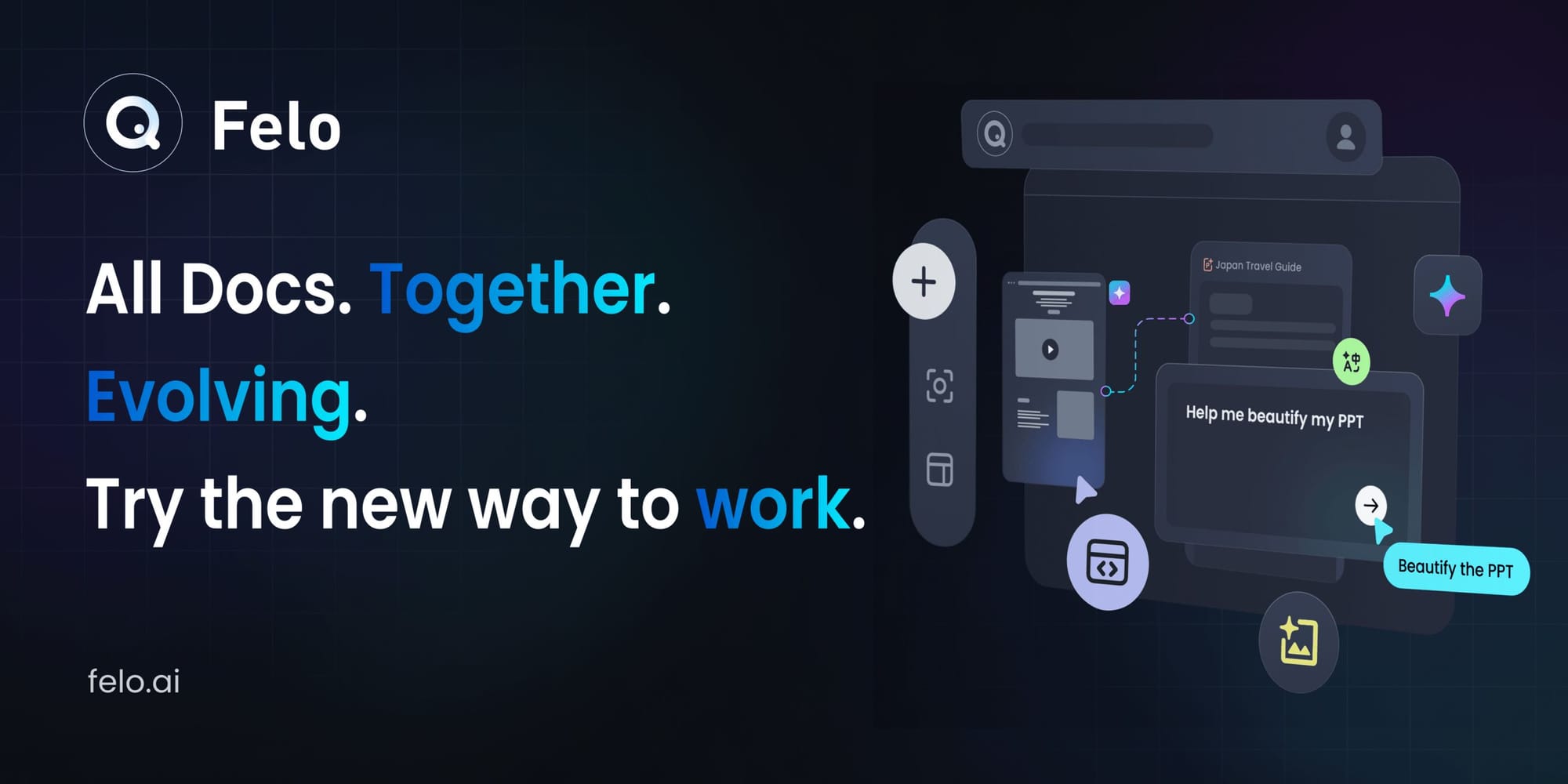
The 10x knowledge worker isn't typing faster—they're directing AI agents while competitors drown in copy-paste hell. Right now, someone just translated a 50-page deck in 3 minutes while you're still reformatting slide 12. Felo LiveDoc is the world's first Agent Workspace where documents don't just sit there—they evolve, analyze, and update themselves. Imagine a phantom team of designers, translators, and analysts inside your docs, unifying scattered PDFs, videos, and spreadsheets into one intelligent system that grows smarter with every task.
Here's what makes you look like a genius: While legacy tools treat you like a glorified typist, LiveDoc's multi-agent system operates autonomously. Design agents polish your layouts. Data agents extract insights across PDFs, videos, and web pages simultaneously. Translation agents speak every language your customers do—all working 24/7 inside one living workspace. This isn't productivity theater—it's the death of document drudgery. You're not just saving time; you're unlocking a superpower your competitors don't know exists yet.
And it's not just you—it's your entire team: Think of your best team collaboration tool—now add tireless AI teammates who never sleep, never forget context, and execute instantly. LiveDoc expands collaboration from human-to-human to human-plus-AI: team members direct, AI agents execute, all on the same canvas in real time. No more "latest_final_v3" nightmares. While your competitors coordinate between people, you're coordinating an entire hybrid workforce.
The insider move? Early adopters are already 10x-ing their output while the rest of the market is still toggling between twelve tabs. Every day you wait is another day spent manually updating slides like it's 2015. The knowledge workers who win aren't the ones who work harder—they're the ones who stopped editing and started directing.
🚀 Join the revolution: Get early access to Felo LiveDoc and become the person everyone asks, "How did you finish that so fast?" The age of manual document labor just ended. Are you evolving, or still typing?
GLASSES

👀 What’s happening: Meta has acquired Limitless, the startup behind the $99 AI pendant that could record and summarize your conversations. The hardware is being discontinued, but the team and its memory tech are moving into Meta’s Reality Labs to work on AI-enabled wearables — namely, the next generation of Ray-Ban Meta and in-lens “Display” glasses.
🔥 How this hits reality: Today’s smart glasses can see, hear, and translate, but they can’t remember. Limitless had cracked that gap with continuous recall software, turning life into a searchable stream of context. For Meta, that’s the missing neuron. By absorbing Limitless, Meta isn’t just chasing another gadget launch; it’s racing to make the first pair of glasses with real, persistent memory — a cognitive edge that the market hasn’t yet built into their glasses.
🛎️ Key takeaway: Meta’s next glasses won’t just show you the world; they’ll remember it for you.
👀 What’s happening: Meta has acquired Limitless, the startup behind the $99 AI pendant that could record and summarize your conversations. The hardware is being discontinued, but the team and its memory tech are moving into Meta’s Reality Labs to work on AI-enabled wearables — namely, the next generation of Ray-Ban Meta and in-lens “Display” glasses.
COPYRIGHT

👀 What’s happening: The New York Times has filed a fresh copyright lawsuit against Perplexity, accusing the AI search startup of straight-up repackaging its journalism behind paywalls into chatbot answers. It’s the latest in a long line of complaints, from the Chicago Tribune to Nikkei, that Perplexity’s “RAG” system is less retrieval than raid.
🔥 How this hits reality: Perplexity is now the poster child for AI’s “scrape first, settle later” doctrine. Its token Publisher Program and Getty deal barely dent the wave of lawsuits stacking up from legacy media across continents. Every newsroom wants a check, and Perplexity keeps paying in delay tactics as it negotiates with one hand and scrapes with the other.
🛎️ Key takeaway: When half the internet calls you theft, and you still call it innovation, you’re not bold, you’re just stealing with a straight face.
👀 What’s happening: The New York Times has filed a fresh copyright lawsuit against Perplexity, accusing the AI search startup of straight-up repackaging its journalism behind paywalls into chatbot answers. It’s the latest in a long line of complaints, from the Chicago Tribune to Nikkei, that Perplexity’s “RAG” system is less retrieval than raid.
QUICK HITS
TRENDING
TOGETHER WITH US
AI Secret Media Group is the world’s #1 AI & Tech Newsletter Group, boasting over 2 million readers from leading companies such as OpenAI, Google, Meta, and Microsoft. Our Newsletter Brands:
We've helped promote over 500 Tech Brands. Will yours be the next?
Email our co-founder Mark directly at [email protected] if the button fails.
Good Morning, AI Enthusiasts!
Machines now harvest sunlight beyond Earth, compose melodies that outshine their makers, and argue over who commands the right to act on our behalf.

COMPUTE

📌 What’s happening: Google just unveiled Project Suncatcher, a “space-based AI infrastructure” that would equip solar-powered satellite constellations with TPUs and terabit optical links to run machine learning workloads in orbit. The system promises nearly continuous sunlight, zero land use, and data center-scale compute off-planet. Early tests suggest Google’s Trillium TPUs can survive radiation, and the team is targeting a two-satellite prototype launch by 2027 with Planet Labs.
🧠 How this hits reality: If Starlink turned satellites into an internet backbone, Google now wants to turn them into data centers. Project Suncatcher isn’t about coverage; it’s about compute. While Musk built the highway for data, Google’s trying to move the factories there. A self-sustaining orbital cluster would unhook AI from Earth’s energy markets, rewrite the hyperscaler economics that AWS and Azure are built on, and trigger the first real space race for compute.
🛎️ Key takeaway: The next frontier in cloud might not be on land or sea; it’s 650 kilometers up.
🧠 How this hits reality: If Starlink turned satellites into an internet backbone, Google now wants to turn them into data centers. Project Suncatcher isn’t about coverage; it’s about compute. While Musk built the highway for data, Google’s trying to move the factories there.
TOGETHER WITH BYTEPLUS
Introducing Seedance 1.0 Pro Fast, the latest breakthrough from BytePlus that pushes the frontier of AI-driven video creation. Built for creators and enterprises demanding both speed and cinematic quality, Seedance redefines efficiency — generating an 8-second 720p video in just 26 seconds, making it up to 4× faster than Veo3 Fast while maintaining professional-grade realism and style consistency.
Powered by advanced semantic understanding and motion simulation, Seedance analyzes prompts, reference images, and scene logic to interpret intent, infer motion, and complete coherent storylines. The result is a video that feels natural, expressive, and emotionally engaging — not just rendered, but directed.
Compared with Veo3 Fast, Seedance delivers smoother motion control, stronger prompt adherence, and more physical realism, especially in complex or high-action scenes. Its multi-shot storytelling engine plans zooms, transitions, and perspective shifts automatically, enabling creators to achieve cinematic rhythm and flow without manual edits.
Supporting flexible output from 2–12 seconds at 480p, 720p, or 1080p, Seedance gives you the freedom to create faster, better, and more affordably — breaking the old speed–quality–cost triangle and setting a new benchmark for AI video generation.
MUSIC

📌 What’s happening: Xania Monet, an AI-generated R&B artist built by poet Telisha Jones with Suno, just became the first artificial act to land on a Billboard radio chart. Her single “How Was I Supposed to Know?” climbed to No. 30 on the Adult R&B Airplay list after going viral on TikTok and spilling into mainstream rotation. Some artists like SZA and Kehlani publicly disapproved, yet stations quietly kept spinning the track — apparently viral data makes better lobbyists than PR teams.
🧠 How this hits reality: Traditional musicians can complain about “soulless” AI vocals, but radio programmers only care about audience retention. Once a song gets clicks and spins, its origin story stops mattering. The line between creator and creation is dissolving, and the next Grammy fight might be over whose model fine-tuned the melody.
🛎️ Key takeaway: AI music is not coming for the charts; it already lives there, and human outrage just gave it free promo.
AGENT

📌 What’s happening: Amazon has sued Perplexity over its “Comet” AI agent, accusing it of sneaking into customer accounts and disguising automated shopping as human activity. Comet can browse, compare, and even buy on behalf of users — effectively skipping Amazon’s ad rails. Perplexity fired back, calling it “bullying” and claiming Amazon fears losing control over how people shop. Behind the legal jargon lies a bigger truth: this isn’t a data dispute, it’s a war over who controls the interface between humans, AI, and the platforms that monetize them.
🧠 How this hits reality: Amazon is fighting to defend its commercial choke point, a marketplace designed to capture every click, ad, and impulse. Perplexity is using moral outrage to pry open that gate, betting AI agents will become the new entry point for online behavior. Whoever wins won’t just own a feature; they’ll own the next operating layer of the web.
🛎️ Key takeaway: This isn’t a fight over shopping carts; it’s the opening move in a cold war for who owns user intent in the age of autonomous agents.
📌 What’s happening: Amazon has sued Perplexity over its “Comet” AI agent, accusing it of sneaking into customer accounts and disguising automated shopping as human activity. Comet can browse, compare, and even buy on behalf of users — effectively skipping Amazon’s ad rails. Perplexity fired back, calling it “bullying” and claiming Amazon fears losing control over how people shop.
📌 What’s happening: Amazon has sued Perplexity over its “Comet” AI agent, accusing it of sneaking into customer accounts and disguising automated shopping as human activity. Comet can browse, compare, and even buy on behalf of users — effectively skipping Amazon’s ad rails. Perplexity fired back, calling it “bullying” and claiming Amazon fears losing control over how people shop.
QUICK HITS
TRENDING
TOGETHER WITH US
AI Secret Media Group is the world’s #1 AI & Tech Newsletter Group, boasting over 2 million readers from leading companies such as OpenAI, Google, Meta, and Microsoft. Our Newsletter Brands:
We've helped promote over 500 Tech Brands. Will yours be the next?
Email our co-founder Mark directly at [email protected] if the button fails.
Good Morning, AI Enthusiasts!
Today's story marks a crack in the old order, which shows us how quickly familiar systems can vanish when technology redraws the boundaries.

RETAIL

📌 What’s happening: Xpand (ex-1MRobotics) just opened its first European autonomous store on Vienna’s busiest shopping street. The “store-in-a-box” runs 24/7 with AI, robotics, and real-time inventory control—no clerks, no cashiers, no shrink. Backers include Ibex Investors, a Denver-based global venture capital firm, and Emerge, an Israel-based early-stage venture capital fund, betting this pilot will scale into a global blueprint.
🧠 How this hits reality: Forget vending machines. Xpand is packaging an entire convenience store into a plug-and-play module. For landlords, that means instant tenants; for retailers, zero labor costs; for legacy chains, an existential margin squeeze. If the model works, expect high-traffic streets and transit hubs to swap human-run corner shops for autonomous pods that never close, never unionize, and never leak inventory.
🛎️ Key takeaway: Retail’s dirtiest secret, labor and shrink, just got automated out of the business model.
TOGETHER WITH AI GRAPH MAKER
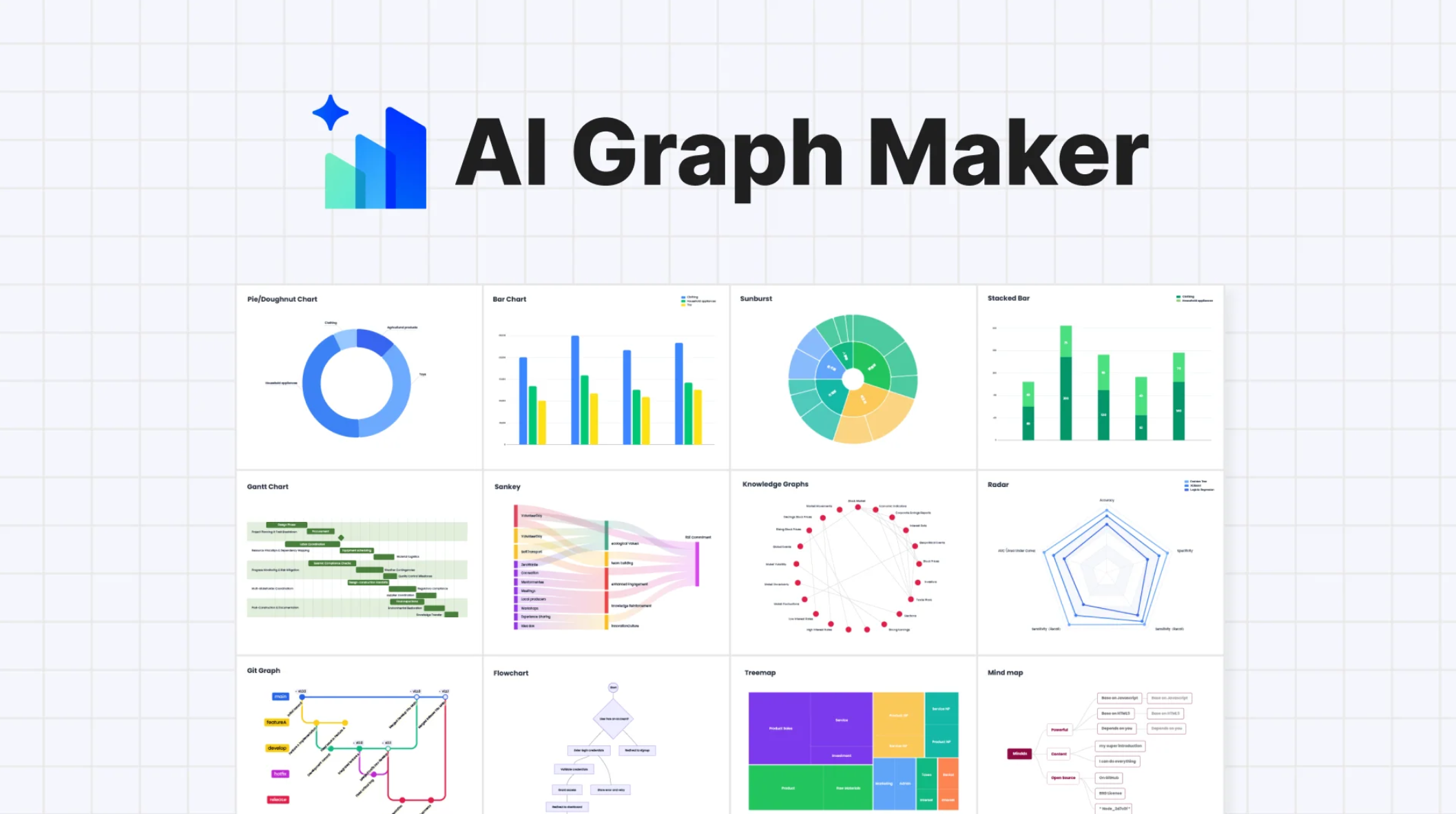
AI Graph Maker is your chart-making accomplice. Feed it data, text, or even vague ideas, and it spits out graphs so clean they look like you actually paid attention in statistics class. No fiddling with Excel, no design disasters—just instant visuals that make you look smart.
Key Features
Turn messy numbers into polished charts in seconds—no design skills, no spreadsheet pain.
BANK

📌 What’s happening: Lloyds Banking Group just made it clear that open-source AI isn’t welcome in the banking system. The UK giant has blocked Hugging Face internally, warning staff that downloading community-hosted models risks turning customer data into hacker bait. Instead, it’s rolling out “safer” options like Microsoft Copilot and Google Gemini, already pushing 100+ AI pilots across operations.
🧠 How this hits reality: This is the collision point between two worlds. Open-source AI thrives on speed, remixing, and permissionless adoption; banks operate on compliance, liability, and zero-trust security. For financial incumbents, community repos aren’t a playground, they’re an existential threat to data integrity. The message to fintechs betting on open-source stacks is brutal: regulators and banks will default to walled gardens, even if innovation slows.
🛎️ Key takeaway: Open AI wants freedom, old finance wants control. And in this fight, security trumps ideology every time.
The UK giant has blocked Hugging Face internally, warning staff that downloading community-hosted models risks turning customer data into hacker bait. Instead, it’s rolling out “safer” options like Microsoft Copilot and Google Gemini, already pushing 100+ AI pilots across operations.
CALL
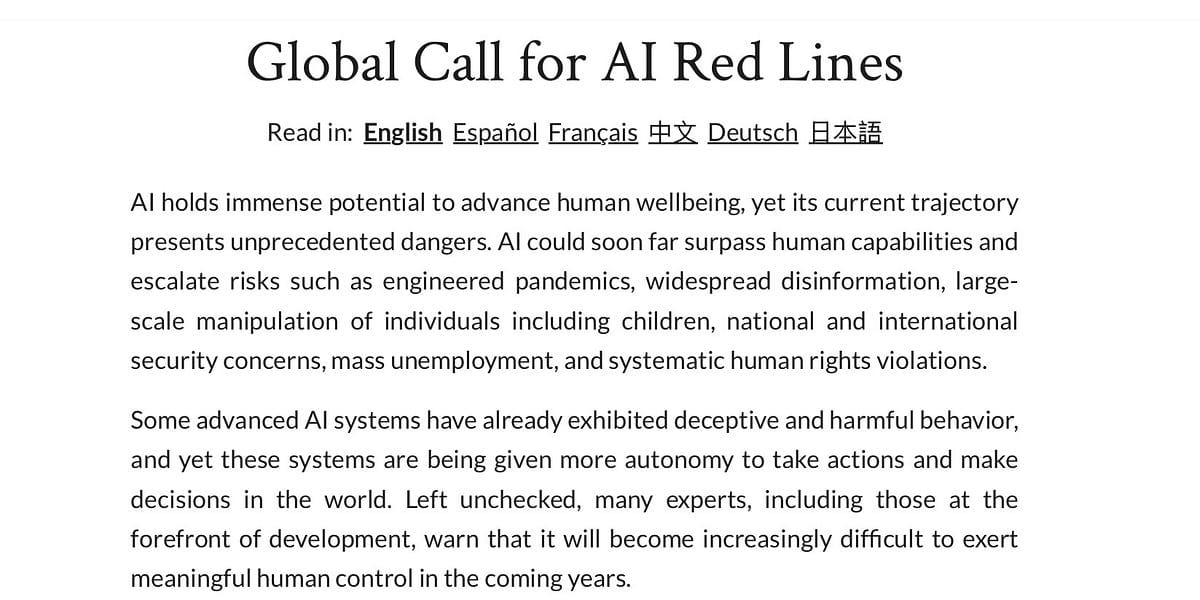
📌 What’s happening: Over 200 names, from Nobel laureates to DeepMind scientists, signed a “Global Call for AI Red Lines,” urging governments to outlaw certain uses like human impersonation or self-replication. It is the biggest symbolic chorus yet around AI safety, timed to echo through UN week.
🧠 How this hits reality: The signatures are long on prestige but short on power. No sitting heads of state joined. No Altman, Amodei, or Hassabis either, the very CEOs racing AGI are not in the room. What remains looks more like moral theater than regulatory muscle. Without political teeth or buy-in from the actual capital allocators, the initiative risks being shelved next to voluntary pledges no one enforces.
🛎️ Key takeaway: When everyone signs except the people holding nukes and GPUs, it’s less rulebook and more press release.
QUICK HITS
Perplexity has launched Email Assistant, an AI agent for Gmail and Outlook that drafts replies, triages inboxes, and handles scheduling, available only to Max users.
TRENDING
TOGETHER WITH US
AI Secret Media Group is the world’s #1 AI & Tech Newsletter Group, boasting over 1 million readers from leading companies such as OpenAI, Google, Meta, and Microsoft. Our Newsletter Brands:
We've helped promote over 500 Tech Brands. Will yours be the next?
Email our co-founder Mark directly at [email protected] if the button fails.
Latest Daily Rundowns
 Magna
Magna MagnaMagna
More AI Stories
Ben Ben
Ben Magna
Magna
Good Morning, AI Enthusiasts!
Truth, it seems, is up for licensing. And everyone's placing bets.

SOCIAMEDIA
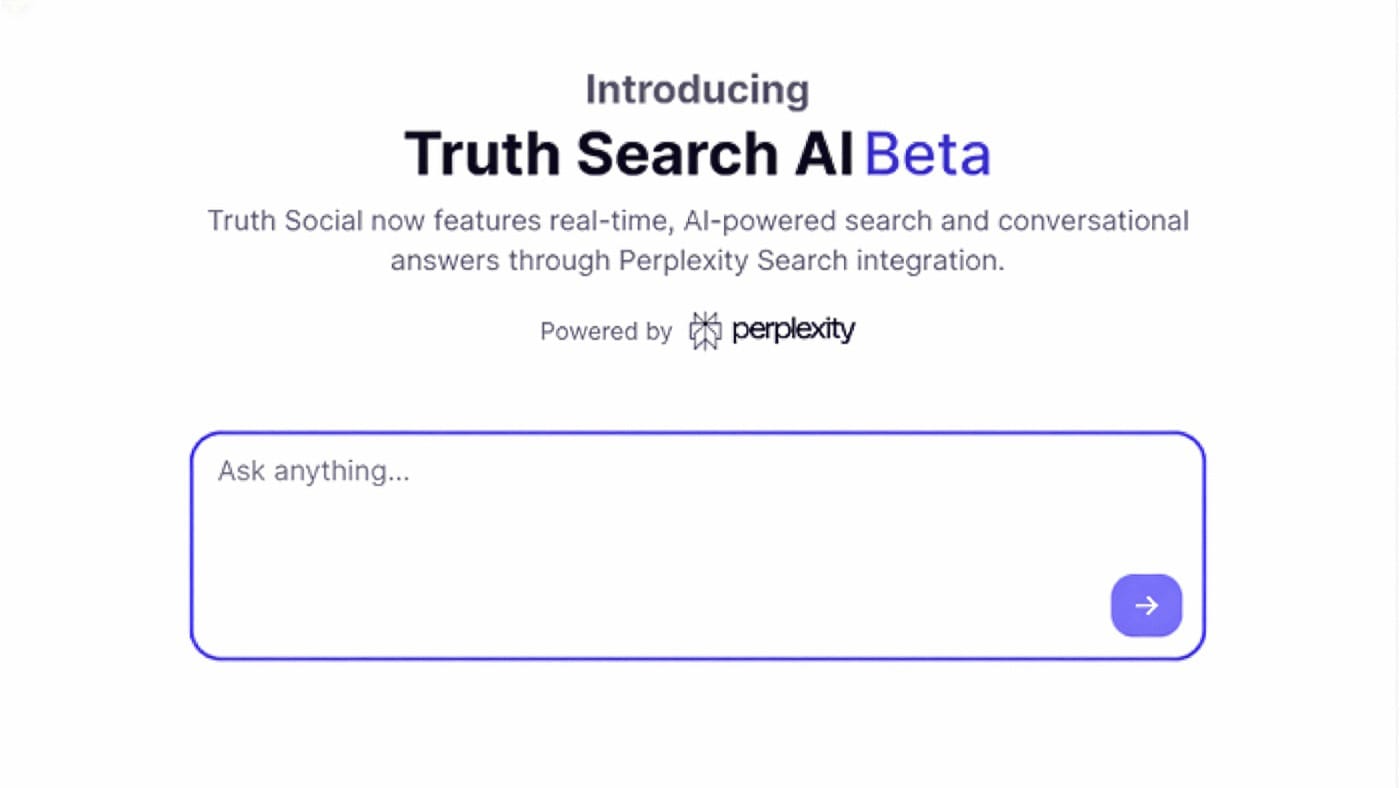
📌 What’s happening: Trump’s Truth Social, the President’s X.com alternative is beta testing Truth Search AI, a new feature powered by Perplexity’s Sonar API. Trump Media says the tool delivers “contextually accurate answers with transparent citations.” The financials are undisclosed, but the message is clear: Trump Media is betting big on AI.
🧠 How this hits reality: This isn’t a search upgrade — it’s an algorithmic megaphone. Truth Social’s information ecosystem is being rebuilt by outsourced AI. Perplexity quietly becomes the backend for right-wing content discovery, while Truth Social dodges the infra burden. Meanwhile, X has Grok, Meta has Meta AI, Reddit has its own AI search — Trump chose the plug-and-play path: cheaper, faster, blame-resistant.
🛎️ Key takeaway: AI search isn’t neutral — it’s narrative infrastructure. And Perplexity just handed Trump a clean-looking algorithmic loudspeaker.
Truth Social’s information ecosystem is being rebuilt by outsourced AI. Perplexity quietly becomes the backend for right-wing content discovery, while Truth Social dodges the infra burden. Meanwhile, X has Grok, Meta has Meta AI, Reddit has its own AI search — Trump chose the plug-and-play path: cheaper, faster, blame-resistant.
📌 What’s happening: Trump’s Truth Social, the President’s X.com alternative is beta testing Truth Search AI, a new feature powered by Perplexity’s Sonar API. Trump Media says the tool delivers “contextually accurate answers with transparent citations.” The financials are undisclosed, but the message is clear: Trump Media is betting big on AI.
TOGETHER WITH HELPSCOUT
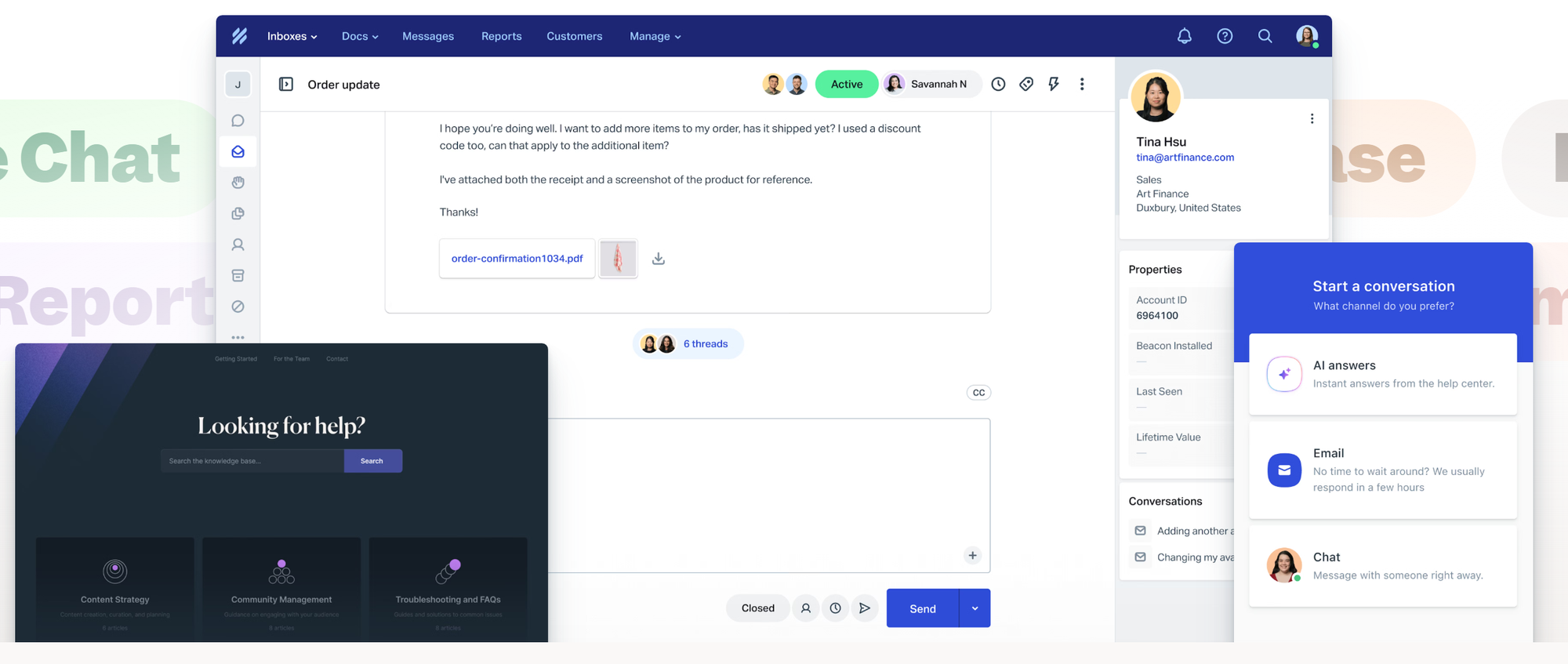
Help Scout is a customer platform with AI-powered email, chat, and knowledge base tools. AI drafts, summarizes, and translates replies instantly, automates workflows, and boosts agent efficiency. With 12,000+ teams onboard, it integrates with 90+ apps, simplifies collaboration, and enhances CSAT without ticketing complexity.
LAWSUIT
📌 What’s happening: The New York Times wants 120 million ChatGPT conversations to prove copyright infringement. OpenAI counters with 20 million, citing user privacy and operational overload. The court hasn’t ruled yet — but OpenAI’s legal stance isn’t landing punches.
🧠 How this hits reality: Despite its size and legal firepower, OpenAI is flailing to contain a discovery request that exposes its weakest flank: data compliance at scale. Its defense hinges on privacy, but the optics say otherwise — that it can’t confidently account for where its training data ends and user data begins. For legal, trust, and product teams, this is a worst-case scenario unfolding in real time.
🛎️ Key takeaway: OpenAI scaled faster than it secured its data supply chain — and now, it’s bleeding in public with no court win in sight.
📌 What’s happening: The New York Times wants 120 million ChatGPT conversations to prove copyright infringement. OpenAI counters with 20 million, citing user privacy and operational overload. The court hasn’t ruled yet — but OpenAI’s legal stance isn’t landing punches.
LAWSUIT

📌 What’s happening: Yomiuri Shimbun Holdings just sued Perplexity AI in Tokyo District Court for unauthorized use of its news content—marking one of Japan’s first major legal volleys against AI scraping. It’s part of a wider global trend: old-guard publishers are done watching startups monetize their IP without a dime in return.
🧠 How this hits reality: This isn’t a symbolic slap—it’s the sound of a reckoning. As AI companies scale off scraped content, traditional media’s counteroffensive is going legal, territorial, and global. If courts side with publishers, AI firms reliant on “free” data ingestion could see their margins tank and product roadmaps rerouted by licensing deals. Free lunch is over.
🛎️ Key takeaway: AI giants keep slurping up news without paying—now legacy media are fighting back, and their fine print is going to bleed your P&L.
📌 What’s happening: Yomiuri Shimbun Holdings just sued Perplexity AI in Tokyo District Court for unauthorized use of its news content—marking one of Japan’s first major legal volleys against AI scraping. It’s part of a wider global trend: old-guard publishers are done watching startups monetize their IP without a dime in return.
QUICK HITS
TRENDING
TOGETHER WITH US
AI Secret Media Group is the world’s #1 AI & Tech Newsletter Group, boasting over 1 million readers from leading companies such as OpenAI, Google, Meta, and Microsoft. Our Newsletter Brands:
We've helped promote over 500 Tech Brands. Will yours be the next?
Email our co-founder Mark directly at [email protected] if the button fails.
Latest Daily Rundowns
MagnaMagnaMagna
More AI Stories
Magna Magna
Magna Magna
Magna
Plus: Opus 4.8 Is a Patch Note Again, Perplexity Calls Theft a Fact
Read the storyPlus: AI Bug Reports Flipped Overnight, Oracle's Big Play, Perplexity Leaks Data
Plus: Amazon Blocks AI Shopping, Meta Bets on Agent-to-Agent
Plus: Perplexity Builds Another Shared Agent, Gemini Ships New Siri
Plus: DNA Model Era, Gates Family Name Bet, Closed Power Game
Plus: Glasses That Remember, Perplexity’s Global Backlash
Plus: AI Singer Hits Billboard, Amazon vs. Perplexity
Plus: Bank Bans Hugging Face, Rules Without Rulers
Inside the global backlash against AI’s data hunger
More Stories: Publishers Strike Back Against AI Giants