Salesforce Takes Missionforce to the Front Line
Salesforce is buying Rune Technologies, a military logistics startup, for $375 million, nearly three times its last valuation, to take Missionforce to the front.
Read the story
Company — Salesforce develops cloud software for customer relationships, enterprise data and AI agents. Its AI strategy brings Agentforce, Data 360 and Slack into sales, service and other business workflows.
Get AI Secret’s free daily briefing, including Salesforce and the wider AI industry.
Salesforce develops cloud software for customer relationships, enterprise data and AI agents. Its AI strategy brings Agentforce, Data 360 and Slack into sales, service and other business workflows.
Sources checked . Selected company background and milestones.
Revenue, funding, product launches and major company events, newest first. Expand earlier milestones for more history.
The proposed cash acquisition has approximately $5.66 billion in enterprise value and is expected to close in fiscal 2028, subject to shareholder and regulatory approvals. It has not closed at announcement.
Source: Salesforce ↗Salesforce reports nearly $3.9 billion in combined ARR. Agentforce exceeds $1.5 billion; its definition expanded this quarter to include additional AI offerings, so earlier figures are not directly comparable.
Source: Salesforce ↗Fiscal Q2 2027 revenue grows 11% year over year, including $456 million from Informatica. This is recognized quarterly revenue, not ARR.
Source: Salesforce ↗Annual revenue rises 10%. Agentforce and Data 360 exceed $2.9 billion in combined ARR, including $1.1 billion of Informatica Cloud ARR; Agentforce alone reaches $800 million.
Source: Salesforce ↗Salesforce introduces its platform for building and deploying autonomous AI agents across enterprise workflows.
Source: Salesforce ↗The company launches the data platform subsequently known as Data Cloud and Data 360, linking customer data with enterprise applications.
Source: Salesforce ↗Slack joins Salesforce, adding workplace communication and collaboration to the company’s enterprise software portfolio.
Source: Salesforce ↗Salesforce introduces predictive AI capabilities to its customer relationship software.
Source: Salesforce ↗The company begins with a cloud-based approach to customer relationship management software.
Source: Salesforce ↗Briefs, articles and relevant sections, newest first. Explore older coverage below.
More coverage

Welcome to AI Secret Growth Map July 2025 Report
As we enter the second half of the year, the AI growth engine is still running hot. Just one month after Gemini topped the June charts, ChatGPT roared back in July with a staggering +325.1M new visits, reclaiming the crown in overall growth. Meanwhile, the visual AI category saw a decisive shift toward utility-first tools, AI coding welcomed a wave of lightweight new entrants, and enterprise adoption leaned deeper into specialized copilots.
At AI Secret, we’ve partnered with leading industry sources and analyzed real traffic data across millions of users to compile the July 2025 Growth Rankings. As always, this report cuts through the noise to highlight the products truly capturing user attention, adoption, and trust.
Let’s dive into the data — and the dynamics — shaping AI’s latest growth wave. 👇
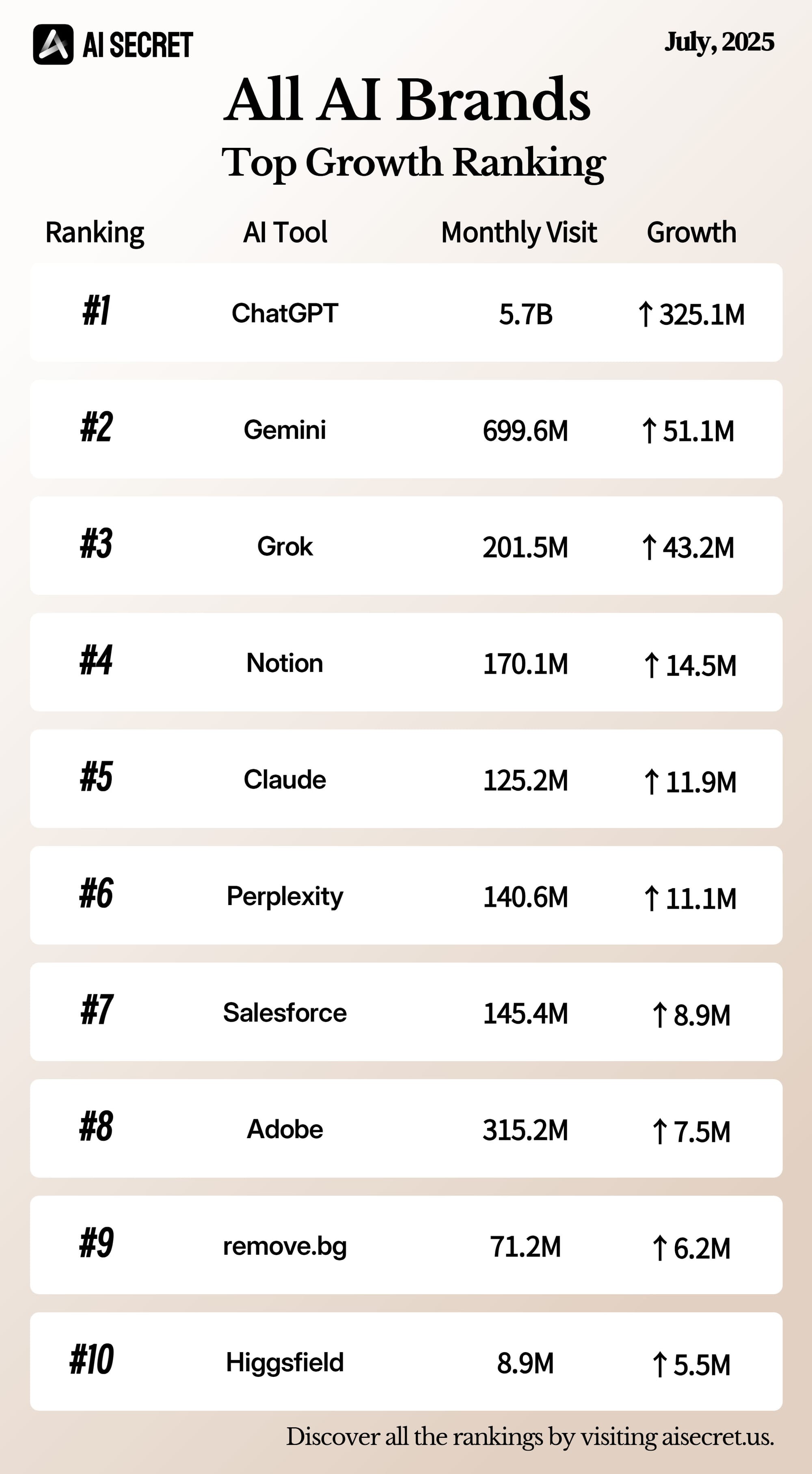
In a reversal from last month’s leaderboard, ChatGPT surged +325.1M to hit 5.7B monthly visits, retaking the growth lead from Gemini. While Gemini still grew +51.1M (to 699.6M visits), the gap this month was decisive.
The rest of the top five saw Grok (+43.2M) leapfrog Claude, with Notion (+14.5M) and Claude (+11.9M) maintaining steady climbs. Perplexity (+11.1M) held strong in the search-oriented corner of the AI stack, while Salesforce (+8.9M) and Adobe (+7.5M) underscored the stickiness of enterprise and creative platforms.
Notion's rise is fueled by its seamless integration of AI into everyday workflows — from auto-summarizing notes to generating content with context. As teams increasingly seek all-in-one workspaces, Notion's AI-native features turn it from a productivity tool into an intelligent knowledge partner.
Notably, two vertical tools — remove.bg (+6.2M) and Higgsfield (+5.5M) — entered the overall top ten, a sign that specialized offerings are gaining enough traction to break into the all-AI conversation.
🛎️ Key takeaway: The top remains anchored by generalist platforms, but July marks a clear broadening — vertical utilities are finding their way into the big leagues.
Notion's rise is fueled by its seamless integration of AI into everyday workflows — from auto-summarizing notes to generating content with context. As teams increasingly seek all-in-one workspaces, Notion's AI-native features turn it from a productivity tool into an intelligent knowledge partner.
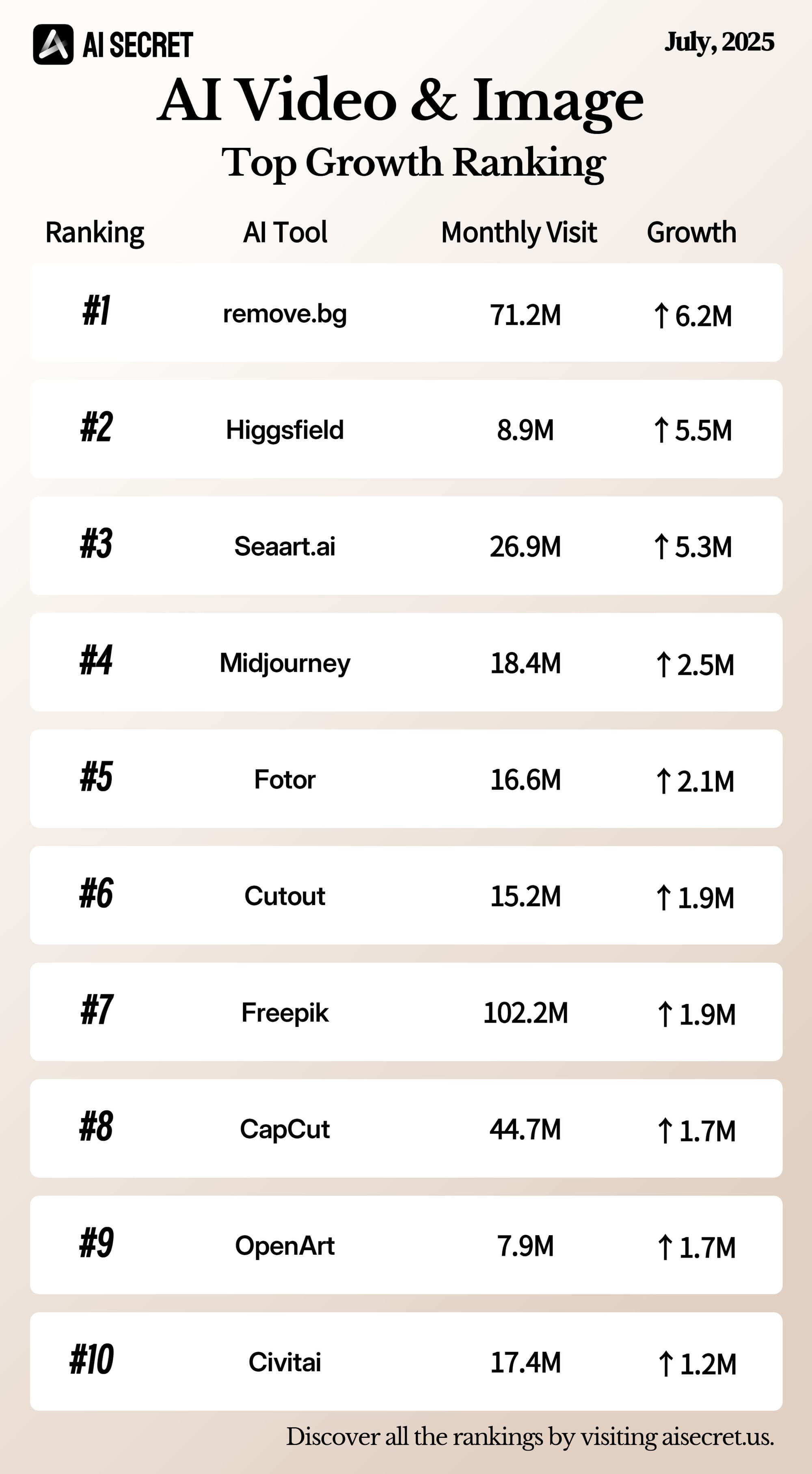
Remove.bg claimed the #1 spot this month with +6.2M growth to 71.2M visits, leveraging its straightforward, high-demand image background removal capabilities. Close behind, Higgsfield (+5.5M) and Seaart.ai (+5.3M) proved that creative tools with a clear aesthetic edge still command attention.
Newcomers like Seaart.ai are riding the wave of AI-native creativity platforms, while Midjourney (+2.5M) continued its slow but steady rise, joined by Fotor (+2.1M) and Cutout (+1.9M) in serving the needs of creators, marketers, and e-commerce workflows. Freepik, CapCut, OpenArt, and Civitai rounded out a list that blended production utility with visual artistry.
Compared to June — when cinematic newcomer Veo 3 stole the show — July’s rankings reveal a pivot toward tools that deliver immediate, practical value alongside creative potential.
🛎️ Key takeaway: When it comes to visual AI, ease-of-use trumps power. Tools that solve one thing beautifully are growing faster than do-it-all platforms.
Remove.bg claimed the #1 spot this month with +6.2M growth to 71.2M visits, leveraging its straightforward, high-demand image background removal capabilities. Close behind, Higgsfield (+5.5M) and Seaart.ai (+5.3M) proved that creative tools with a clear aesthetic edge still command attention.
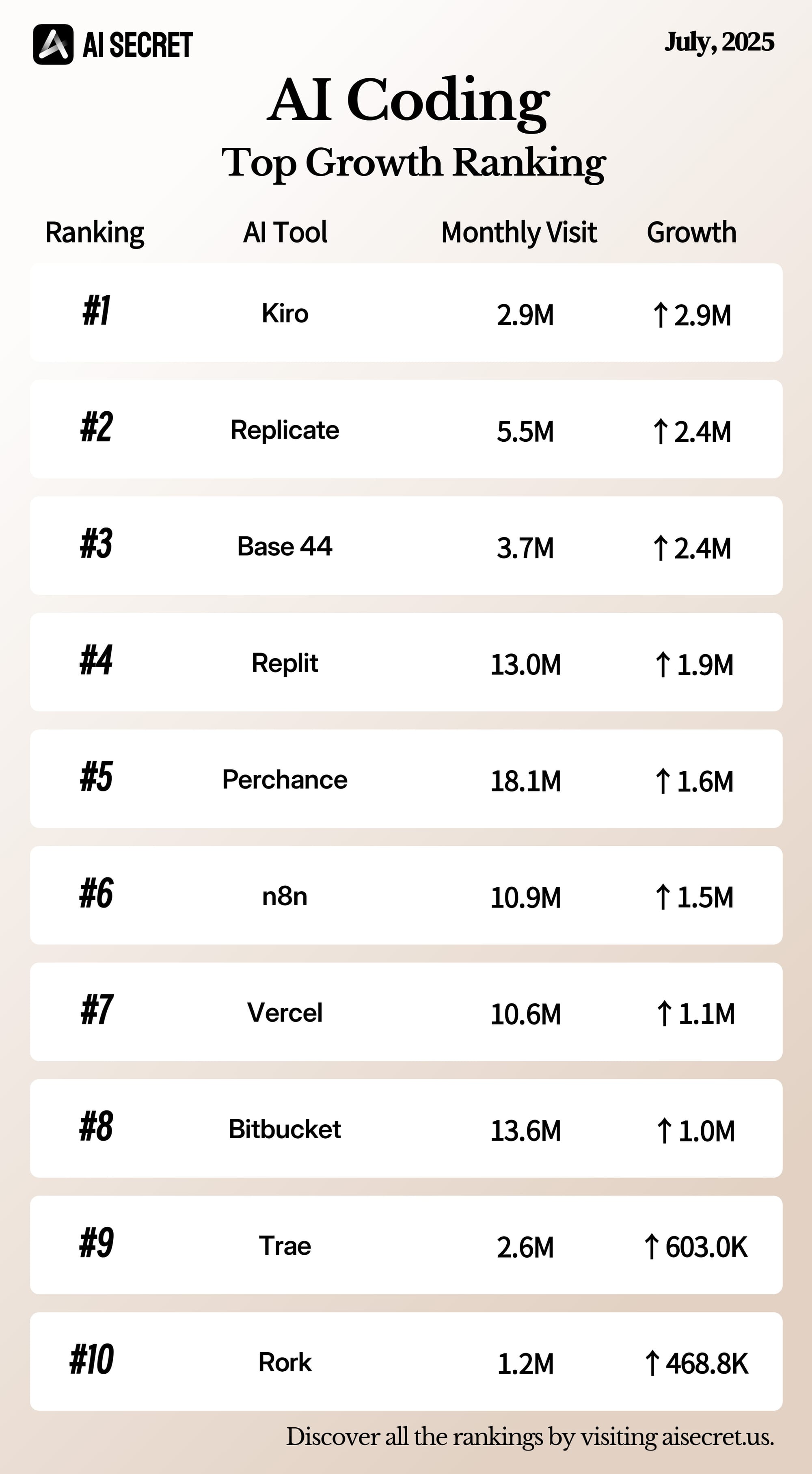
Kiro came out of nowhere to claim the #1 growth spot in coding tools with +2.9M new visits — a likely indicator of a product that fits the “copilot for X” archetype.
Replicate (+2.4M) and Base 44 (+2.4M) followed closely, showing strong demand for platforms that simplify model deployment and experimentation.
Replit (+1.9M) and Perchance (+1.6M) maintained momentum, with n8n (+1.5M), Vercel (+1.1M), and Bitbucket (+1.0M) reinforcing the backbone of the builder stack. Trae and Rork rounded out the top ten, catering to niche developer needs.
In June, Lovable ranked prominently in the AI Coding category, signaling strong early traction likely driven by buzz and initial user onboarding. However, by July, it dropped out of the top ranks — replaced by fast-rising tools like Kiro, which offer more focused, utility-driven features. This shift suggests that developer preferences are consolidating around tools with clear, task-specific value, while hype-driven products without sustained engagement are quickly overtaken.
🛎️ Key takeaway: The builder economy is fragmenting — new AI-native tools are claiming ground between traditional IDEs, scripting, and automation layers.
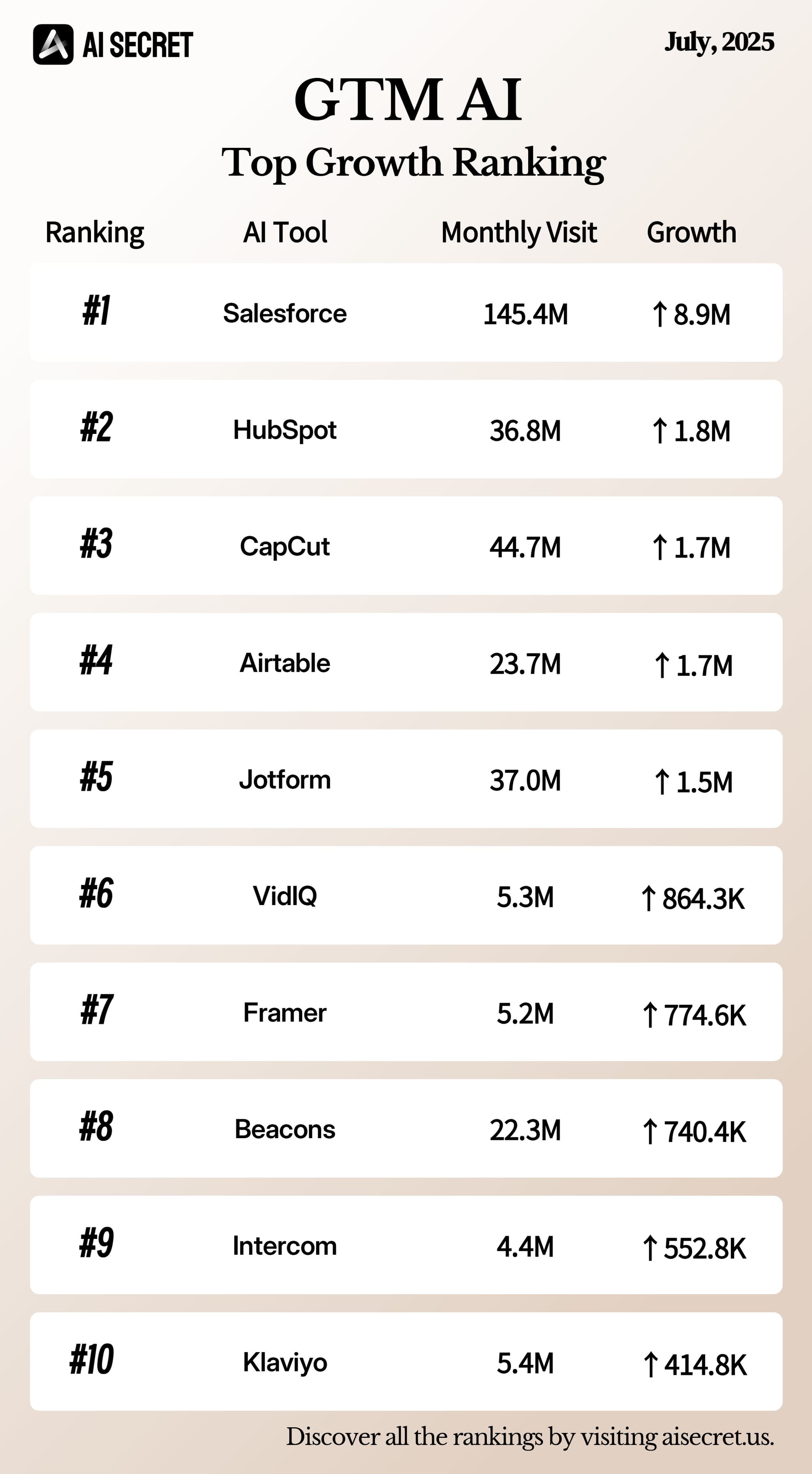
Growth teams are quietly becoming AI-first. Salesforce (+8.9M) extended its dominance, serving as the AI-powered backbone for many GTM stacks. HubSpot (+1.8M) held its ground, while Airtable added +1.7M — all layering AI across content, CRM, and operations.
VidIQ (+864.3K) and Framer (+774.6K) show that creators and marketers are embracing AI for content strategy, landing pages, and distribution.
The presence of Beacons (+740.4K), Intercom (+552.8K), and Klaviyo (+414.8K) confirms a growing demand for AI in customer engagement and funnel automation.
Compared to June, GTM AI tools in July showed a shift from core CRM platforms to creator-focused and lightweight automation tools. While Salesforce maintained its lead, tools like VidIQ, Framer, and Beacons surged up the ranks — signaling growing adoption of AI among content-driven growth teams and indie marketers.
🛎️ Key takeaway: The AI go-to-market stack is taking shape — with every touchpoint from awareness to retention getting an intelligence upgrade.
Salesforce (+8.9M) extended its dominance, serving as the AI-powered backbone for many GTM stacks. HubSpot (+1.8M) held its ground, while Airtable added +1.7M — all layering AI across content, CRM, and operations.
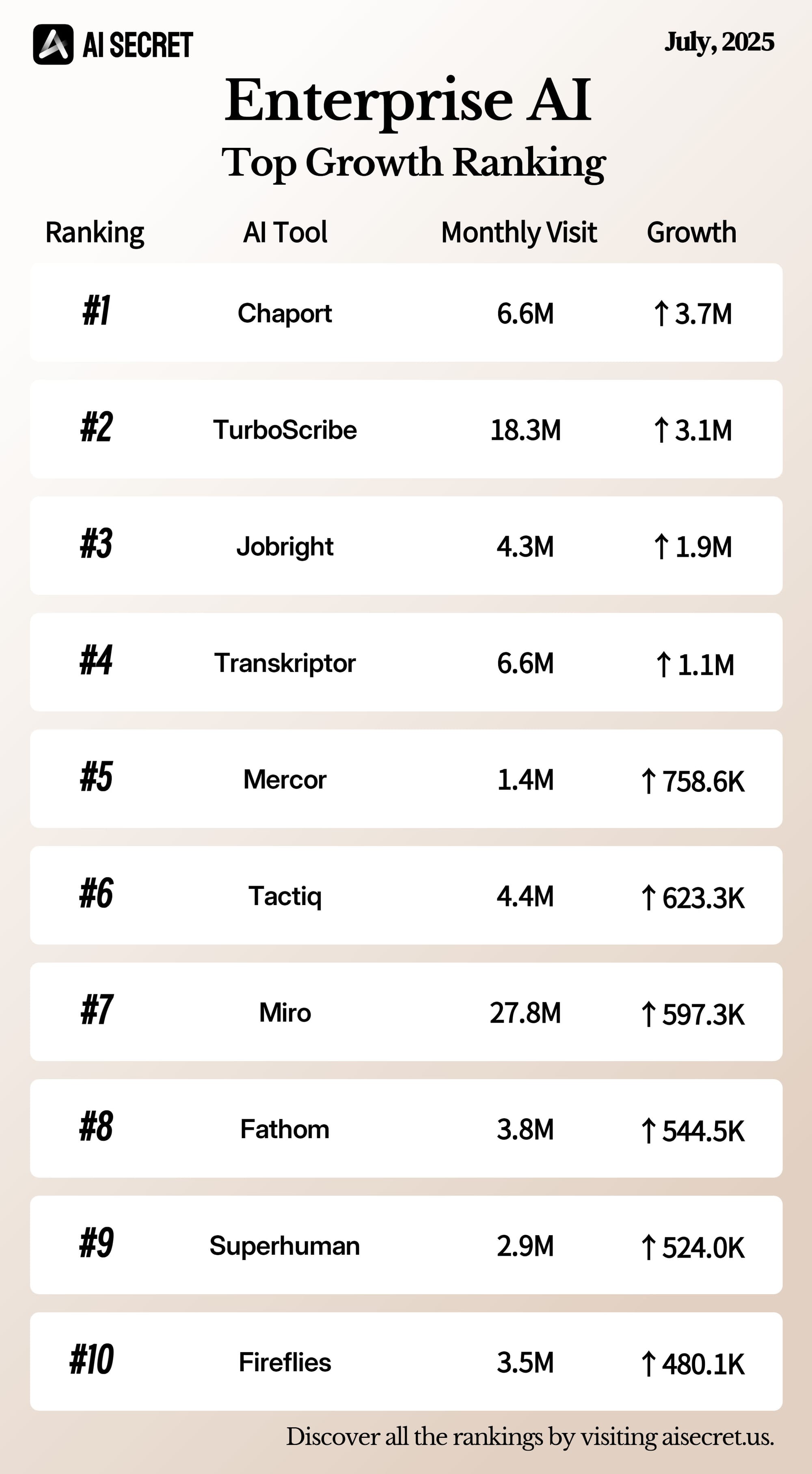
In enterprise AI, Chaport (+3.7M) took the lead. TurboScribe (+3.1M) followed, capturing the transcription and meeting note market, while Jobright (+1.9M) carved a niche in recruitment intelligence.
Transkriptor (+1.1M) and Mercor (+758.6K) joined incumbents like Miro (+597.3K), as well as Tactiq, Fathom, Superhuman, and Fireflies — all focused on solving highly specific workflow challenges.
By July, the landscape shifted toward utility-first, operational tools — with Chaport, TurboScribe, and Transkriptor rising sharply. These tools address specific, high-frequency enterprise pain points like real-time support, transcription, and team documentation.
The contrast reflects a broader trend: enterprises are moving from flashy AI add-ons to embedded, ROI-driven automation that scales quietly in the background.
🛎️ Key takeaway: The next wave of enterprise AI is quiet. It’s not flashy — it’s embedded, useful, and often invisible.
July’s data underscores that while the giants are still towering over the field, the real action is happening at the edges:
What stood out across categories?
As the AI landscape matures, utility is outperforming novelty. July’s data reveals a clear shift: users are gravitating toward tools that solve real problems quickly, whether it's coding smarter, launching faster, or automating mundane workflows. The race isn’t just about intelligence anymore — it’s about adoption at scale.
TOGETHER WITH US
AI Secret Media Group is the world’s #1 AI & Tech Newsletter Group, boasting over 1 million readers from leading companies such as OpenAI, Google, Meta, and Microsoft. Our Newsletter Brands:
We've helped promote over 500 Tech Brands. Will yours be the next?
Email our co-founder Mark directly at [email protected] if the button fails.
Related Stories
 Magna
 Magna
 Magna
 Magna

Salesforce is buying Rune Technologies, a military logistics startup, for $375 million, nearly three times its last valuation, to take Missionforce to the front.
Read the storySalesforce will pay $47.50 a share in cash for Braze, its biggest marketing deal ever and its fourth purchase of 2026.
Salesforce closed its roughly $3.6 billion purchase of Fin, formerly Intercom, adding 30,000 customer companies while Fin keeps building its own models.
Plus: IRS Cuts 25% of Staff, Insurers Quit on AI Risk
Plus: The Smart Warehouse Age, Salesforce Crowns Itself
Utility Wins-July’s Fastest-Growing AI Products Solve Real Problems
Join the largest AI user survey to date!
Artificial Intelligence (AI) has long been the tech industry’s favorite buzzword, promising everything from self-driving cars to robot chefs who can whip up a Michelin-starred
Scale AI Banned, Midjourney's First Video Model, AI Agent Failed
In the world of Customer Relationship Management (CRM), where businesses rely on seamless interactions with customers, Salesforce's new benchmark, CRMArena-Pro, has delivered a reality