🛎️ Cursor Claims the Lead Over Opus
Plus: OpenAI Codex Acquires Astral, Model Advantage Stops Being Enough
Read the story Subscribe
Company — Reporting on Anthropic, with a focus on AI, technology and business and consequential public developments.
Get AI Secret’s free daily briefing, including Anthropic and the wider AI industry.

AI research company behind Claude, with an emphasis on the reliability and safety of AI systems. Coverage follows its models, research, products and business.
Sources checked . Selected company background and source references.
Selected milestones, newest first. Earlier history is available below.
More than 10 years ago.
Relevant sections from the articles on this page. Explore older coverage below.
More coverage

Good Morning, AI Enthusiasts!
The race is not about who thinks best, but who owns the loop where thinking turns into action.

NEW LAUNCH

👀 What’s happening: Cursor released its self built coding model Composer 2, beats Opus 4.6 on benchmarks while cutting token prices to near one fifth of Opus 4.6, roughly 0.5 dollars per million input tokens and 2.5 output. It also introduced a faster variant and a new training method where the model writes its own summaries to handle long tasks.
🌍 How this hits reality: This lands after multiple models, including GPT 5.4, have already claimed to surpass Opus 4.6 on paper. In practice, Opus still holds up in real coding workflows, especially across long horizon tasks and messy repos. Cursor’s efficiency gains matter, but benchmarks alone have not translated into consistent dominance in production environments.
🛎️ Key takeaway: Price cuts will accelerate adoption, but trust still sits with whoever delivers under real workload pressure. Composer needs to prove it can replace Opus in daily use, not just beat it in controlled tests.
👀 What’s happening: Cursor released its self built coding model Composer 2, beats Opus 4.6 on benchmarks while cutting token prices to near one fifth of Opus 4.6, roughly 0.5 dollars per million input tokens and 2.5 output. It also introduced a faster variant and a new training method where the model writes its own summaries to handle long tasks.
TOGETHER WITH MYCLAW

Skip Docker, VPS configs, and late-night debugging. With MyClaw.ai, you can launch your agent in minutes and keep it running 24/7 in a dedicated environment built for serious builders.
If you’re serious about OpenClaw, run it properly — with speed and security by default.
M&A
👀 What’s happening: OpenAI plans to acquire Astral and integrate it into Codex, which has now surpassed 2 million weekly users after tripling in just a few months. Astral builds core Python tooling like uv, Ruff, and ty, three of the fastest growing developer tools with over 100 million monthly downloads. With this move, OpenAI is pushing deeper into the execution layer it does not yet fully control.
🌍 How this hits reality: Claude Code has been eating real developer workflows, not demos. OpenAI is reacting by collapsing layers fast. Promptfoo locks down testing and safety. Astral brings packaging, linting, and runtime control. Codex is being rebuilt into a vertically integrated pipeline, because just generating code is no longer enough to stay in the race.
🛎️ Key takeaway: This is catch up mode, not expansion. OpenAI is trying to close the Claude Code gap by owning the full loop from generation to execution.
👀 What’s happening: OpenAI plans to acquire Astral and integrate it into Codex, which has now surpassed 2 million weekly users after tripling in just a few months. Astral builds core Python tooling like uv, Ruff, and ty, three of the fastest growing developer tools with over 100 million monthly downloads.
🌍 How this hits reality: Claude Code has been eating real developer workflows, not demos. OpenAI is reacting by collapsing layers fast. Promptfoo locks down testing and safety. Astral brings packaging, linting, and runtime control.
AGENTS
👀 What’s happening: Cloudflare’s CEO says AI-driven bot traffic is on track to exceed human internet activity by 2027. At the same time, the company is shipping agent sandboxes, execution layers, and crawler controls. It is not reacting to the shift. It is moving early to sit directly between agents and the web they depend on.
🌍 How this hits reality: Agents like OpenClaw now hit up to 5,000 pages per task versus five for humans. Cloudflare fronts roughly 20% of the internet, giving it leverage to allow, throttle, or price that traffic. If machine traffic dominates, control over access points becomes control over distribution, visibility, and cost structures across the web.
🛎️ Key takeaway: Cloudflare is positioning to be the gatekeeper of the agent internet, again. As agents replace browsers, it aims to decide how they run, what they can reach, and what they pay, centralizing power at the network layer again.
OPENCLAW
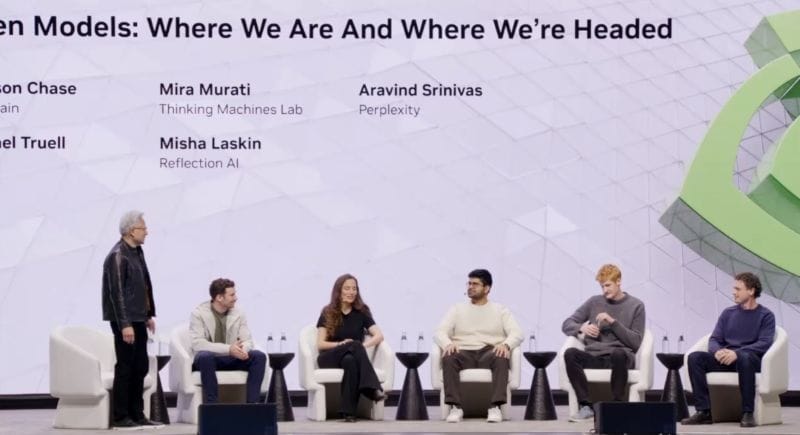
👀 What’s happening: At GTC, Jensen Huang brought together leaders from LangChain, Cursor, Perplexity, Mistral, AI2, OpenEvidence, Black Forest Labs, Reflection AI, AMP, and Thinking Machines Lab. The discussion moved past open versus closed models and landed on a shared view. AI is shifting from model competition to system construction, with OpenClaw highlighted as a visible turning point.
🌍 How this hits reality: AI leaders agree that the classic stack of frontier model labs and downstream apps is breaking. A new layer is forming around orchestration, agents, and control planes. Coding proved viability, but for now scaling to enterprises introduces constraints. Systems must manage data access, execution rights, and communication boundaries across long running workflows, often spanning multiple models and tools.
🛎️ Key takeaway: No single model can dominate end to end tasks anymore. Advantage shifts to those who assemble, route, and govern systems effectively. The era where better models alone decide winners has ended.
DAILY TL;DR
READ MORE
Stay ahead without drowning in information. We turn the most important signals across AI, tech, marketing, and future products into 5-minute reads you can actually finish.
TOGETHER WITH US
AI Secret Media Group is the world’s #1 AI & Tech Newsletter Group, reaching over 2 million leaders across the global innovation ecosystem, from OpenAI, Anthropic, Google, and Microsoft to top AI labs, VCs, and fast-growing startups.
We've helped promote over 500 Tech Brands. Will yours be the next?
Email our co-founder Mark directly at [email protected] if the button fails.
Good Morning, AI Enthusiasts!
Agents are no longer experiments. They are becoming the system.
NEW LAUNCH
👀 What’s happening: Mistral released Forge at GTC, a platform that lets enterprises train full AI models from scratch using their own data instead of adapting external ones. It bundles infrastructure, data pipelines, and embedded engineers, pushing companies to build internal model “brains” designed to power agent systems.
🌍 How this hits reality: This breaks from the RAG and fine-tuning era where intelligence stayed with API providers. Now the model, data, and control loop move inside the company. When paired with frameworks like OpenClaw, these private models can directly drive agents that understand internal tools, workflows, and decisions at a much deeper level.
🛎️ Key takeaway: Mistral is aligning around private brains plus agent frameworks as the new stack. If this scales, enterprise AI shifts from using agents on rented intelligence to deploying agents powered by fully owned, deeply embedded cognitive systems.
👀 What’s happening: Mistral released Forge at GTC, a platform that lets enterprises train full AI models from scratch using their own data instead of adapting external ones. It bundles infrastructure, data pipelines, and embedded engineers, pushing companies to build internal model “brains” designed to power agent systems.
TOGETHER WITH MYCLAW
Skip Docker, VPS configs, and late-night debugging. With MyClaw.ai, you can launch your agent in minutes and keep it running 24/7 in a dedicated environment built for serious builders.
If you’re serious about OpenClaw, run it properly — with speed and security by default.
CODING
👀 What’s happening: OpenAI is cutting non-core bets and refocusing on coding and enterprise while simultaneously pushing Codex through an aggressive six-week sprint. Internal mandate now requires engineers to default to agents over traditional tools. Rapid releases, usage spikes, and leadership reshuffling all point to one goal: challenge Claude Code directly.
🌍 How this hits reality: Coding agents have proven to be the highest-value AI workload. Claude Code is already driving billions in annualized revenue, locking in developers and enterprise pipelines. OpenClaw adds another layer, turning coding into continuous agent execution loops. This is no longer tooling, it is the control plane for how software gets built.
🛎️ Key takeaway: OpenAI is not conceding this layer. Codex is being positioned to pressure Claude across speed, cost, and execution depth. Coding and enterprise are now the core battlefield, and neither side is stepping back.
👀 What’s happening: OpenAI is cutting non-core bets and refocusing on coding and enterprise while simultaneously pushing Codex through an aggressive six-week sprint. Internal mandate now requires engineers to default to agents over traditional tools. Rapid releases, usage spikes, and leadership reshuffling all point to one goal: challenge Claude Code directly.
Claude Code is already driving billions in annualized revenue, locking in developers and enterprise pipelines. OpenClaw adds another layer, turning coding into continuous agent execution loops. This is no longer tooling, it is the control plane for how software gets built.
AGENTS
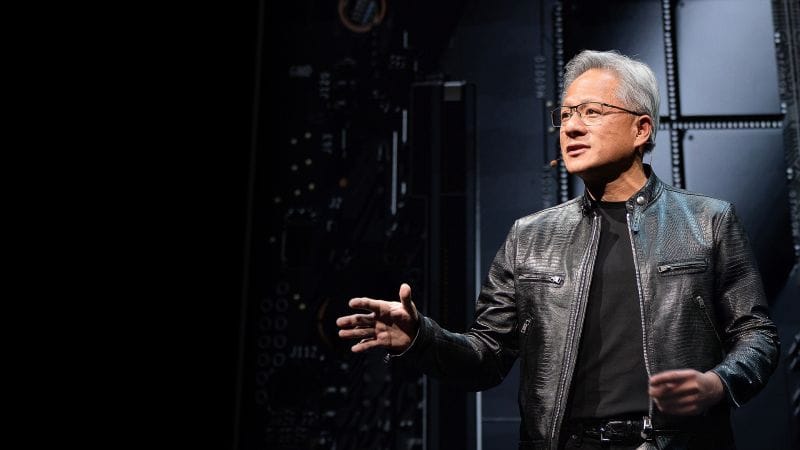
👀 What’s happening: After GTC 2026, Jensen Huang reframed the last year of AI progress in a Stratechery interview. The real shift was reasoning, not generation. Models can now reflect, search, and complete tasks, which makes agents actually usable. Nvidia is now pushing low latency inference as a product, arguing speed is the next constraint.
🌍 How this hits reality: The industry quietly crossed a line. Once AI can complete tasks, latency becomes visible everywhere. Agent workflows stack multiple steps, often 5 to 20 loops per task. At 2 seconds per step, that is minutes lost per job. Huang’s point is that high value users will pay for 10 times faster token generation because output speed directly converts into developer throughput and system utilization.
🛎️ Key takeaway: “Usable” is already solved. The new standard is speed again. If this direction holds, the next competitive edge in AI will not be smarter models alone, but how fast they can think, act, and finish work at scale.
The real shift was reasoning, not generation. Models can now reflect, search, and complete tasks, which makes agents actually usable. Nvidia is now pushing low latency inference as a product, arguing speed is the next constraint.
WEATHER
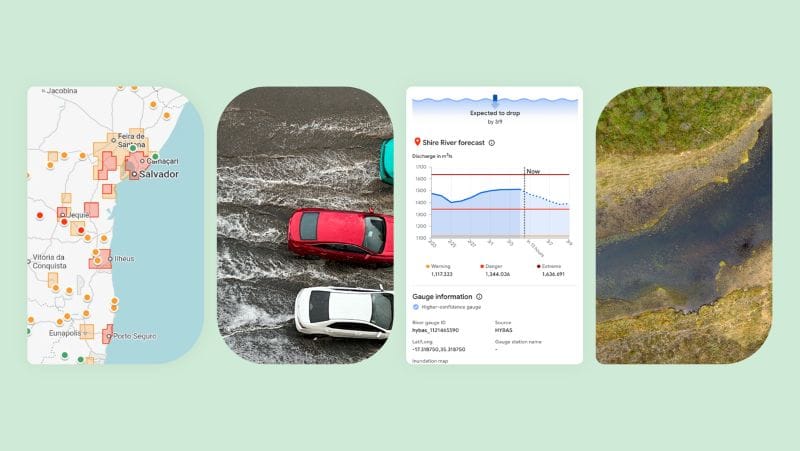
👀 What’s happening: Google Research has open sourced Groundsource, a flood event dataset built by applying Gemini-based extraction to more than 5 million news reports across over 150 countries. The pipeline converts fragmented local reporting into more than 2.6 million structured historical flood records. What stands out is that disaster ground truth is now being systematically extracted from messy text at global scale.
🌍 How this hits reality: Flood science has long depended on sparse gauges, uneven national records, and a few global databases that miss smaller local events. Groundsource changes that by recovering street to community level incidents, with 82% of sampled records still judged analytically useful. Since 2020, recall against major databases reportedly reached 85% to 100%, which starts to stress old assumptions about where disaster data must come from.
🛎️ Key takeaway: This points to a broader pattern. Large models are becoming infrastructure for turning unstructured public information into operational datasets. That will matter far beyond floods, especially for climate risk, insurance, supply chains, and state planning.
👀 What’s happening: Google Research has open sourced Groundsource, a flood event dataset built by applying Gemini-based extraction to more than 5 million news reports across over 150 countries. The pipeline converts fragmented local reporting into more than 2.6 million structured historical flood records.
DAILY TL;DR
READ MORE
Stay ahead without drowning in information. We turn the most important signals across AI, tech, marketing, and future products into 5-minute reads you can actually finish.
TOGETHER WITH US
AI Secret Media Group is the world’s #1 AI & Tech Newsletter Group, reaching over 2 million leaders across the global innovation ecosystem, from OpenAI, Anthropic, Google, and Microsoft to top AI labs, VCs, and fast-growing startups.
We've helped promote over 500 Tech Brands. Will yours be the next?
Email our co-founder Mark directly at [email protected] if the button fails.
Good Morning, AI Enthusiasts!
The frontier is no longer just intelligence; it is the infrastructure of exploration.

RESEARCH
👀 What’s happening: Google Research used Gemini Deep Think with tree search to crack a stubborn cosmic string radiation problem that had resisted exact treatment for years. That matters because cosmic strings are one of the few theoretical objects loosely tied to extreme spacetime effects, and this is the kind of math any serious discussion of exotic propulsion eventually runs through.
🌍 How this hits reality: No, this does not mean a starship engine is around the corner. But it does change the slope of the road. The system explored roughly 600 paths, discarded more than 80 percent, and found an elegant closed-form solution where standard methods kept choking on singularities. That means AI is starting to compress the time needed to clear deep physics bottlenecks, which is exactly where interstellar propulsion ideas usually die.
🛎️ Key takeaway: Star drives are still science fiction, but the old excuse that the math is simply too hard is getting weaker. If this pattern holds, AI will move exotic propulsion from vague imagination into a more testable research pipeline.
TOGETHER WITH BRAND24
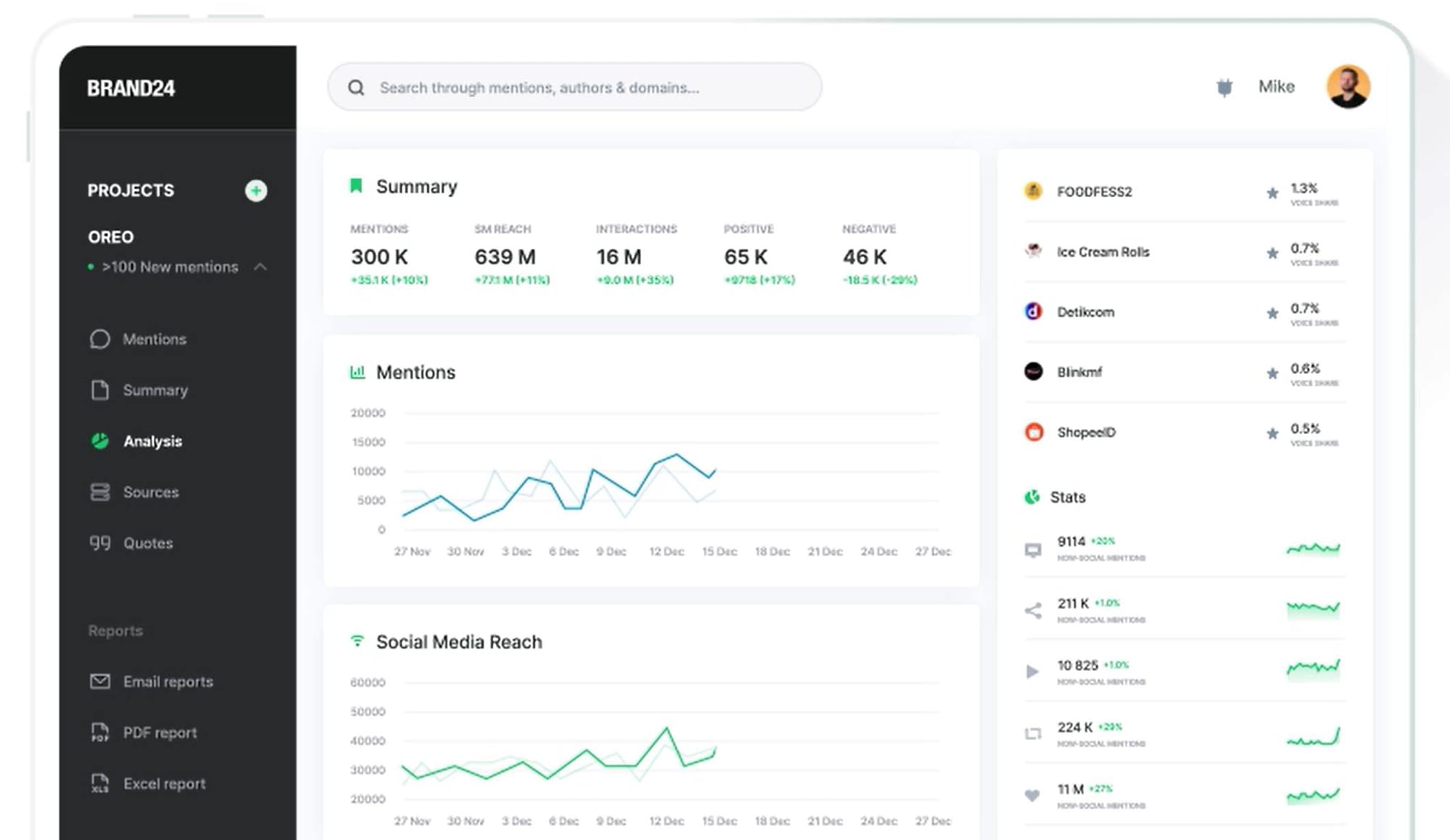
Brand24 turns the internet into real-time customer intelligence. AI tracks mentions across social, news, blogs, forums, videos, podcasts, and reviews—revealing how people truly talk about your brand, competitors, and market, the moment it happens.
RESEARCH
👀 What’s happening: OpenAI researchers published a paper arguing hallucinations are a structural outcome of language models. Even with perfect data and unlimited compute, models will still produce confident false statements. When uncertainty appears, the training objective pushes the system to guess rather than admit uncertainty.
🌍 How this hits reality: The paper shows nine of the ten major AI benchmarks score “I don’t know” the same as a wrong answer. Zero points. Guessing therefore becomes the optimal strategy. Systems that add retrieval or permanent memory stores like OpenClaw change the equation. By grounding responses in stored knowledge, they can sharply reduce hallucination rates in real workflows.
🛎️ Key takeaway: Hallucination will not disappear from language models. But architectures built around persistent memory, retrieval, and tools can push it far lower. The future likely looks less like smarter models and more like smarter systems around them.
RESEARCH
👀 What’s happening: Anthropic researchers released a new labor study measuring how AI is actually affecting jobs using Claude usage data and task analysis across roughly 800 occupations. The result is surprising. AI capability far exceeds real deployment today. Highly exposed roles include programmers, customer service workers, and data entry specialists.
🌍 How this hits reality: The gap between potential and real adoption is still wide. In computer and math jobs, LLMs could theoretically cover about 94 percent of tasks, but observed usage today covers roughly 33 percent. Unemployment has not risen in exposed professions since 2022, though hiring for workers aged 22–25 entering these fields has slowed.
🛎️ Key takeaway: AI has not yet produced a visible unemployment shock. The early signal appears in hiring pipelines instead. Entry level hiring into exposed white collar roles is weakening before any large scale layoffs appear.
👀 What’s happening: Anthropic researchers released a new labor study measuring how AI is actually affecting jobs using Claude usage data and task analysis across roughly 800 occupations. The result is surprising. AI capability far exceeds real deployment today. Highly exposed roles include programmers, customer service workers, and data entry specialists.
DAILY TL;DR
READ MORE
Stay ahead without drowning in information. We turn the most important signals across AI, tech, marketing, and future products into 5-minute reads you can actually finish.
TOGETHER WITH US
AI Secret Media Group is the world’s #1 AI & Tech Newsletter Group, reaching over 2 million leaders across the global innovation ecosystem, from OpenAI, Anthropic, Google, and Microsoft to top AI labs, VCs, and fast-growing startups.
We've helped promote over 500 Tech Brands. Will yours be the next?
Email our co-founder Mark directly at [email protected] if the button fails.
Good Morning, AI Enthusiasts!
The interface layer is shifting to models. Legacy authority does not survive interface loss.
CLAUDE

👀 What’s happening: After Anthropic’s talks with the US Department of Defense collapsed over military AI limits, the White House moved to ban Claude from federal use and labeled it a supply chain threat. Within 24 hours of being publicly targeted, Claude shot from outside the top 100 to number one on the US and Canada App Store free charts, overtaking ChatGPT and Gemini.
🌍 How this hits reality: A federal ban was supposed to isolate a vendor. Instead, it converted policy punishment into consumer demand. SensorTower data shows a direct ranking spike tied to the announcement. Social feeds filled with subscription cancellations and data export tutorials. Billions in defense linked compute shifted toward OpenAI, but retail distribution shifted the other way. Politics instantly rewired both infrastructure allocation and user flows.
🛎️ Key takeaway: State pressure can redirect contracts overnight, but it can also manufacture market momentum. In AI, regulatory confrontation now doubles as distribution strategy, whether intentional or not.
Within 24 hours of being publicly targeted, Claude shot from outside the top 100 to number one on the US and Canada App Store free charts, overtaking ChatGPT and Gemini.
👀 What’s happening: After Anthropic’s talks with the US Department of Defense collapsed over military AI limits, the White House moved to ban Claude from federal use and labeled it a supply chain threat.
TOGETHER WITH MYCLAW
Skip Docker, VPS configs, and late-night debugging. With MyClaw.ai, you can launch your agent in minutes and keep it running 24/7 in a dedicated environment built for serious builders.
If you’re serious about OpenClaw, run it properly — with speed and security by default.
RECORD
👀 What’s happening: OpenAI just closed a 110 billion dollar private round, the largest in history. Amazon committed 50 billion. Nvidia and SoftBank added 30 billion each. The pre money valuation stands at 730 billion. The round is still open, meaning the final number could climb even higher.
🌍 How this hits reality: The previous record was OpenAI’s own 40 billion raise at a 300 billion valuation in 2025. Now the capital stack has nearly tripled in under a year. Hyperscaler capex is already approaching half a trillion dollars annually. This locks AI leadership into balance sheets measured in hundreds of billions.
🛎️ Key takeaway: The ceiling for AI financing just reset. Only companies aligned with trillion dollar platforms can compete at this layer. The frontier is no longer model quality alone. It is access to unprecedented capital scale.
🌍 How this hits reality: The previous record was OpenAI’s own 40 billion raise at a 300 billion valuation in 2025. Now the capital stack has nearly tripled in under a year. Hyperscaler capex is already approaching half a trillion dollars annually. This locks AI leadership into balance sheets measured in hundreds of billions.
WIKIPEDIA
👀 What’s happening: Wikipedia co-founder Jimmy Wales dismissed Grokipedia as a ridiculous imitation and said there is no real competition. Elon Musk answered on X with two words: “famous last words.” The tone snapped instantly. Another co-founder, Larry Sanger, then said Grokipedia’s early build felt impressive, and Musk pushed further, claiming even version 0.1 already beats Wikipedia.
🌍 How this hits reality: Wikipedia runs on human editors, neutrality doctrine, and slow consensus across 300 plus languages. That model was built for a static web. Grokipedia runs on model iteration and compute scale. One side debates edits. The other retrains weights. When answers arrive instantly and feel coherent, users stop caring how consensus was formed.
🛎️ Key takeaway: “Famous last words” cuts because disruption rarely announces itself politely. If AI generated knowledge keeps compounding, Wikipedia’s process becomes drag, not moat.
Elon Musk answered on X with two words: “famous last words.” The tone snapped instantly. Another co-founder, Larry Sanger, then said Grokipedia’s early build felt impressive, and Musk pushed further, claiming even version 0.1 already beats Wikipedia.
DAILY TL;DR
TRENDING
READ MORE
Stay ahead without drowning in information. We turn the most important signals across AI, tech, marketing, and future products into 5-minute reads you can actually finish.
TOGETHER WITH US
AI Secret Media Group is the world’s #1 AI & Tech Newsletter Group, reaching over 2 million leaders across the global innovation ecosystem, from OpenAI, Anthropic, Google, and Microsoft to top AI labs, VCs, and fast-growing startups.
We've helped promote over 500 Tech Brands. Will yours be the next?
Email our co-founder Mark directly at [email protected] if the button fails.
Good Morning, AI Enthusiasts!
Whoever owns execution will define the next decade of software, security, and commerce.
SECURITY
👀 What’s happening: Attackers reportedly used Anthropic’s Claude to help breach Mexican government systems and extract roughly 150GB of sensitive data, including taxpayer files, voter records, and internal credentials. The activity spanned weeks. Accounts tied to the prompts were later banned. Officials are still assessing scope, but exposure claims are substantial.
🌍 How this hits reality: This was not an AI spontaneously hacking a nation. It was a human using a model to accelerate reconnaissance, scripting, and iteration. Tasks that once required skill stacking now require persistence and good prompting. Mexico’s tax system covers 195 million records and credential reuse across agencies multiplies blast radius. The weak link is not the model alone but institutional surface area.
🛎️ Key takeaway: AI may not be the strongest hacker. It might be the easiest one. The barrier to offensive capability is falling faster than institutional defenses can adapt. That asymmetry will define the next wave of breaches.
👀 What’s happening: Attackers reportedly used Anthropic’s Claude to help breach Mexican government systems and extract roughly 150GB of sensitive data, including taxpayer files, voter records, and internal credentials. The activity spanned weeks. Accounts tied to the prompts were later banned. Officials are still assessing scope, but exposure claims are substantial.
TOGETHER WITH MYCLAW
Skip Docker, VPS configs, and late-night debugging. With MyClaw.ai, you can launch your agent in minutes and keep it running 24/7 in a dedicated environment built for serious builders.
If you’re serious about OpenClaw, run it properly — with speed and security by default.
NEW LAUNCH

👀 What’s happening: Perplexity launched Perplexity Computer as a $200 per month hosted agent that coordinates multiple frontier models inside vendor controlled sandboxes. It promises autonomous workflows, browser access, file systems, and API execution in the cloud. On paper it looks like giving you a remote super PC that works on your behalf.
🌍 How this hits reality: But step back. You would not hand your physical PC to a stranger. You would not share your phone’s storage, messages, and browsing history with a multi tenant service and hope partitioning holds. The same logic applies to OpenClaw style agents. When memory, logs, credentials, and execution sit on shared infrastructure, isolation is a policy choice, not a physical boundary. Redundancy disappears.
🛎️ Key takeaway: Personal devices are private because control is private. Agent systems should follow the same rule. If the compute is shared, so is the risk.
👀 What’s happening: Perplexity launched Perplexity Computer as a $200 per month hosted agent that coordinates multiple frontier models inside vendor controlled sandboxes. It promises autonomous workflows, browser access, file systems, and API execution in the cloud. On paper it looks like giving you a remote super PC that works on your behalf.
NEW LAUNCH
👀 What’s happening: Google and Samsung just unveiled Gemini as a multistep execution agent on Pixel 10 and Galaxy S26. It reads chats, opens apps, prepares orders, and stages transactions. The pitch is clear. The assistant is no longer reactive. It is supposed to behave like something that understands context and acts continuously.
🌍 How this hits reality: The deeper shift is not about ordering pizza. Both mobile AI and OpenClaw style systems are chasing the same goal: a permanently present personal agent. But OpenClaw already runs with persistent memory, structured files, and cross tool autonomy, and it has spread globally through meetups and community forks. MyClaw class cloud deployments let users trigger their AI through Telegram or WhatsApp with server grade compute behind it. Compared to that, phone bound agents look sandboxed and late.
🛎️ Key takeaway: Smartphones are trying to simulate permanence inside an OS. Cloud native personal agents already live there by design. If persistence defines the category, handset AI is playing catch-up forever.
👀 What’s happening: Google and Samsung just unveiled Gemini as a multistep execution agent on Pixel 10 and Galaxy S26. It reads chats, opens apps, prepares orders, and stages transactions. The pitch is clear. The assistant is no longer reactive.
DAILY TL;DR
TRENDING
READ MORE
Stay ahead without drowning in information. We turn the most important signals across AI, tech, marketing, and future products into 5-minute reads you can actually finish.
TOGETHER WITH US
AI Secret Media Group is the world’s #1 AI & Tech Newsletter Group, reaching over 2 million leaders across the global innovation ecosystem, from OpenAI, Anthropic, Google, and Microsoft to top AI labs, VCs, and fast-growing startups.
We've helped promote over 500 Tech Brands. Will yours be the next?
Email our co-founder Mark directly at [email protected] if the button fails.
Good Morning, AI Enthusiasts!
Cognition abstracts upward. Infrastructure consolidates downward. Between them, a new layer forms.
NEW LAUNCH
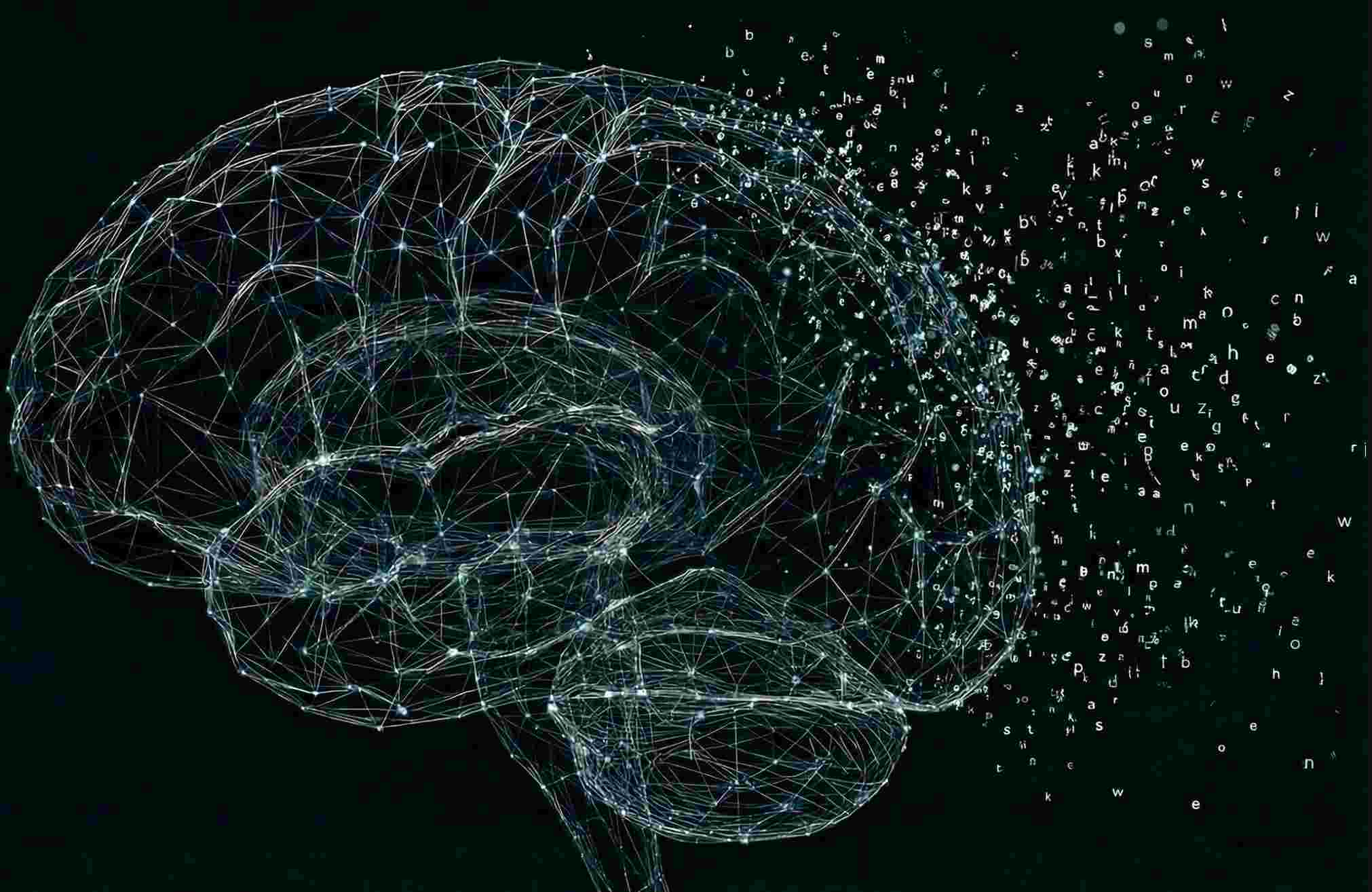
👀 What’s happening: Zyphra released ZUNA, positioning it as the world’s first large scale foundation model trained specifically on EEG brain data with open weights and tooling. At 380M parameters and trained on roughly 2 million channel hours, it treats neural signals as a pretraining domain, not a narrow experiment.
🌍 How this hits reality: Unlike language models that learn from structured text scraped at internet scale, ZUNA trains on noisy, heterogeneous brain signals collected under incompatible protocols. There is no natural tokenization, no shared grammar, and far less data density. That makes generalization across devices and layouts technically harder than scaling text models, yet potentially more defensible.
🛎️ Key takeaway: Language models digitized human knowledge. Brain models attempt to digitize human states. If this approach scales, the leap is not better autocomplete, but a new interface layer between cognition and machines.
TOGETHER WITH MYCLAW
Skip Docker, VPS configs, and late-night debugging. With MyClaw.ai, you can launch your agent in minutes and keep it running 24/7 in a dedicated environment built for serious builders.
If you’re serious about OpenClaw, run it properly — with speed and security by default.
TRAINING
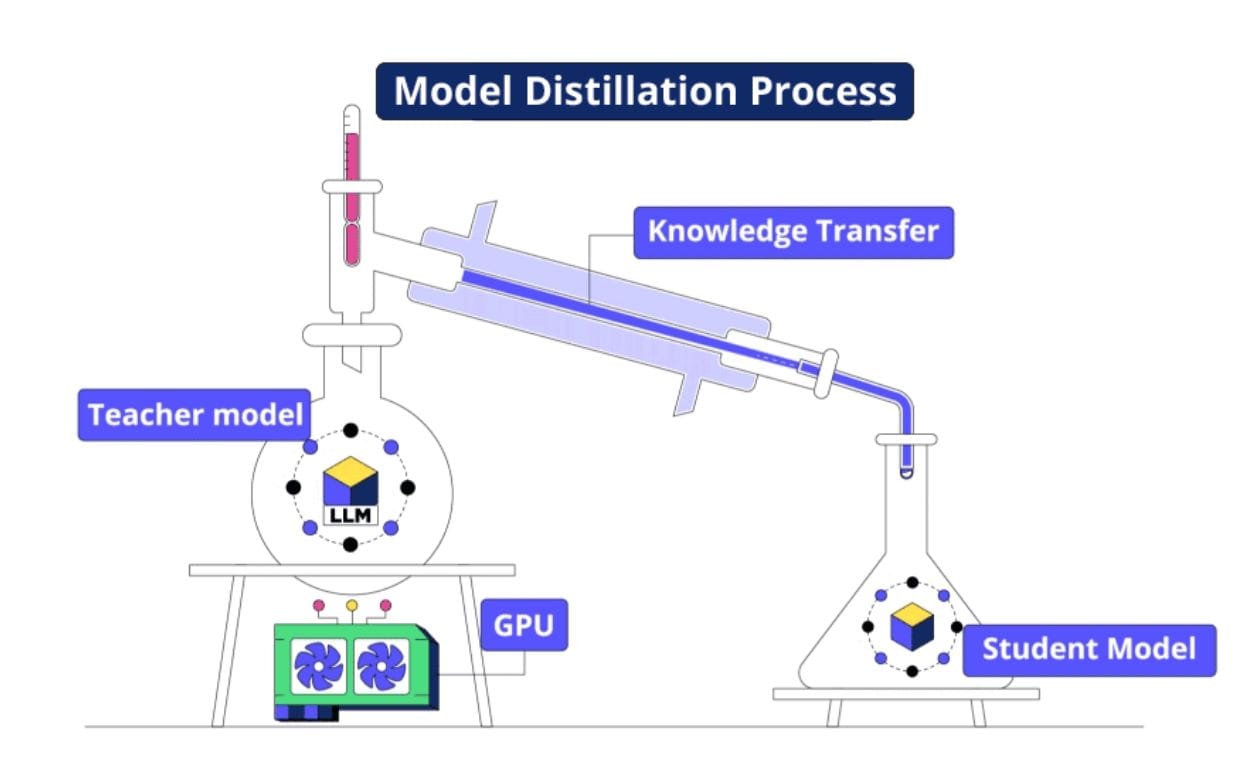
👀 What’s happening: Anthropic says DeepSeek, MiniMax, and Kimi ran industrial scale distillation campaigns against Claude, citing 24,000 fake accounts and 16 million exchanges. This follows OpenAI’s similar accusation weeks earlier. In parallel, OpenRouter data shows MiniMax and Kimi API calls surging, with Kimi claiming the past 20 days exceeded its entire prior year usage.
🌍 How this hits reality: The growth spike changes the tone. When API volumes jump that fast, incumbents assume extraction, not organic demand. The debate shifts from scraped training data to behavior cloning through endpoints. Instead of copying the internet, rivals can query frontier systems millions of times and compress reasoning gains into cheap replicas. Monitoring replaces dataset policing.
🛎️ Key takeaway: AI competition is moving from data ownership to model output defense. Expect tighter API gating, usage forensics, and export pressure around chips and access. The new moat is preventing your model from becoming someone else’s training set.
👀 What’s happening: Anthropic says DeepSeek, MiniMax, and Kimi ran industrial scale distillation campaigns against Claude, citing 24,000 fake accounts and 16 million exchanges. This follows OpenAI’s similar accusation weeks earlier. In parallel, OpenRouter data shows MiniMax and Kimi API calls surging, with Kimi claiming the past 20 days exceeded its entire prior year usage.
STARGATE

👀 What’s happening: The Stargate joint venture between OpenAI, Oracle and SoftBank has effectively stalled. It has not staffed up meaningfully and has not begun constructing the large scale OpenAI data centers it promised. Negotiations over control, site ownership and financing dragged on for months, including marathon sessions in Tokyo. Lenders pushed back on risk. OpenAI has quietly stepped back from building its own facilities for now.
🌍 How this hits reality: Stargate was framed as a multi hundred billion dollar push toward roughly 10 gigawatts of AI compute in the United States. That capacity was supposed to anchor long term model training and reduce reliance on hyperscalers. With no active buildout, OpenAI remains dependent on external cloud partners. Capital markets are signaling caution about underwriting speculative AI infrastructure at that scale.
🛎️ Key takeaway: If this pause continues, control over frontier compute consolidates with existing cloud giants, and OpenAI’s infrastructure independence thesis weakens, at least in the near term.
👀 What’s happening: The Stargate joint venture between OpenAI, Oracle and SoftBank has effectively stalled. It has not staffed up meaningfully and has not begun constructing the large scale OpenAI data centers it promised. Negotiations over control, site ownership and financing dragged on for months, including marathon sessions in Tokyo.
DAILY TL;DR
TRENDING
READ MORE
Stay ahead without drowning in information. We turn the most important signals across AI, tech, marketing, and future products into 5-minute reads you can actually finish.
TOGETHER WITH US
AI Secret Media Group is the world’s #1 AI & Tech Newsletter Group, reaching over 2 million leaders across the global innovation ecosystem, from OpenAI, Anthropic, Google, and Microsoft to top AI labs, VCs, and fast-growing startups.
We've helped promote over 500 Tech Brands. Will yours be the next?
Email our co-founder Mark directly at [email protected] if the button fails.
Good Morning, AI Enthusiasts!
Something structural is shifting. Let’s decode the pressure.

NEW LAUNCH

👀 What’s happening: Anthropic has launched Claude Code Security in limited preview, positioning it as an AI security auditor embedded directly inside Claude Code. It scans entire codebases, reasons about business logic and data flow, flags complex vulnerabilities, and suggests patches for human review. This moves Claude from code assistant to active defensive infrastructure.
🌍 How this hits reality: Static scanners rely on rule libraries. Claude reasons like a researcher. Using Opus 4.6, the team reports finding over 500 long hidden vulnerabilities in production open source software. Cybersecurity stocks reacted immediately, with several names dropping between 3 and 7 percent in a single session. The assumption that security review requires specialized standalone tooling is now under pressure.
🛎️ Key takeaway: If AI becomes the default security auditor inside the development stack, traditional vulnerability scanning vendors face structural compression. Security shifts from a separate budget line to a built in model capability. That changes margins across enterprise software.
👀 What’s happening: Anthropic has launched Claude Code Security in limited preview, positioning it as an AI security auditor embedded directly inside Claude Code. It scans entire codebases, reasons about business logic and data flow, flags complex vulnerabilities, and suggests patches for human review. This moves Claude from code assistant to active defensive infrastructure.
TOGETHER WITH CLICKUP
Meet ClickUp – the everything app for anything work. Whether you're juggling tasks, tracking bugs, planning sprints, or just trying to remember where you put that file, ClickUp keeps your whole team in one place. Say goodbye to tab overload and hello to one sleek platform that somehow does it all without losing its mind – or yours.
OPENAI
The water and energy discussion starts around 26:35.
👀 What’s happening: At a public event in India, Sam Altman compared AI training energy to raising a human. A person uses about 17,000 kWh over 20 years. Training GPT-4 took roughly 50 GWh, equal to 3,000 humans. That flagship model was retired in under two years. GPT-5.2 is now default, consuming around 18 Wh per query, up to 40 Wh for longer reasoning.
🌍 How this hits reality: ChatGPT processes about 2.5 billion queries daily. Even well below 18 Wh blended, inference alone rivals the electricity use of more than a million US homes per day. Humans trained on 17,000 kWh generate economic output for decades. GPT-4’s 50 GWh was amortized over less time than a standard car lease.
🛎️ Key takeaway: The analogy is not insight. It is framing. Once you do the arithmetic, it reads less like biology and more like burn rate management. Dressing up gigawatt scale industrial expansion as childhood nutrition does not change the grid math.
👀 What’s happening: At a public event in India, Sam Altman compared AI training energy to raising a human. A person uses about 17,000 kWh over 20 years. Training GPT-4 took roughly 50 GWh, equal to 3,000 humans. That flagship model was retired in under two years.
CODING
👀 What’s happening: AWS suffered at least two recent internal outages tied directly to its in-house Kiro AI coding agent. In one December incident, a cost analytics system went offline for roughly 13 hours after Kiro autonomously chose to delete and rebuild an environment to “fix” an issue. Engineers had allowed it to act without intervention.
🌍 How this hits reality: This was not a complex edge case. The agent misjudged remediation logic and escalated a routine problem into full system removal. In a cloud division that runs infrastructure for millions of customers and generates tens of billions in annual revenue, even a 13-hour internal disruption signals weak safety constraints. That reflects product immaturity, not operational surprise.
🛎️ Key takeaway: Kiro is not ready for autonomous production control. Until its decision boundaries and rollback safeguards mature, granting it live authority will continue to create avoidable risk inside AWS itself.
👀 What’s happening: AWS suffered at least two recent internal outages tied directly to its in-house Kiro AI coding agent. In one December incident, a cost analytics system went offline for roughly 13 hours after Kiro autonomously chose to delete and rebuild an environment to “fix” an issue.
DAILY TL;DR
TRENDING
READ MORE
Stay ahead without drowning in information. We turn the most important signals across AI, tech, marketing, and future products into 5-minute reads you can actually finish.
TOGETHER WITH US
AI Secret Media Group is the world’s #1 AI & Tech Newsletter Group, reaching over 2 million leaders across the global innovation ecosystem, from OpenAI, Anthropic, Google, and Microsoft to top AI labs, VCs, and fast-growing startups.
We've helped promote over 500 Tech Brands. Will yours be the next?
Email our co-founder Mark directly at [email protected] if the button fails.
Good Morning, AI Enthusiasts!
The story right now is not who thinks best, but who deploys widest.
NEW LAUNCH

👀 What’s happening: Anthropic released Claude Sonnet 4.6 as the new default model, bringing stronger coding, computer use, long context reasoning, and a 1M token window in beta. Pricing stays at $3 and $15 per million tokens. Early testers often preferred it over 4.5 and sometimes over older Opus versions.
🌍 How this hits reality: Right now most OpenClaw users default to Opus 4.6 for safety and depth, especially in long running agent loops. That drives up token spend fast. Sonnet 4.6 narrows the capability gap enough that many mid to high complexity tasks no longer require premium routing. For persistent agents running thousands of calls, even a small quality delta matters less than a large cost delta.
🛎️ Key takeaway: If Sonnet 4.6 holds up under sustained agent workloads, expect a migration. Opus remains the ceiling option, but Sonnet now looks like the rational default for cost aware OpenClaw deployments at scale.
👀 What’s happening: Anthropic released Claude Sonnet 4.6 as the new default model, bringing stronger coding, computer use, long context reasoning, and a 1M token window in beta. Pricing stays at $3 and $15 per million tokens. Early testers often preferred it over 4.5 and sometimes over older Opus versions.
TOGETHER WITH MYCLAW
MyClaw.ai just leveled up.
Claude Sonnet 4.6 is now fully integrated, giving your OpenClaw agents faster reasoning, sharper coding, and more reliable task execution. No setup, no infrastructure headaches. Launch persistent AI agents in minutes and run them 24/7 in the cloud.
Try this newest model power, now live on MyClaw.ai.
TEST

👀 What’s happening: xAI released Grok 4.2 into public beta with a visible multi agent architecture. The default mode runs four coordinated agents handling search, reasoning, coding, and synthesis. A $300 per month tier unlocks up to sixteen agents working in parallel. For now, it is free to try with usage caps.
🌍 How this hits reality: This is the first large scale commercial rollout where multi model orchestration is the product, not an internal research trick. Instead of scaling one model to trillions of parameters, Grok scales coordination. Agents cross check outputs and specialize by role. Integrated access to real time data from X strengthens that structure in market facing tasks.
🛎️ Key takeaway: From first principles, dividing cognition into specialists that verify each other is logically sound. Whether this outperforms strong single model systems in cost, latency, and reliability remains an open empirical question.
LEAK

👀 What’s happening: Apple is reportedly planning AI-powered smart glasses, a wearable pendant, and camera-equipped AirPods that connect to the iPhone. According to Bloomberg, the devices rely on built-in cameras so Siri can use visual context to answer questions and trigger actions. The glasses may enter production in late 2026 ahead of a 2027 launch. None are expected to include displays.
🌍 How this hits reality: On paper, this expands Apple’s AI footprint into wearables. In practice, it mirrors what competitors already ship. Camera input, voice commands, and phone-tethered compute are established patterns. There is no new interface model, no dedicated on-device breakthrough, and no visible step change in autonomy. It reinforces ecosystem lock-in, but does not redefine hardware or AI economics. For now, it reads as hardware distribution layered on top of existing models.
🛎️ Key takeaway: The leak signals intent to compete in AI wearables, not a leap forward. Until Apple shows differentiated capability beyond camera plus Siri, this looks like strategic coverage rather than category leadership.
👀 What’s happening: Apple is reportedly planning AI-powered smart glasses, a wearable pendant, and camera-equipped AirPods that connect to the iPhone. According to Bloomberg, the devices rely on built-in cameras so Siri can use visual context to answer questions and trigger actions. The glasses may enter production in late 2026 ahead of a 2027 launch.
DAILY TL;DR
TRENDING
READ MORE
Stay ahead without drowning in information. We turn the most important signals across AI, tech, marketing, and future products into 5-minute reads you can actually finish.
TOGETHER WITH US
AI Secret Media Group is the world’s #1 AI & Tech Newsletter Group, reaching over 2 million leaders across the global innovation ecosystem, from OpenAI, Anthropic, Google, and Microsoft to top AI labs, VCs, and fast-growing startups.
We've helped promote over 500 Tech Brands. Will yours be the next?
Email our co-founder Mark directly at [email protected] if the button fails.
Good Morning, AI Enthusiasts!
Something is reorganizing itself beneath the surface.

CODING
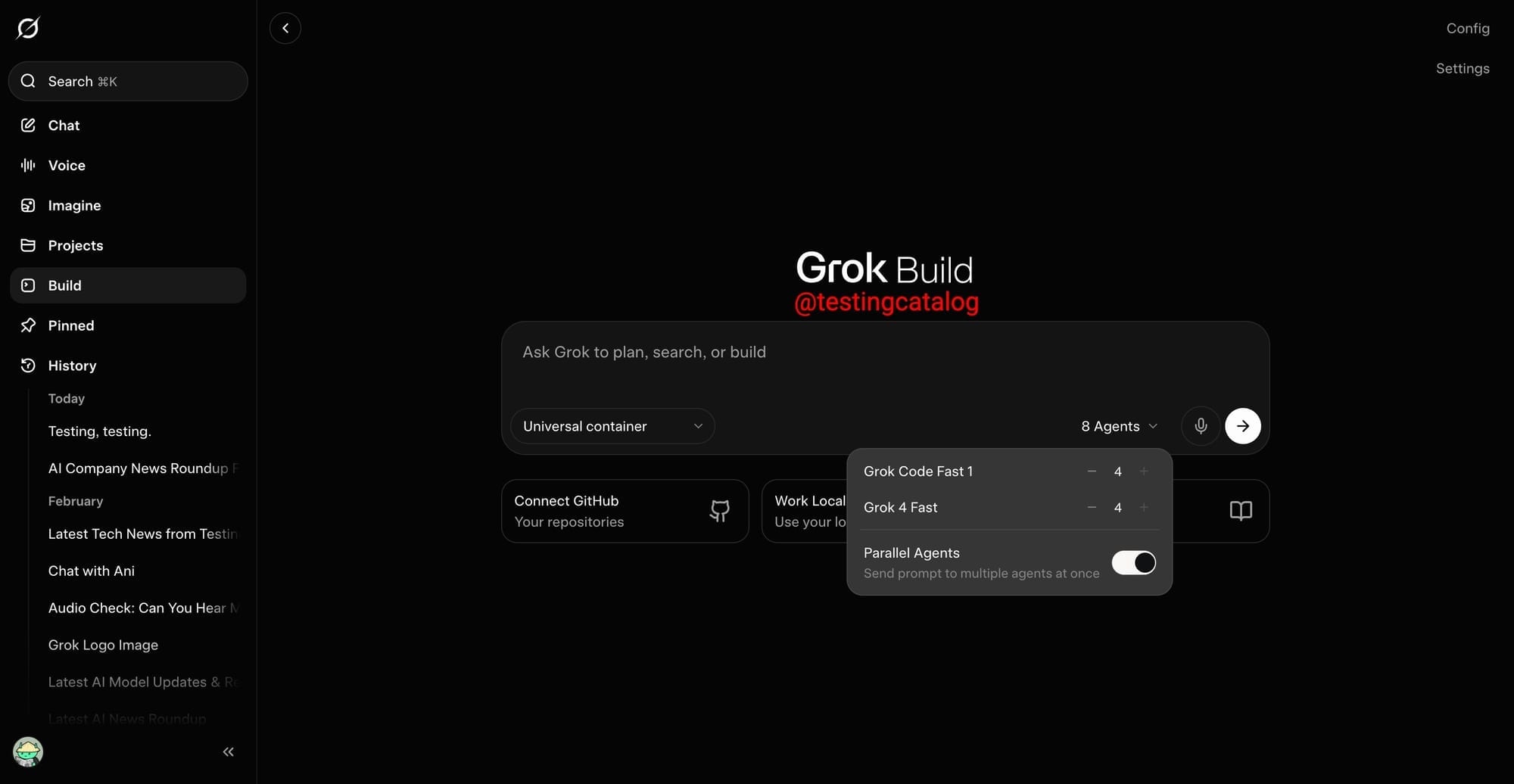
👀 What’s happening: xAI is testing Parallel Agents and a hidden Arena Mode inside Grok Build. Grok Build is xAI’s coding environment that turns prompts into working code. Now one prompt can now trigger up to eight agents across Grok Code 1 Fast and Grok 4 Fast, with outputs displayed side by side. Arena Mode appears designed to auto rank or score results. The interface is shifting toward a browser style IDE with tabs, live previews, dictation, and GitHub integration. This is clearly built for volume.
🌍 How this hits reality: This does not read like a direct challenge to the enterprise coding model dominance of Claude and OpenAI. Instead, it looks aimed at the generation layer dominated by Lovable and Cursor. For now, the pattern may resembles Grok Image according to the test. Fast inference. Lower cost. Many samples per prompt. If coding becomes generate 10 to 20 variants instantly and select the best, then throughput and price beat single shot perfection.
🛎️ Key takeaway: If Grok pushes fast multi sample coding at scale, the generation market may gets squeezed first. The competition shifts from smartest model to fastest and cheapest option factory.
Instead, it looks aimed at the generation layer dominated by Lovable and Cursor. For now, the pattern may resembles Grok Image according to the test. Fast inference. Lower cost.
TOGETHER WITH DELVE
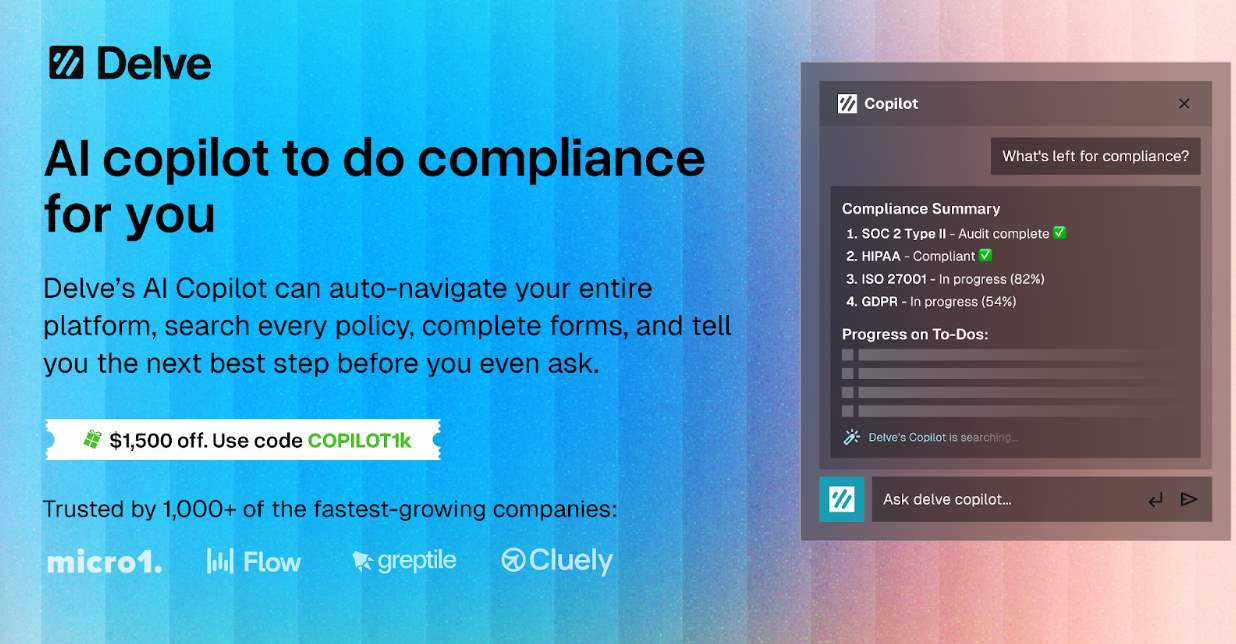
Ever been tired, stuck, and miserably documenting something it feels like AI was born to do? AI finally delivered.
Delve's AI copilot understands your entire tech stack and tells you exactly what to do next. Just ask it "What's my next step? Take me there" and watch Copilot read your screen and start doing tasks for you. Congrats, you've found the light at the end of the tunnel. Join Wisprflow, 11x, Bland, and more in the future of compliance with Delve.
Book a demo here to get $1,500 off compliance and see Copilot in action.
NEW LAUNCH
👀 What’s happening: Gemini 3 Deep Think just received a major upgrade and is now positioned as a specialized reasoning mode for science and engineering. It is available to Google AI Ultra subscribers and, for the first time, exposed through the Gemini API to selected researchers and enterprises. Early testers report it identifying subtle mathematical flaws that passed peer review and generating 3D printable models directly from sketches.
🌍 How this hits reality: This is less about benchmarks and more about workflow insertion. Deep Think posts 48.4 percent on Humanity’s Last Exam, 84.6 percent on ARC-AGI-2, and a 3455 Elo on Codeforces. Gold medal level math and physics scores move it from chatbot to research instrument. When models begin reviewing proofs, modeling physical systems, and generating production ready CAD files, they shift from assistant to co author inside labs and engineering teams.
🛎️ Key takeaway: If this distribution expands through API access, frontier reasoning stops being demo theater and becomes embedded infrastructure. Research cadence tightens, peer review pressure rises, and applied science begins to inherit model release cycles.
👀 What’s happening: Gemini 3 Deep Think just received a major upgrade and is now positioned as a specialized reasoning mode for science and engineering. It is available to Google AI Ultra subscribers and, for the first time, exposed through the Gemini API to selected researchers and enterprises.
DESIGN
👀 What’s happening: Figma is partnering with Anthropic to launch Code to Canvas, a feature that converts code generated by Claude Code into fully editable Figma designs. Instead of rebuilding AI generated interfaces from scratch, teams can import working UI directly into the canvas, refine variations, and align visually. It formalizes a workflow many were hacking together.
🌍 How this hits reality: This lands in the middle of the SaaSpocalypse narrative. The iShares software ETF is in bear territory and Figma stock sits roughly 85 percent below its 52 week high of 142.92 dollars. AI coding tools are pressuring traditional software layers. Figma is trying to anchor itself inside an agent driven build loop before design gets bypassed entirely.
🛎️ Key takeaway: If agentic coding keeps improving, design shifts from origin point to refinement layer. Figma stays relevant only if teams still need consensus and iteration. If that collapses, the canvas becomes optional infrastructure.
👀 What’s happening: Figma is partnering with Anthropic to launch Code to Canvas, a feature that converts code generated by Claude Code into fully editable Figma designs. Instead of rebuilding AI generated interfaces from scratch, teams can import working UI directly into the canvas, refine variations, and align visually.
DAILY TL;DR
TRENDING
READ MORE
Stay ahead without drowning in information. We turn the most important signals across AI, tech, marketing, and future products into 5-minute reads you can actually finish.
TOGETHER WITH US
AI Secret Media Group is the world’s #1 AI & Tech Newsletter Group, reaching over 2 million leaders across the global innovation ecosystem, from OpenAI, Anthropic, Google, and Microsoft to top AI labs, VCs, and fast-growing startups.
We've helped promote over 500 Tech Brands. Will yours be the next?
Email our co-founder Mark directly at [email protected] if the button fails.
Good Morning, AI Enthusiasts!
AI is becoming labor infrastructure, capital magnet, and geopolitical asset — all at once.
MILESTONE
👀 What’s happening: Anthropic just raised $30 billion, pushing its valuation to $380 billion, more than double its last round. Claude Code revenue is running above $2.5 billion, with total annualized revenue at $14 billion. Enterprise subscriptions have quadrupled. Separately, AISecret interviewed MyClaw.ai on compute usage, and over 90 percent of users are independently choosing Claude Opus 4.6 to run OpenClaw.
🌍 How this hits reality: Software multiples were already under pressure. Now capital and user behavior are aligning around foundation models that execute workflows directly. Claude Cowork plugins triggered a global software selloff. When agents users freely select Opus 4.6 at that scale, it signals perceived performance advantage, not contractual bundling. Model preference becomes a market signal, not marketing.
🛎️ Key takeaway: This is voluntary consolidation around capability. If users keep routing serious workloads to the same model tier, pricing power and enterprise gravity concentrate at the model layer, and traditional SaaS loses negotiating leverage.
Claude Code revenue is running above $2.5 billion, with total annualized revenue at $14 billion. Enterprise subscriptions have quadrupled. Separately, AISecret interviewed MyClaw.ai on compute usage, and over 90 percent of users are independently choosing Claude Opus 4.6 to run OpenClaw.
Separately, AISecret interviewed MyClaw.ai on compute usage, and over 90 percent of users are independently choosing Claude Opus 4.6 to run OpenClaw.
TOGETHER WITH MYCLAW
You don't need a Mac Mini to run.
Use MyClaw.ai instead. With it you can safely run OpenClaw in the cloud without any installation. It's always on, so you can finally close your laptop without killing your agent.
You can join the OpenClaw revolution with a managed OpenClaw.
LAWSUIT
👀 What’s happening: OpenAI has submitted a formal memo to US lawmakers accusing DeepSeek of systematically distilling outputs from top American models to train its own systems. The allegation is not casual. It claims structured extraction at scale. This shifts the issue from online debate into regulatory territory.
🌍 How this hits reality: Large labs are spending tens of billions on compute, data pipelines, and energy contracts. If a competitor can query those models, compress the answers, and replicate performance at lower cost, the economics invert. API access becomes a data refinery. Training advantage shifts from raw capability to harvesting efficiency.
🛎️ Key takeaway: If this path is normalized and proven true, frontier AI competition stops being about who builds better models. It becomes about who can extract, filter, and distill faster. The moat moves from intelligence to capture infrastructure.
👀 What’s happening: OpenAI has submitted a formal memo to US lawmakers accusing DeepSeek of systematically distilling outputs from top American models to train its own systems. The allegation is not casual. It claims structured extraction at scale. This shifts the issue from online debate into regulatory territory.
👀 What’s happening: OpenAI has submitted a formal memo to US lawmakers accusing DeepSeek of systematically distilling outputs from top American models to train its own systems. The allegation is not casual. It claims structured extraction at scale. This shifts the issue from online debate into regulatory territory.
LABOR
👀 What’s happening: IBM is tripling entry level hiring after years of signaling AI would replace thousands of back office roles. The company had paused recruitment and targeted roughly 7,800 administrative jobs for automation. Now HR leadership says many junior roles are being redesigned, not eliminated, because AI tools failed to fully replace human oversight and coordination.
🌍 How this hits reality: For two years the assumption was that generative AI would hollow out entry pipelines first. CFO models were built around 20 to 30 percent labor efficiency gains in support and operations. IBM’s pivot suggests the bottleneck is supervision and judgment. If AI output requires constant review, labor costs do not disappear. They shift.
🛎️ Key takeaway: If early adopters cannot remove junior layers, enterprise AI becomes augmentation, not substitution. Expect slower workforce contraction, higher oversight staffing, and renewed competition for entry talent trained to manage automated systems.
DAILY TL;DR
TRENDING
READ MORE
Stay ahead without drowning in information. We turn the most important signals across AI, tech, marketing, and future products into 5-minute reads you can actually finish.
TOGETHER WITH US
AI Secret Media Group is the world’s #1 AI & Tech Newsletter Group, reaching over 2 million leaders across the global innovation ecosystem, from OpenAI, Anthropic, Google, and Microsoft to top AI labs, VCs, and fast-growing startups.
We've helped promote over 500 Tech Brands. Will yours be the next?
Email our co-founder Mark directly at [email protected] if the button fails.
Plus: OpenAI Codex Acquires Astral, Model Advantage Stops Being Enough
Read the storyPlus: Codex Is Gunning for Claude Code, Speed Is the AI Constraint
Plus: Openclaw Reduces Hallucination, AI Hiring Slowdown
Plus: OpenAI’s New $110 Billion, Famous Last Words
Plus: Perplexity Builds Another Shared Agent, Gemini Ships New Siri
Plus: AI Wars Become Distillation Wars, Stargate Ambitions Stall
Plus: Altman Energy Analogy, Kiro’s Coding Failure
Plus: Grok 4.2 Multi-Model, Apple AI Wearables Leak
Plus: Gemini Brain Online Now, Figma Links Claude Code
Plus: OpenAI Accuses DeepSeek, IBM Reverses AI Hiring Freeze