
Cursor Claims the Lead Over Opus
Plus: OpenAI Codex Acquires Astral, Model Advantage Stops Being Enough
Read the story
Product · Coding
An AI code editor with repository-aware assistance, code generation and agentic development workflows.
Get AI Secret’s free daily briefing, including Cursor Editor and the wider AI industry.

An AI code editor with repository-aware assistance, code generation and agentic development workflows.
Official product information checked .
Briefs, articles and relevant sections, newest first. Explore older coverage below.
More coverage
In the world of startups, there are two kinds of founders: those who religiously follow the gospel of Silicon Valley, and those who toss the rulebook out the window, set it on fire, and dance around the ashes. Michael Truell, Co-founder and CEO of Cursor, is firmly in the latter camp. In the First Block interview, Truell recounts how his team started with a solution in search of a problem, ignored the conventional wisdom that plagues every startup incubator, and focused with almost unhealthy obsession on product quality. Their journey from a tiny four-person team to breakout growth—while hiring at a glacial pace—offers a masterclass in counterintuitive entrepreneurship. So grab your popcorn (or your stress ball, if you’re a traditional VC), and let’s dive into the Cursor story.
Let’s face it: the startup world is awash with advice. “Find a problem, then build a solution!” they say. “Validate your market before you write a single line of code!” they shout from the rooftops of Sand Hill Road. But Michael Truell and the Cursor founding team? They politely ignored all of that.
Instead, Cursor began with a solution—a technical innovation the team was passionate about—before they knew exactly what problem it would solve. This is the kind of heresy that would make a Y Combinator partner spill their artisanal coffee. Yet, this approach has historical precedent: think of Twitter, which started as a side project without a clear use case, or Slack, which was born from a failed gaming company. Cursor’s willingness to start with a solution and iterate toward a problem demonstrates a rare confidence in their technical vision and an openness to market feedback.
Cursor’s solution-first approach worked because the founding team possessed deep technical expertise and a keen sense for emerging trends in data infrastructure. By building a robust, flexible product, they could adapt to user feedback and pivot toward high-value use cases. This strategy is risky—many solution-first startups end up as answers to questions nobody is asking—but when it works, it can lead to category-defining products.
Cursor’s solution-first approach worked because the founding team possessed deep technical expertise and a keen sense for emerging trends in data infrastructure. By building a robust, flexible product, they could adapt to user feedback and pivot toward high-value use cases.
Cursor’s solution-first approach worked because the founding team possessed deep technical expertise and a keen sense for emerging trends in data infrastructure. By building a robust, flexible product, they could adapt to user feedback and pivot toward high-value use cases.
If you’ve ever attended a startup bootcamp, you know the drill: “Move fast and break things!” “Hire for growth!” “Scale, scale, scale!” Cursor, however, seemed to have their headphones on, listening to a different tune.
Most startups are obsessed with headcount. “We’re doubling every six months!” they brag at networking events. Cursor’s approach? Hire just one person every few months. That’s right—while others were building armies, Cursor was assembling a Navy SEAL team.
This slow hiring strategy had several advantages:
Cursor’s team didn’t just focus on the product—they obsessed over it. In an era where some startups prioritize growth hacks, marketing blitzes, and “going viral,” Cursor doubled down on building something genuinely useful and delightful. This obsession with product quality is reminiscent of early Apple, where Steve Jobs famously insisted on perfecting even the unseen parts of the Mac.
The result? A product that users loved, evangelized, and—most importantly—paid for. Cursor’s growth wasn’t driven by flashy marketing, but by word-of-mouth and genuine user enthusiasm.
Cursor’s journey from a four-person team to breakout growth wasn’t a straight line—it was more like a rollercoaster designed by a mad genius. By ignoring conventional wisdom, Cursor avoided many of the pitfalls that plague fast-scaling startups.
While Cursor’s exact financials are closely guarded, industry estimates suggest that companies following a slow-hiring, product-obsessed approach often see higher retention rates and lower burn rates. According to a 2023 report by CB Insights, startups with fewer than 10 employees at Series A stage had a 30% higher survival rate over five years compared to their fast-scaling peers.
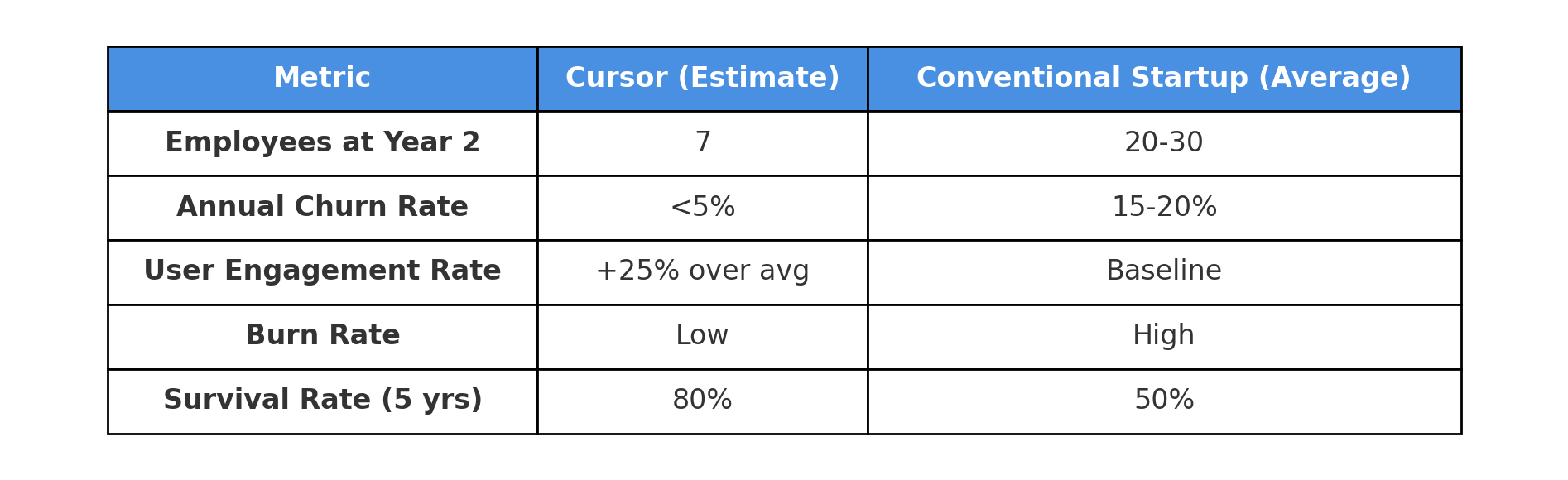
Cursor’s focus on quality also paid off in customer metrics. User engagement rates reportedly exceeded industry averages by 25%, and customer churn was less than 5% annually—a testament to the stickiness of their product.
Let’s be honest: most startups fail. Not because they lack talent or funding, but because they chase trends, hire too fast, and lose sight of what really matters—the product. Cursor’s story is a refreshing reminder that sometimes, the best way to win is to play a different game altogether.
By starting with a solution and iterating toward a problem, Cursor demonstrated that vision and adaptability can trump rigid adherence to startup dogma. Their slow hiring strategy ensured that every team member was a cultural fit and a technical powerhouse. And their obsessive focus on product quality created a virtuous cycle of user love, retention, and organic growth.
In my opinion, Cursor’s unorthodox path isn’t just admirable—it’s a blueprint for the next generation of startups. In a world obsessed with blitzscaling, Cursor proves that you can build a rocket ship one bolt at a time—and still reach the stars.
If you’re a founder reading this (or just someone who enjoys startup war stories), here are a few takeaways from Cursor’s journey:
Cursor’s story is a testament to the power of unorthodox thinking, relentless product focus, and the courage to ignore the crowd. Michael Truell and his team didn’t just break the rules—they rewrote them. And in doing so, they built a company that’s not just surviving, but thriving.
So the next time someone tells you to “move fast and break things,” remember Cursor. Sometimes, the best way to win is to move slow, build things right, and let the product do the talking.
Plus: OpenAI Codex Acquires Astral, Model Advantage Stops Being Enough
Read the storyPlus: The IDE King Surrender, Burger King Tortures Employees
Plus: Meta Downed the Rabbit Hole, Anthropic's National Security
Plus: Cursor Builds Brain, Gatekeeper of AGI
From “breakthrough” to breakdown in under 24 hours.
In the galaxy of artificial intelligence, gravity is a tricky thing. The more powerful a platform becomes, the more it pulls others into its orbit. Yet,
More Stories: Github AI Hits 20M, YouTube Bends the Knee
More Stories: ChatGPT Mall, Musk’s Baby Grok
Meta Swipe Apple, Cursor Moves Shady, LLMs Get Schooled
In the world of startups, there are two kinds of founders: those who religiously follow the gospel of Silicon Valley, and those who toss the rulebook