🛎️ The Interpreter Got Fired
Plus: Reddit Runs On What It Hates, DeepSeek Is Cornered Into Silicon
Read the story Subscribe
Reporting and context on DeepSeek, with a closer look at the decisions and developments that matter.
Get AI Secret’s free daily briefing, including DeepSeek and the wider AI industry.

DeepSeek develops AI language and reasoning models. Coverage follows its research, open model releases and their implications for the AI industry.
Sources checked . Selected company background and milestones.
Selected milestones, newest first. Earlier history is available below.
More than 10 years ago.
Relevant sections from the articles on this page. Explore older coverage below.
More coverage

Good Morning, AI Enthusiasts!
Language lost its delay, the human web outsourced its immune system, and the cheapest future still depends on what you refuse to count.

VOICE

👀 What's happening: OpenAI just released GPT-Live, a full-duplex voice mode that listens while it talks instead of waiting its turn. It does live speech translation with near-zero lag, a person speaks and the rendered translation lands almost instantly. Under the hood it routes heavy questions to GPT-5.5 in the background while the front-end voice keeps flowing. It now runs inside the ChatGPT app.
🌍 How this hits reality: Simultaneous interpretation was one of the last language jobs that stayed expensive because it was hard, real-time, and human. The skill priced high precisely because so few people could hold two languages at once with no delay. GPT-Live does that on a phone, for free, as a side effect of a chat feature. The booth, the day rate, the certification, all of it was scaffolding around a bottleneck that just disappeared. Conference translation does not get cheaper here. It gets absorbed.
🛎️ Key takeaway: An entire profession priced on the scarcity of instant bilingual minds just watched that scarcity become a toggle inside a chatbot.
TOGETHER WITH MOMOKET
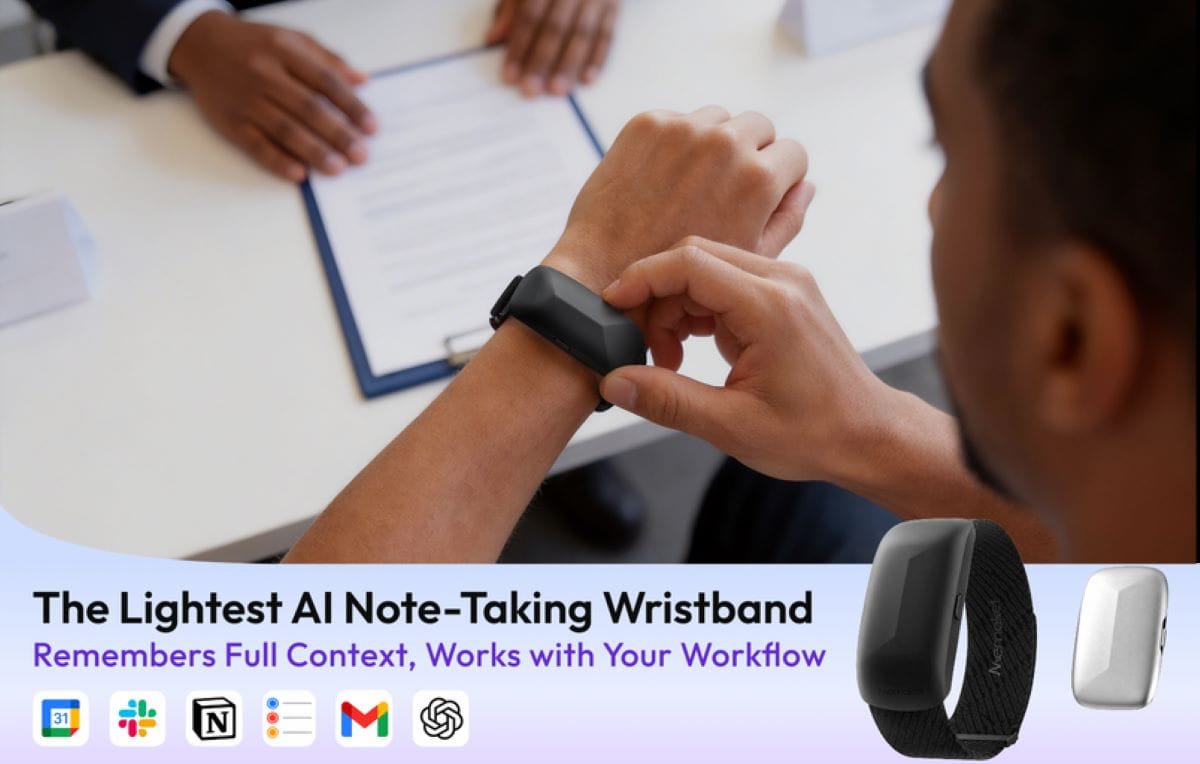
Memoket Gem is the lightest AI wristband on the market — a 0.4 oz wearable that records your conversations with one press and turns them into instant summaries, action items, and full context across every meeting, call, and catch-up.
With Memoket Gem, you get:
Reserve today with $5 — it counts toward the $199 early-bird price at launch, with a FREE year of the app included.
SOCIAL MEDIA

👀 What's happening: Reddit now uses large language models to fight spam, most of it generated by large language models. The platform says it blocks 23 million spam views a day and catches about 25,000 new spam posts and comments. It credits the LLM tools with cutting users' spam exposure 20 percent from January to March against the prior quarter.
🌍 How this hits reality: Reddit's whole pitch was being the last human room online, the place you go when search turns to AI slop. Then the slop showed up at the door. The same models that make spam free are now the only things fast enough to catch the coordinated fakery older filters kept missing. The human internet now runs on the machine it defines itself against. Keep going and the moat is a bot with better manners.
🛎️ Key takeaway: The anti-AI internet is discovering that purity does not scale; once language machines flood the feed, only better machines can keep it readable.
CHIPS
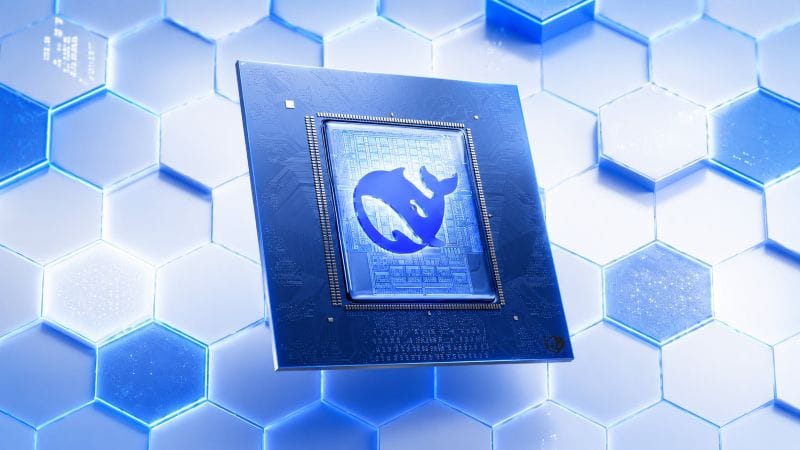
👀 What's happening: DeepSeek is reportedly building its own inference chip to reduce dependence on Nvidia and Huawei. The project began about a year ago, is still early, and has been kept quiet, with hiring done off public platforms and talks already opened with chip designers, foundries, and memory suppliers. For a company famous for squeezing more out of less compute, this is a very physical admission: software can only dodge the hardware wall for so long.
🌍 How this hits reality: Companies build their own silicon to shave margin off a chip that already works. That is OpenAI with Broadcom. DeepSeek's version is different. Nvidia's best is walled off by export controls, and Huawei's Ascend, the only fallback, is merely fine. Rolling its own is not the confident next step. It is the third option after the first two ran short. A homemade inference chip is a bet made from a corner, not a position of strength.
🛎️ Key takeaway: DeepSeek didn't graduate into a chip company, it got cornered into one, and is calling the last resort a roadmap.
👀 What's happening: DeepSeek is reportedly building its own inference chip to reduce dependence on Nvidia and Huawei. The project began about a year ago, is still early, and has been kept quiet, with hiring done off public platforms and talks already opened with chip designers, foundries, and memory suppliers.
👀 What's happening: DeepSeek is reportedly building its own inference chip to reduce dependence on Nvidia and Huawei. The project began about a year ago, is still early, and has been kept quiet, with hiring done off public platforms and talks already opened with chip designers, foundries, and memory suppliers.
NEW LAUNCH

👀 What's happening: Musk's xAI released Grok 4.5, a coding model near Opus 4.7 on quality, and hyped it relentlessly as the cost-performance king, cheaper and faster than anyone. The pitch is price: 2 dollars input, 6 dollars output per million, far under Western frontier models that start in the teens. Every comparison Musk drew was against Opus and GPT. He never once mentioned DeepSeek or the other Chinese LLM labs already charging a fraction of his numbers.
🌍 How this hits reality: The value crown Musk keeps grabbing was already worn, by Chinese models that price under him and hand out the weights for free. His whole pitch works by pretending that half the market does not exist. Benchmark against the two American labs you can beat on price, stay silent on the labs beating you, and call yourself the floor. It is not a cost breakthrough. It is a comparison rigged to flatter the person drawing it.
🛎️ Key takeaway: Musk is throwing a victory party for a price war DeepSeek already won, and keeping the actual winner off the guest list.
👀 What's happening: Musk's xAI released Grok 4.5, a coding model near Opus 4.7 on quality, and hyped it relentlessly as the cost-performance king, cheaper and faster than anyone. The pitch is price: 2 dollars input, 6 dollars output per million, far under Western frontier models that start in the teens. Every comparison Musk drew was against Opus and GPT.
🛎️ Key takeaway: Musk is throwing a victory party for a price war DeepSeek already won, and keeping the actual winner off the guest list.
DAILY TL;DR
READ MORE
Stay ahead without drowning in information. We turn the most important signals across AI, tech, marketing, and future products into 5-minute reads you can actually finish.
TOGETHER WITH US
AI Secret Media Group is the world’s #1 AI & Tech Newsletter Group, reaching over 2 million leaders across the global innovation ecosystem, from OpenAI, Anthropic, Google, and Microsoft to top AI labs, VCs, and fast-growing startups.
We've helped promote over 500 Tech Brands. Will yours be the next?
Email our co-founder Mark directly at [email protected] if the button fails.
Good Morning, AI Enthusiasts!
AI got cheap enough to fake a living world, noisy enough to kill old code, and expensive enough to break its own business model.
FUTURE

👀 What’s happening: A Reddit user filled a private World of Warcraft server with 1,800 AI players, each wired to DeepSeek's API so the chat channel buzzes like a live city. Hunters reminisce about old talent trees, mages name their favorite raids, players banter like the place never emptied out. The reason it works is price. Running 1,800 full-time characters pencils out to roughly 43 euros a month, the price of one dinner. The post hit 1,100 upvotes and topped the board.
🌍 How this hits reality: This is what happens the moment intelligence gets cheap enough to spend freely. One hobbyist repopulated a dead twenty-year-old game for pocket change, something that would have cost a studio a fortune in writers and servers a year ago. Today the budget only buys talk, so the bots chat but don't act. But DeepSeek is just the first model to hit this price floor. When frontier models follow it down, the same hobbyist budget buys agents that quest, raid, and scheme, not just converse. The cost of a believable digital person is falling toward zero.
🛎️ Key takeaway: The real story isn't 1,800 chatbots in a fantasy game; it's that cheap intelligence lets one person conjure a living world, and the day every frontier model is this cheap, those worlds start acting, not just talking.
👀 What’s happening: A Reddit user filled a private World of Warcraft server with 1,800 AI players, each wired to DeepSeek's API so the chat channel buzzes like a live city. Hunters reminisce about old talent trees, mages name their favorite raids, players banter like the place never emptied out.
POWER
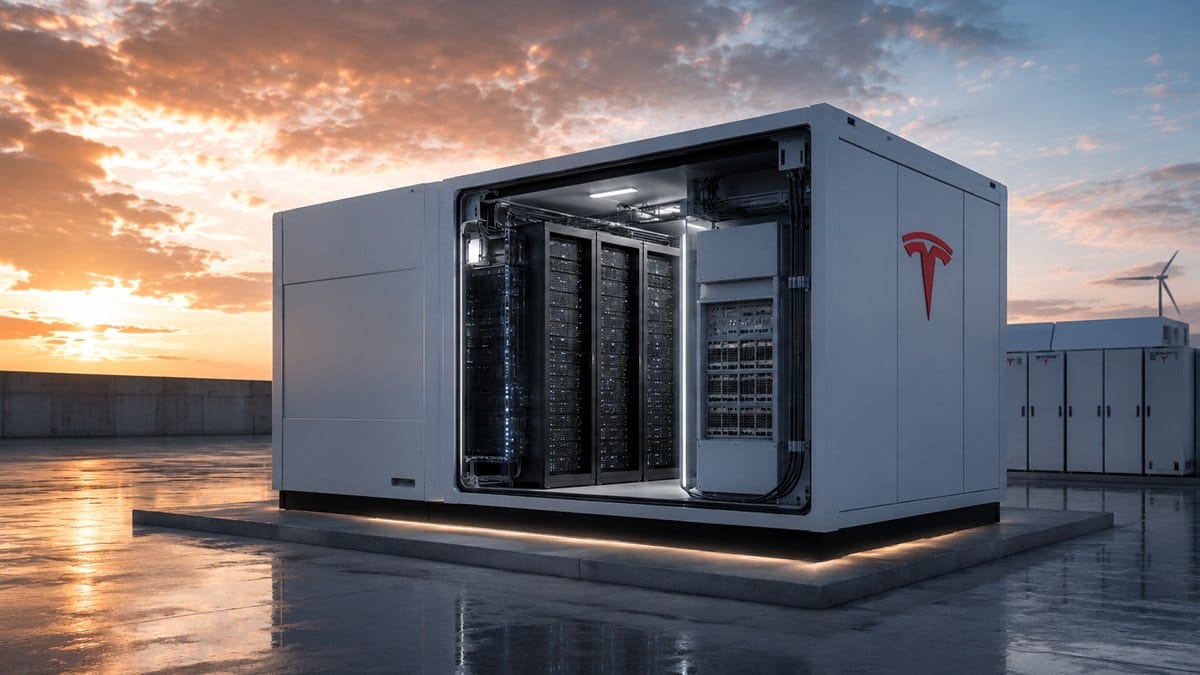
👀 What’s happening: Tesla filed a US trademark for Megapod on June 18, an intent-to-use mark covering a modular AI data-center hardware system: servers, AI compute, networking, power distribution, cooling, and management software in one plug-and-play unit. Think prefab housing for compute. You truck the module to the site, plug it in with GPUs, and it runs training and inference. No prototype, specs, price, or ship date exist yet.
🌍 How this hits reality: The reflex is to call this a shot at Nvidia. It isn't. Tesla is an Nvidia customer that just killed its own training chip. Megapod targets the layer below silicon: power, grid interconnect, cooling, deployment, where GPUs sit idle waiting on substations. That's Tesla's home turf, and xAI already bought roughly $1 billion in Megapack grid batteries. Megapod marches modular manufacturing into the data hall.
🛎️ Key takeaway: The scarce thing in AI stopped being silicon and became the power and cooling to run it, and Tesla just trademarked the part everyone knows but forgot to fight over.
Tesla is an Nvidia customer that just killed its own training chip. Megapod targets the layer below silicon: power, grid interconnect, cooling, deployment, where GPUs sit idle waiting on substations. That's Tesla's home turf, and xAI already bought roughly $1 billion in Megapack grid batteries.
TOKEN

👀 What’s happening: A SemiAnalysis report stress-tested the top AI subscriptions and found the math underwater. Pushed to its limit, a $200/month ChatGPT Pro plan can burn roughly $14,000 in compute at API rates; Anthropic's $200 Claude Max runs near $8,000. OpenAI goes negative past 11.4% utilization. And the API revenue meant to offset this is draining: Microsoft, Meta, and Amazon are capping internal AI spend, and Lindy just moved 100% of its traffic to DeepSeek V4, saving millions.
🌍 How this hits reality: Both revenue lines leak at once. Flat-rate plans were priced for the chatbot era, one question, one answer; agent workloads now burn up to 1,000 times that, so every power user is a loss leader. The API meter was supposed to carry the margin, but open models gutted it, and buyers walk for cheaper tokens. Raise prices and they leave; hold them and the per-user loss widens. Neither lever reaches profit.
🛎️ Key takeaway: Nobody's dying here; the labs are flush with capital and users. They just can't find the price that turns the most capable machines ever built into a business that makes money instead of spending it.
CODING
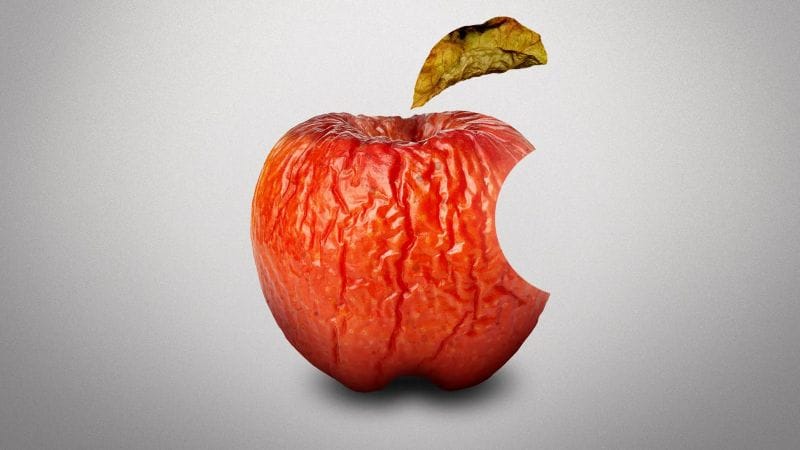
👀 What’s happening: Jakub Kicinski, a Linux network subsystem maintainer, removed AppleTalk, Apple's 1985 zero-configuration networking protocol, deleting nearly 4,000 lines from the mainline kernel. Apple itself dropped it in 2009; Linux kept it alive 17 years longer for vintage Mac holdouts in schools and archives. The trigger wasn't disuse. A wave of "well-meaning" AI-generated fix patches flooded the kernel mailing list, none of them reviewed by anyone.
🌍 How this hits reality: This isn't one dead protocol; it's a pattern arriving early. AI can now automatically generate plausible patches for any module faster than maintainers can read them, and the oldest, least-defended code is the softest target. Linux is already purging older network drivers like ARCnet, ISDN, and AX.25. Every kernel carries hundreds of such modules, stable for years precisely because nobody touched them. AI just made "nobody touches it" impossible.
🛎️ Key takeaway: AppleTalk didn't die of old age, it drowned in help nobody asked for. So the real question isn't what got deleted, it's which legacy module AI floods next.
👀 What’s happening: Jakub Kicinski, a Linux network subsystem maintainer, removed AppleTalk, Apple's 1985 zero-configuration networking protocol, deleting nearly 4,000 lines from the mainline kernel. Apple itself dropped it in 2009; Linux kept it alive 17 years longer for vintage Mac holdouts in schools and archives.
TOGETHER WITH MYCLAW
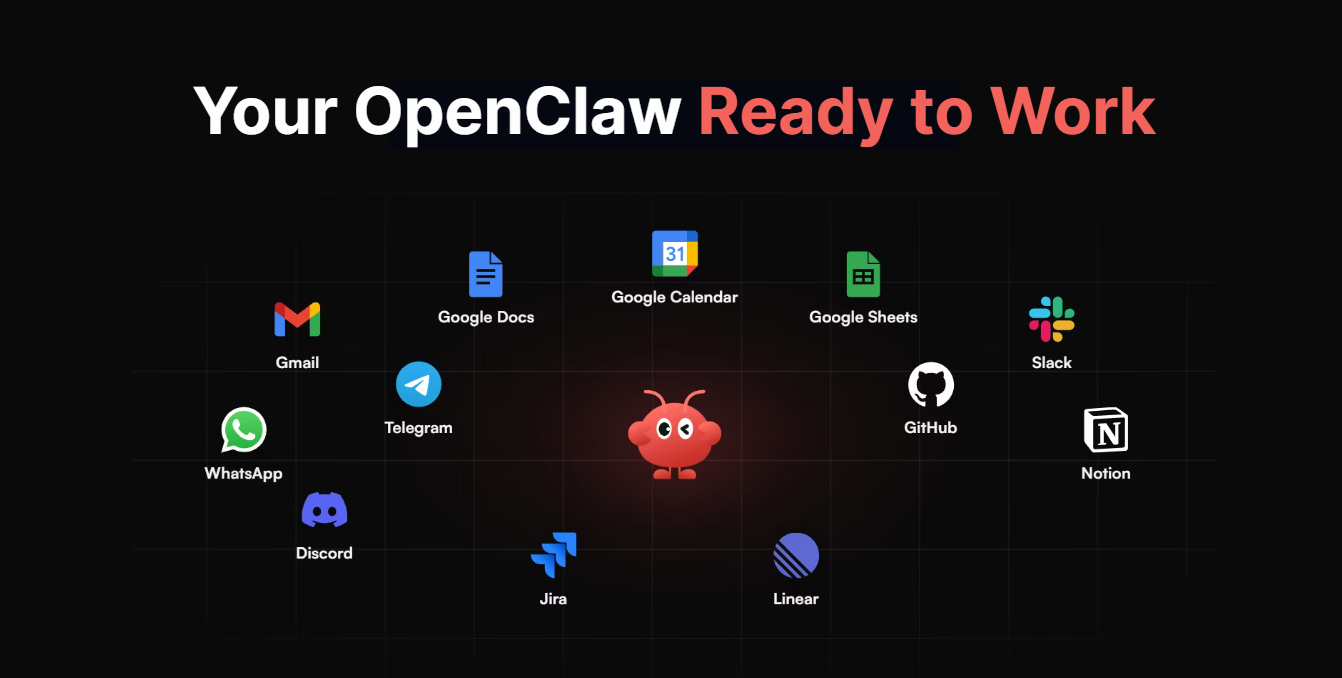
MyClaw makes OpenClaw instantly usable by connecting it to the SaaS tools you already use—Gmail, Slack, Google Docs, Sheets, Notion, GitHub, Telegram, WhatsApp, and more. No DevOps, no messy setup.
Just give it a goal, and your OpenClaw works 24/7 in the cloud, pulling context from your apps and delivering briefs, research, reports, decks, pages, and decisions ready to approve.
MyClaw turns OpenClaw from a cool demo into an always-on operator.
DAILY TL;DR
READ MORE
Stay ahead without drowning in information. We turn the most important signals across AI, tech, marketing, and future products into 5-minute reads you can actually finish.
TOGETHER WITH US
AI Secret Media Group is the world’s #1 AI & Tech Newsletter Group, reaching over 2 million leaders across the global innovation ecosystem, from OpenAI, Anthropic, Google, and Microsoft to top AI labs, VCs, and fast-growing startups.
We've helped promote over 500 Tech Brands. Will yours be the next?
Email our co-founder Mark directly at [email protected] if the button fails.
Good Morning, AI Enthusiasts!
The future is still inevitable — it just has layoffs, splashdowns, sanctions backlash, and puddles in the way.
TECH
👀 What’s happening: Meta engineering manager Sam Voigt cleared the latest 8000 layoff, then got demoted from manager to individual contributor and called it "suboptimal" on LinkedIn. Other survivors fared worse: senior infrastructure engineers were yanked off distributed systems work to label AI training data. Industry chatter puts new manager spans at one-to-fifty, up from one-to-eight. Survivor was the wrong word.
🌍 How this hits reality: Meta built a trap with no exit. Stay, and your career flattens while your reasoning gets harvested as training data. Meta already owns 49% of Scale AI, the data-labeling firm it bought into for billions, yet still wants its own engineers labeling. Leave, and you walk into a frozen 2026 tech market with no severance. This infra reassignment is engineered attrition: make the most market-mobile talent quit on their own, save the payout, keep the model weights. Meta cashes both checks.
🛎️ Key takeaway: Meta didn't just kill the job; it killed the way out. Stay and you become the training set. Leave and the frozen market won't take you back.
LLM
👀 What’s happening: DeepSeek, the Chinese AI startup known for frontier models at fractional prices, made permanent a 75 percent cut on V4-Pro. Tokens now run $0.0035 to $0.83 per million, far below any US frontier model. V4-Pro had been priced 12 times its lighter sibling on "compute capacity constraints," constraints that broke with Huawei's Ascend 950 supernodes ramping in H2.
🌍 How this hits reality: The export-control bet was that cutting off Nvidia would choke China's compute and hold the AI frontier for US labs. All three pieces broke. Huawei shipped Ascend, DeepSeek built V4-Pro on it, prices fell 75 percent. Sanctions didn't slow Chinese AI. They subsidized it. DeepSeek now sells frontier-tier AI at a fraction of US prices, on the chip Washington banned. Anthropic and OpenAI bet developers pay premium for the best; DeepSeek bets most pay for good-enough at near zero. Keep going, and the frontier stops being where developers buy.
🛎️ Key takeaway: Washington banned the chip to slow Chinese AI, China built one anyway, and the cheapest frontier AI on the market now runs on it.
DeepSeek now sells frontier-tier AI at a fraction of US prices, on the chip Washington banned. Anthropic and OpenAI bet developers pay premium for the best; DeepSeek bets most pay for good-enough at near zero. Keep going, and the frontier stops being where developers buy.
ROBOTAXI

👀 What’s happening: Waymo paused service in Atlanta, San Antonio, Dallas, and Houston this week after a robotaxi drove into a flooded Atlanta intersection and sat stuck for an hour. The pauses followed last week's NHTSA recall over flood-handling Waymo admits has no final remedy.
🌍 How this hits reality: Self-driving's wall now look like isn't regulation, geofencing, or compute. It's water. Tesla bet on cameras only, with Musk calling LiDAR a crutch, and the cars once reportedly rushed into lakes recently. Waymo bet on the full stack and the cars freeze in the puddle. After tens of billions and a decade, the industry that promised to outdrive humans has share the one wall that love water. The frontier of autonomous driving may not general intelligence anymore. It's whoever ships the puddle patch first wins the city.
🛎️ Key takeaway: Self-driving cleared every benchmark engineers wrote for it and got stopped by the one humans have known about since they invented shoes: don't step in the puddle.
SPACE

👀 What’s happening: SpaceX flew Starship V3 from Starbase Friday, the largest rocket ever built at 408 feet. The two mission goals split clean. Ship 39 deployed 20 mock Starlinks plus two heat-shield sensors, hit Mach 7, and splashed down in the Indian Ocean as planned. The Super Heavy booster lost its aft section during the relight burn and was destroyed before any controlled descent.
🌍 How this hits reality: Starlink is not just internet anymore. With xAI merged into SpaceX in February at a $1.25T valuation, one company now owns the rocket, the connectivity layer, and the model layer. Starship V3's promise of 100 tons to orbit at airline-like cadence is what would let Starlink saturate dense cities, push AI inference to every corner of the globe, and eventually host compute off Earth. Without booster reuse, that economics collapses. Artemis 2028 still depends on a modified Starship to land humans on the moon. Friday proved V3 can deliver payload. It did not prove it can be a cost structure.
🛎️ Key takeaway: Humanity is buying the deployment layer of its AI civilization at $1.75T. Friday showed the payload reaches orbit. It has not shown the layer comes back.
👀 What’s happening: SpaceX flew Starship V3 from Starbase Friday, the largest rocket ever built at 408 feet. The two mission goals split clean. Ship 39 deployed 20 mock Starlinks plus two heat-shield sensors, hit Mach 7, and splashed down in the Indian Ocean as planned.
TOGETHER WITH MYCLAW

A personal AI shouldn’t feel generic. MyClaw lets you install skills that adapt to your preferences from the start, so your assistant feels relevant on day one. Behind the scenes, OpenClaw provides the agent power. What you see is a simpler way to put it to work.
If you’re serious about OpenClaw, don’t run it halfway. Run it the way it was meant to be run — fast, secure, and production-ready by default.
DAILY TL;DR
READ MORE
Stay ahead without drowning in information. We turn the most important signals across AI, tech, marketing, and future products into 5-minute reads you can actually finish.
TOGETHER WITH US
AI Secret Media Group is the world’s #1 AI & Tech Newsletter Group, reaching over 2 million leaders across the global innovation ecosystem, from OpenAI, Anthropic, Google, and Microsoft to top AI labs, VCs, and fast-growing startups.
We've helped promote over 500 Tech Brands. Will yours be the next?
Email our co-founder Mark directly at [email protected] if the button fails.
Good Morning, AI Enthusiasts!
The agent era just got a little more expensive, and a lot more competitive.
NEW LAUNCH
👀 What’s happening: OpenAI just released GPT-5.5, and the story is not just a smarter chat model. It is a more expensive, more capable execution engine for agent systems like OpenClaw. The uploaded report says GPT-5.5 beats Claude Opus 4.7 across many core benchmarks, while using roughly half the tokens at comparable intelligence.
🌍 How this hits reality: Pricing is the tell. Standard GPT-5.5 is listed at $5 input and $30 output per million tokens, while GPT-5.5 Pro jumps to $30 and $180. That only works if the model actually finishes more work per run. For OpenClaw, this stresses the Claude-first assumption around agents, context, and coding reliability.
🛎️ Key takeaway: The agent era is becoming a routing war. Claude Opus 4.7 still has brand trust, but GPT-5.5 forces platforms like OpenClaw to optimize for cost, capability, and task completion instead of model loyalty.
Claude Opus 4.7 still has brand trust, but GPT-5.5 forces platforms like OpenClaw to optimize for cost, capability, and task completion instead of model loyalty.
NEW LAUNCH

👀 What’s happening: DeepSeek V4 launched with the usual big numbers: two open models, 1M context, stronger agents, better coding, and lower-cost deployment. But the official report accidentally tells the truth. It says V4 beats Sonnet 4.5 and approaches Opus 4.5. Not Opus 4.6 Thinking. Not the real ceiling.
🌍 How this hits reality: That gap is the whole story. The document admits reality, while the benchmark theater keeps selling fantasy. GLM, Kimi, and now DeepSeek all know the script: find a chart, pick a lane, claim Opus-level strength, then collapse when agents meet real work, messy context, and actual delivery pressure.
🛎️ Key takeaway: DeepSeek V4 may still be the best open long-context model. But the hype is already ahead of the product. If real usage does not match the charts, this becomes another Chinese benchmark miracle with Opus in the headline and cleanup work in production.
👀 What’s happening: DeepSeek V4 launched with the usual big numbers: two open models, 1M context, stronger agents, better coding, and lower-cost deployment. But the official report accidentally tells the truth. It says V4 beats Sonnet 4.5 and approaches Opus 4.5. Not Opus 4.6 Thinking.
SEARCH

👀 What’s happening: AI search is forcing publishers back into the basement: raw server logs. ChatGPT, Claude, Perplexity, and other systems crawl the web, but they do not show what they touched, skipped, blocked, or used. So the cleanest signal is ugly again: the log file.
🌍 How this hits reality: This breaks the old SEO comfort layer. Google gave dashboards, clicks, impressions, and crawl hints. AI gives almost nothing. GPTBot, ClaudeBot, ChatGPT-User, and PerplexityBot behave differently. That is why log files matter. They show whether AI crawlers reached your real pages, or only skimmed the surface and left.
🛎️ Key takeaway: The next search war may start in infrastructure, not just content. Log files become the new control room. Teams that ignore them will be optimized for a search world that already died.
ChatGPT, Claude, Perplexity, and other systems crawl the web, but they do not show what they touched, skipped, blocked, or used. So the cleanest signal is ugly again: the log file.
HUMANOIDS

👀 What’s happening: Sony AI’s ping-pong robot Ace has made history because it did what old robots never really did. It played elite and professional humans under International Table Tennis Federation rules, with licensed umpires, and won. Earlier table-tennis robots existed since 1983. Ace crossed from controlled demo into real competition.
🌍 How this hits reality: The old model was simple that robots could repeat, assist, or entertain, but humans still owned fast physical judgment. Ace breaks that comfort. It reads spin with nine cameras and three vision systems, then reacts without fatigue, nerves, or emotional tells. Add Beijing’s humanoid half-marathon winner faster than the human world record, and sport is now the clearest place robots are visibly outrunning the body.
🛎️ Key takeaway: Do not overextend this to every factory or warehouse yet. But in sport, reaction, motion, and repeatability, the historical line has moved.
TOGETHER WITH MYCLAW
A personal AI shouldn’t feel generic. MyClaw lets you install skills that adapt to your preferences from the start, so your assistant feels relevant on day one. Behind the scenes, OpenClaw provides the agent power. What you see is a simpler way to put it to work.
If you’re serious about OpenClaw, don’t run it halfway. Run it the way it was meant to be run — fast, secure, and production-ready by default.
DAILY TL;DR
READ MORE
Stay ahead without drowning in information. We turn the most important signals across AI, tech, marketing, and future products into 5-minute reads you can actually finish.
TOGETHER WITH US
AI Secret Media Group is the world’s #1 AI & Tech Newsletter Group, reaching over 2 million leaders across the global innovation ecosystem, from OpenAI, Anthropic, Google, and Microsoft to top AI labs, VCs, and fast-growing startups.
We've helped promote over 500 Tech Brands. Will yours be the next?
Email our co-founder Mark directly at [email protected] if the button fails.
Good Morning, AI Enthusiasts!
Today’s AI race looks less like software and more like heavy industry.
AGI
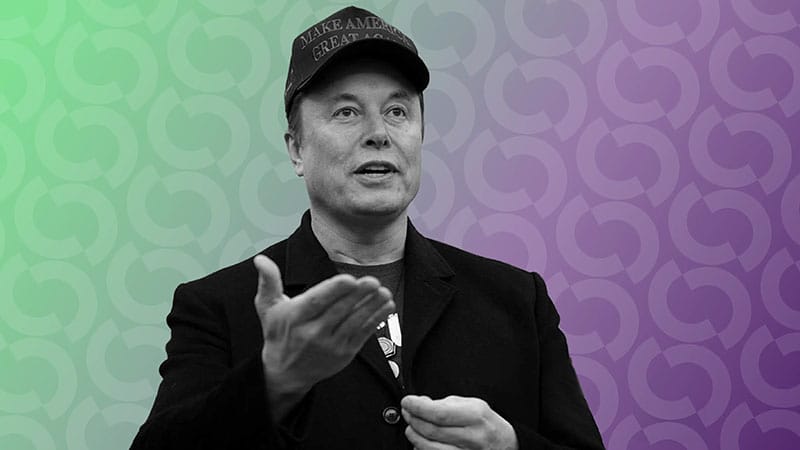
👀 What’s Happening: Elon Musk is now openly treating AGI like an industrial construction project. Grok 4.4 is expected in early May, Grok 4.5 by the end of the month, and Grok 5 is already training behind them. The logic is simple: build bigger clusters, add more chips, spend more electricity, and intelligence will eventually fall out of the machine.
🌍 How This Hits Reality: xAI’s Colossus system reportedly already uses more than 550,000 GPUs and around 2 gigawatts of electricity, enough to power a city of 1.5 million people. That is why Musk’s AGI strategy increasingly feels less like computer science and more like building a nuclear plant. More land, more chips, more cooling, more power. OpenAI and Anthropic are both spending heavily too, but nobody else is scaling this aggressively.
🛎️ Key Takeaway: Maybe Musk is right and AGI really does emerge from brute force. Or maybe he is just building the world’s most expensive autocomplete machine. Either way, the future of AI now looks a lot more like heavy industry than software.
👀 What’s Happening: Elon Musk is now openly treating AGI like an industrial construction project. Grok 4.4 is expected in early May, Grok 4.5 by the end of the month, and Grok 5 is already training behind them. The logic is simple: build bigger clusters, add more chips, spend more electricity, and intelligence will eventually fall out of the machine.
CORPORATE

👀 What’s Happening: A fintech company with more than 60 employees woke up to find every Claude account dead at once. No warning. No human explanation. Just an automated email and a Google form. An entire company lost access to coding, support, analysis, and internal workflows because one model provider decided something “looked suspicious.” Fifteen hours later the accounts came back. Anthropic never explained what happened.
🌍 How This Hits Reality: Claude is starting to behave less like enterprise software and more like a corporate guillotine hanging over every customer’s neck. Build your workflows around it, connect your documents, train your staff, wire your operations into it, then wait for one invisible moderation trigger to erase everything overnight. No hotline. No account manager. No real appeal process. Just a faceless safety system deciding whether your company gets to function today.
🛎️ Key Takeaway: Claude is becoming too unstable to trust as a core business layer. A company that builds entirely on Claude is not building on infrastructure. It is building on the mood swings of a black box.
🛎️ Key Takeaway: Claude is becoming too unstable to trust as a core business layer. A company that builds entirely on Claude is not building on infrastructure. It is building on the mood swings of a black box.
LEAK
👀 What’s Happening: DeepSeek is reportedly seeking outside funding for the first time, targeting at least $300 million at a valuation above $10 billion. That is a major shift for a company that built its reputation on staying independent and refusing investor pressure. The timing is not random. V4 has already been delayed multiple times, and rumors keep circulating that access to high-quality distillation targets from rivals like OpenAI and Anthropic has become harder. DeepSeek suddenly looks less like a lean research lab and more like a company running out of cheap shortcuts.
🌍 How This Hits Reality: DeepSeek grew fast because distillation is faster and cheaper than training from scratch. But distillation only works when someone else has already spent billions building the frontier model first. Once those companies tighten access, rate limits, or legal pressure, the shortcut breaks. That is the ugly truth here. DeepSeek cannot expect to keep climbing forever by copying reasoning traces and outputs from models it did not build. At some point the company has to pay for its own compute, its own researchers, and its own original breakthroughs.
🛎️ Key Takeaway: DeepSeek is reaching the point where imitation is no longer enough. V4 now has to prove the company can build a frontier model with its own ideas, its own infrastructure, and eventually its own hardware stack. Otherwise it risks becoming the smartest follower in a race that only rewards leaders.
👀 What’s Happening: DeepSeek is reportedly seeking outside funding for the first time, targeting at least $300 million at a valuation above $10 billion. That is a major shift for a company that built its reputation on staying independent and refusing investor pressure. The timing is not random.
OPENSOURCE
👀 What’s Happening: MiniMax changed the license on M2.7 after release. The weights are still downloadable and researchers can still run, fine tune, and modify the model. But any serious commercial use now needs written approval, and some deployments must visibly say “Built with MiniMax M2.7.” The bigger problem is that MiniMax kept calling it “Modified-MIT” even though MIT explicitly allows unrestricted commercial use. Developers immediately saw this as bait and switch.
🌍 How This Hits Reality: This is worse than simply going closed source. At least companies like Meta are now upfront about where the boundaries are. MiniMax wants the credibility, goodwill, and developer adoption of open source while quietly removing one of the main freedoms that made open source matter in the first place.
🛎️ Key Takeaway: Once you need lawyers, approvals, and branding requirements before shipping a product, it stops being open source and starts becoming a controlled ecosystem with a free trial attached.
But any serious commercial use now needs written approval, and some deployments must visibly say “Built with MiniMax M2.7.” The bigger problem is that MiniMax kept calling it “Modified-MIT” even though MIT explicitly allows unrestricted commercial use. Developers immediately saw this as bait and switch.
TOGETHER WITH MYCLAW
A personal AI shouldn’t feel generic. MyClaw lets you install skills that adapt to your preferences from the start, so your assistant feels relevant on day one. Behind the scenes, OpenClaw provides the agent power. What you see is a simpler way to put it to work.
If you’re serious about OpenClaw, don’t run it halfway. Run it the way it was meant to be run — fast, secure, and production-ready by default.
DAILY TL;DR
READ MORE
Stay ahead without drowning in information. We turn the most important signals across AI, tech, marketing, and future products into 5-minute reads you can actually finish.
TOGETHER WITH US
AI Secret Media Group is the world’s #1 AI & Tech Newsletter Group, reaching over 2 million leaders across the global innovation ecosystem, from OpenAI, Anthropic, Google, and Microsoft to top AI labs, VCs, and fast-growing startups.
We've helped promote over 500 Tech Brands. Will yours be the next?
Email our co-founder Mark directly at [email protected] if the button fails.
Good Morning, AI Enthusiasts!
Anthropic has started using its usual tricks for releasing new models again; the Opus 4.6 we're using now has become an idiot.

PREVIEW
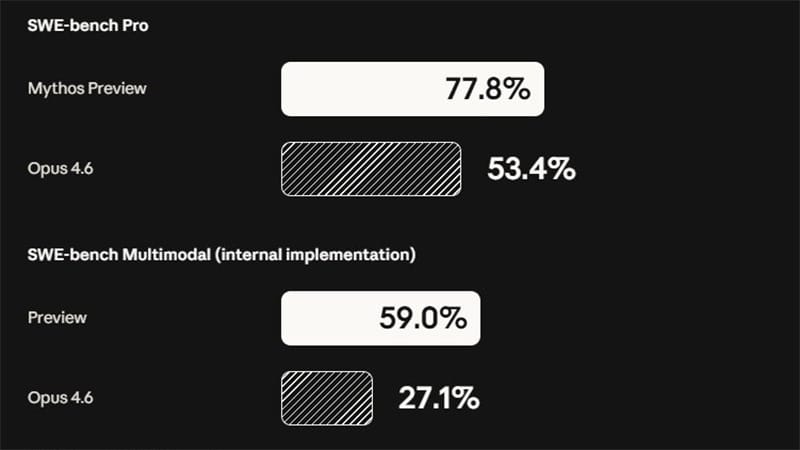
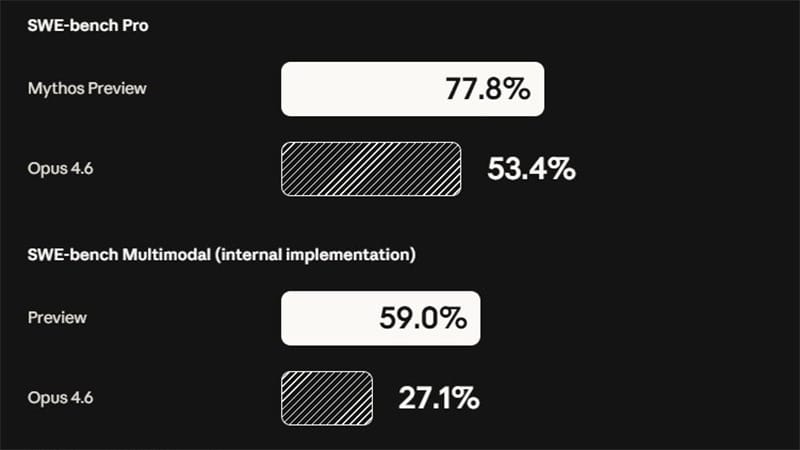
👀 What's happening: Before Anthropic’s release, a third party got access to Mythos preview build and published benchmark results showing a huge gap over Opus 4.6. At the same time, users have been reporting degraded Opus performance for weeks. The comparison now reads like full-power Mythos versus a constrained Opus.
🌍 How this hits reality: SWE-bench Pro lands at 77.8% vs 53.4%. Multimodal is 59% vs 27%. It looks like a breakthrough until you notice the baseline moved. Users already measured up to 67% drop in reasoning depth and more shortcut behavior in Opus . So this is less a fair comparison and more full Mythos versus a “idiot” Opus.
🛎️ Key takeaway: This is becoming a playbook. Keep the best model internal, quietly tune down the public one, then show a dramatic gap. So, is the new model truly smart, or has the old model become dumber? Who knows?
👀 What's happening: Before Anthropic’s release, a third party got access to Mythos preview build and published benchmark results showing a huge gap over Opus 4.6. At the same time, users have been reporting degraded Opus performance for weeks. The comparison now reads like full-power Mythos versus a constrained Opus.
TOGETHER WITH MYCLAW
Skip Docker, VPS configs, and late-night debugging. With MyClaw.ai, you can launch your agent in minutes and keep it running 24/7 in a dedicated environment built for serious builders.
If you’re serious about OpenClaw, run it properly — with speed and security by default.
LEAK
👀 What's happening: DeepSeek pushed a late-night update with “fast” and “expert” modes plus a gated vision feature. Users quickly found the model self-identifying as V4, but performance, context limits around 130K, and evasive answers suggest it is not a real V4 release, just another ambiguous tease.
🌍 How this hits reality: This is the third or fourth cycle of implied V4 arrival without delivery. Expectations are being artificially sustained while competitors ship real upgrades almost weekly. Developers and power users depend on stable capabilities launched, not "expectations narrative". Each fake-out increases switching risk, especially when alternatives already offer 200K to 1M context and consistent APIs.
🛎️ Key takeaway: Expectation inflation only works once or twice. If the eventual V4 underdelivers or slips again, DeepSeek risks collapsing trust entirely and losing its remaining positioning in the serious model race.
👀 What's happening: DeepSeek pushed a late-night update with “fast” and “expert” modes plus a gated vision feature. Users quickly found the model self-identifying as V4, but performance, context limits around 130K, and evasive answers suggest it is not a real V4 release, just another ambiguous tease.
OPENAI
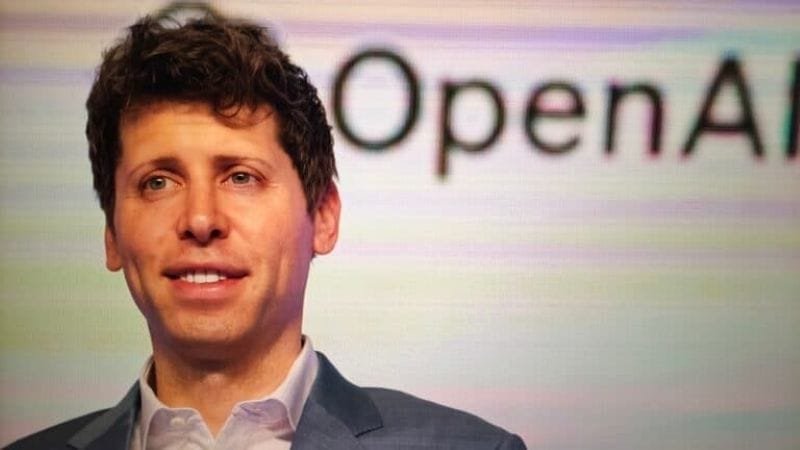
👀 What's happening: The New Yorker just published an 18-month investigation built on internal memos from former Chief Scientist Ilya Sutskever and Anthropic CEO Dario Amodei, directly accusing Sam Altman of misleading the board and overstating safety efforts. It details compute diversion from alignment, unchecked releases, and the earlier board crisis now reframed as a governance failure.
🌍 How this hits reality: This lands at the worst possible time. OpenAI is targeting an IPO while projecting massive losses and relying on external capital to sustain compute expansion. At the same time, Musk is escalating legal pressure. Governance risk now stacks on top of financial and legal exposure, which directly threatens listing approval, partner confidence, and long-term contracts.
🛎️ Key takeaway: This is the failure mode people feared. If investigations solidify and legal pressure builds, one leader becomes the single point of collapse. OpenAI may not even reach IPO before credibility and capital completely slip away.
OpenAI is targeting an IPO while projecting massive losses and relying on external capital to sustain compute expansion. At the same time, Musk is escalating legal pressure. Governance risk now stacks on top of financial and legal exposure, which directly threatens listing approval, partner confidence, and long-term contracts.
CHIPS

👀 What's happening: Intel has joined Musk’s TeraFab project alongside Tesla, SpaceX, and xAI to build large-scale AI chip factories in Texas. Intel brings manufacturing, packaging, and process capability to a plan targeting 1 terawatt of annual compute for robots and data centers.
🌍 How this hits reality: Intel has been bleeding, with over $10B in foundry losses and no hyperscale anchor customer. This deal hands it exactly that, at unprecedented scale. In return, Musk gains partial control over manufacturing, breaking reliance on external supply chains that currently gate AI growth and deployment speed.
🛎️ Key takeaway: This looks less like partnership and more like a bailout with strings attached. If that pattern holds, Intel does not just survive, it becomes the real production arm behind a new compute order.
👀 What's happening: Intel has joined Musk’s TeraFab project alongside Tesla, SpaceX, and xAI to build large-scale AI chip factories in Texas. Intel brings manufacturing, packaging, and process capability to a plan targeting 1 terawatt of annual compute for robots and data centers.
DAILY TL;DR
READ MORE
Stay ahead without drowning in information. We turn the most important signals across AI, tech, marketing, and future products into 5-minute reads you can actually finish.
TOGETHER WITH US
AI Secret Media Group is the world’s #1 AI & Tech Newsletter Group, reaching over 2 million leaders across the global innovation ecosystem, from OpenAI, Anthropic, Google, and Microsoft to top AI labs, VCs, and fast-growing startups.
We've helped promote over 500 Tech Brands. Will yours be the next?
Email our co-founder Mark directly at [email protected] if the button fails.
Good Morning, AI Enthusiasts!
AI is becoming labor infrastructure, capital magnet, and geopolitical asset — all at once.
MILESTONE

👀 What’s happening: Anthropic just raised $30 billion, pushing its valuation to $380 billion, more than double its last round. Claude Code revenue is running above $2.5 billion, with total annualized revenue at $14 billion. Enterprise subscriptions have quadrupled. Separately, AISecret interviewed MyClaw.ai on compute usage, and over 90 percent of users are independently choosing Claude Opus 4.6 to run OpenClaw.
🌍 How this hits reality: Software multiples were already under pressure. Now capital and user behavior are aligning around foundation models that execute workflows directly. Claude Cowork plugins triggered a global software selloff. When agents users freely select Opus 4.6 at that scale, it signals perceived performance advantage, not contractual bundling. Model preference becomes a market signal, not marketing.
🛎️ Key takeaway: This is voluntary consolidation around capability. If users keep routing serious workloads to the same model tier, pricing power and enterprise gravity concentrate at the model layer, and traditional SaaS loses negotiating leverage.
Claude Code revenue is running above $2.5 billion, with total annualized revenue at $14 billion. Enterprise subscriptions have quadrupled. Separately, AISecret interviewed MyClaw.ai on compute usage, and over 90 percent of users are independently choosing Claude Opus 4.6 to run OpenClaw.
Separately, AISecret interviewed MyClaw.ai on compute usage, and over 90 percent of users are independently choosing Claude Opus 4.6 to run OpenClaw.
TOGETHER WITH MYCLAW
You don't need a Mac Mini to run.
Use MyClaw.ai instead. With it you can safely run OpenClaw in the cloud without any installation. It's always on, so you can finally close your laptop without killing your agent.
You can join the OpenClaw revolution with a managed OpenClaw.
LAWSUIT
👀 What’s happening: OpenAI has submitted a formal memo to US lawmakers accusing DeepSeek of systematically distilling outputs from top American models to train its own systems. The allegation is not casual. It claims structured extraction at scale. This shifts the issue from online debate into regulatory territory.
🌍 How this hits reality: Large labs are spending tens of billions on compute, data pipelines, and energy contracts. If a competitor can query those models, compress the answers, and replicate performance at lower cost, the economics invert. API access becomes a data refinery. Training advantage shifts from raw capability to harvesting efficiency.
🛎️ Key takeaway: If this path is normalized and proven true, frontier AI competition stops being about who builds better models. It becomes about who can extract, filter, and distill faster. The moat moves from intelligence to capture infrastructure.
👀 What’s happening: OpenAI has submitted a formal memo to US lawmakers accusing DeepSeek of systematically distilling outputs from top American models to train its own systems. The allegation is not casual. It claims structured extraction at scale. This shifts the issue from online debate into regulatory territory.
👀 What’s happening: OpenAI has submitted a formal memo to US lawmakers accusing DeepSeek of systematically distilling outputs from top American models to train its own systems. The allegation is not casual. It claims structured extraction at scale. This shifts the issue from online debate into regulatory territory.
LABOR
👀 What’s happening: IBM is tripling entry level hiring after years of signaling AI would replace thousands of back office roles. The company had paused recruitment and targeted roughly 7,800 administrative jobs for automation. Now HR leadership says many junior roles are being redesigned, not eliminated, because AI tools failed to fully replace human oversight and coordination.
🌍 How this hits reality: For two years the assumption was that generative AI would hollow out entry pipelines first. CFO models were built around 20 to 30 percent labor efficiency gains in support and operations. IBM’s pivot suggests the bottleneck is supervision and judgment. If AI output requires constant review, labor costs do not disappear. They shift.
🛎️ Key takeaway: If early adopters cannot remove junior layers, enterprise AI becomes augmentation, not substitution. Expect slower workforce contraction, higher oversight staffing, and renewed competition for entry talent trained to manage automated systems.
DAILY TL;DR
TRENDING
READ MORE
Stay ahead without drowning in information. We turn the most important signals across AI, tech, marketing, and future products into 5-minute reads you can actually finish.
TOGETHER WITH US
AI Secret Media Group is the world’s #1 AI & Tech Newsletter Group, reaching over 2 million leaders across the global innovation ecosystem, from OpenAI, Anthropic, Google, and Microsoft to top AI labs, VCs, and fast-growing startups.
We've helped promote over 500 Tech Brands. Will yours be the next?
Email our co-founder Mark directly at [email protected] if the button fails.
Good Morning, AI Enthusiasts!
Not all AI should be built to optimize efficiency. Some AI should exist to accompany humans as they learn how to think.

NEW LAUNCH

👀 What’s happening: Evie’s Magical Tale introduces a new AI category best described as an AI small theater. Children no longer consume stories but stage them. Characters converse, debate, and improvise together. Intelligence shifts from answering prompts to performing roles inside a shared narrative space that feels alive.
🌍 How this hits reality: This quietly alters how humans first encounter AI. Instead of tools, feeds, or tutors, children meet intelligence as characters and dialogue. That matters. Early cognition is shaped by stories, not interfaces. A screen free system with 100 plus personas and dual character reasoning reframes AI as environment, not software.
🛎️ Key takeaway: If this spreads, AI’s cultural role changes before regulation or norms catch up. We move from AI as assistant to AI as world builder. The long term impact is not productivity, but how a generation learns to think.
TOGETHER WITH MUSEMAIL
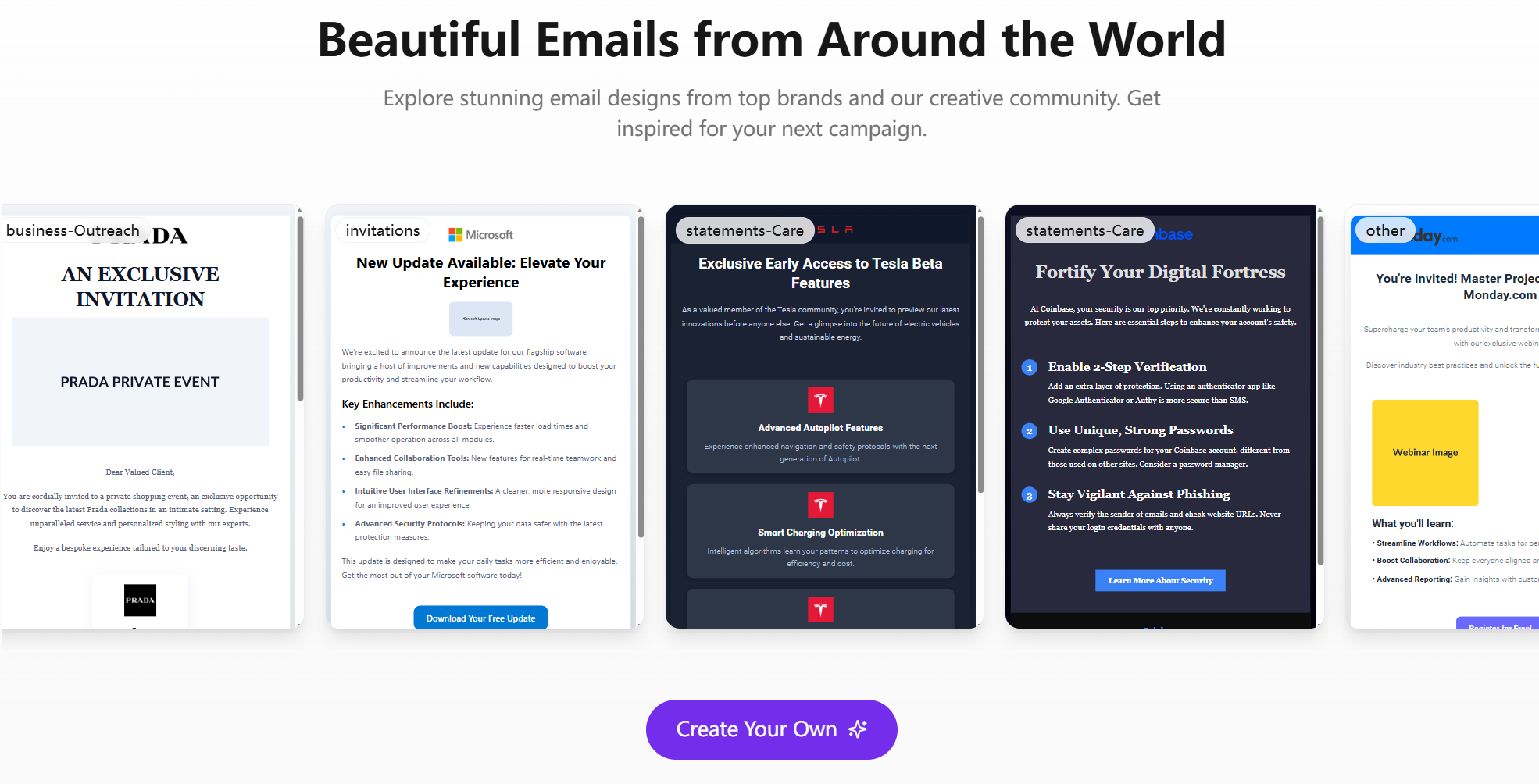
You don’t need another “fine” email. You need one that actually looks stunning. MuseMail uses AI to turn rough intent into emails people notice. Sharp copy. Clean structure. Polished HTML. You give it context. It gives you something that looks deliberate, even if you barely tried.
NEW LAUNCH
👀 What’s happening: DeepSeek published a paper introducing Engram, a conditional memory module that stores static knowledge in system RAM rather than GPU HBM. Models query facts instead of recomputing them, freeing GPUs for reasoning. Long context accuracy jumps, and memory and compute are treated as separable resources.
🌍 How this hits reality: HBM is scarce and expensive, while DRAM and CXL pools scale. Engram shows a 27B model beating MoE baselines and pushing NIAH accuracy to about 97 percent. Compared with Nvidia KVCache, this is persistent knowledge, not session memory. The stress shifts from GPUs to system memory supply.
🛎️ Key takeaway: If this pattern holds, inference economics change. Teams buy fewer top tier GPUs and more pooled memory. Expect architectures that cache knowledge once and reason selectively, easing HBM pressure while raising new constraints around DRAM capacity and data center memory fabrics.
👀 What’s happening: DeepSeek published a paper introducing Engram, a conditional memory module that stores static knowledge in system RAM rather than GPU HBM. Models query facts instead of recomputing them, freeing GPUs for reasoning. Long context accuracy jumps, and memory and compute are treated as separable resources.
RETAIL
👀 What’s happening: Walmart is doubling down on agent led commerce by embedding its full shopping flow into Gemini, after already linking with ChatGPT. Instead of forcing users into a Walmart owned interface, it is letting AI models handle discovery, decisions, and checkout.
🌍 How this hits reality: This is a clear open strategy. Walmart is betting model platforms become the new entry point, not branded apps. That contrasts with Amazon, which is still building and defending its own AI surfaces. Walmart trades control for reach. Agents already command daily attention. Plugging in early captures demand before habits and defaults fully lock.
🛎️ Key takeaway: Walmart is positioning itself as the easiest retailer for AI agents to transact with. If agents win, distribution beats ownership. The risk is margin and data leakage. The direction points toward retail competing for agent preference, not consumer clicks.
QUICK HITS
TRENDING
READ MORE
Stay ahead without drowning in information. We turn the most important signals across AI, tech, marketing, and future products into 5-minute reads you can actually finish.
TOGETHER WITH US
AI Secret Media Group is the world’s #1 AI & Tech Newsletter Group, reaching over 2 million leaders across the global innovation ecosystem, from OpenAI, Anthropic, Google, and Microsoft to top AI labs, VCs, and fast-growing startups.
We've helped promote over 500 Tech Brands. Will yours be the next?
Email our co-founder Mark directly at [email protected] if the button fails.

Good Morning, AI Enthusiasts!
As the year opens, DeepSeek fires a technical opening salvo that reshapes how large models scale.

NEW LAUNCH
👀 What’s happening: On New Year’s Day, DeepSeek published a new paper introducing mHC, or manifold constrained hyper connections, co authored by its core research team and CEO Liang Wenfeng. The work tackles a long standing problem in widened residual architectures where performance gains come with training instability at scale. mHC restructures residual flows and mathematically constrains their interactions to keep large models trainable.
🌍 How this hits reality: Residual connections are the load bearing beams of modern transformers. Efforts to widen them promise better capacity but often break identity mapping, causing gradient blowups and memory pressure. mHC forces residual mixing matrices onto a doubly stochastic manifold, guaranteeing norm stability across depth. In practice, DeepSeek shows a 27B parameter model scaling cleanly with only a 6.7 percent training overhead at four times residual width. That shifts the compute tradeoff.
🛎️ Key takeaway: This is less about one paper and more about direction. Architecture level math constraints are becoming a prerequisite for scaling. Expect more base models to compete on topology and training physics, not just data and parameters.
👀 What’s happening: On New Year’s Day, DeepSeek published a new paper introducing mHC, or manifold constrained hyper connections, co authored by its core research team and CEO Liang Wenfeng.
TOGETHER WITH HARDWIRE
The Hardwire is a weekly newsletter tracking the next wave of AI-powered hardware: consumer devices, wearables, spatial computing, and the silicon shaping it all. From product launches to deep-tech inflection points, it connects what’s being built with why it matters.
Read by founders, engineers, investors, and operators who want to understand how AI escapes the cloud and enters the physical world.
If you care about where software meets atoms, The Hardwire is where the future gets wired.
CONTENT

👀 What’s happening: Adam Mosseri, head of Instagram, is publicly conceding that the visual contract is broken. Photos and videos can no longer be assumed real because AI makes convincing fakes trivial. On Instagram, polished imagery now signals manipulation, while raw and imperfect content temporarily signals truth.
🌍 How this hits reality: This marks the end of the aesthetic arms race. When flawless images are cheap, beauty stops differentiating anything. Platforms cannot reliably detect AI forever, and labels will fail as generation improves. The stress shifts to identity, capture provenance, and account context. Trust moves upstream to cameras, cryptographic signatures, and long lived social graphs.
🛎️ Key takeaway: The aesthetic war is already lost. What follows is a harder fight over who produced something and why they matter. Platforms that fail to anchor identity and provenance risk turning visual content into noise.
META

👀 What’s happening: Internal files reviewed by Reuters show Meta built “a global playbook” to game its own ad transparency verification tools. As AI powered scams surged on Facebook and Instagram, Meta focused on making fraudulent ads harder to find in the Ad Library, not harder to run, beginning in Japan and then exporting the method globally.
🌍 How this hits reality: Meta‘s file confirmed advertiser verification could cut scam ads by about 29 percent and be deployed in weeks. It also calculated a $2 billion cost and nearly 5 percent revenue hit. The response was selective enforcement instead. Clean up the search paths regulators use, leave the underlying system intact, and let scams flow to other markets. Transparency became a cosmetic layer, not a diagnostic tool.
🛎️ Key takeaway: This was a profit defense strategy, not a safety strategy. By optimizing what oversight sees instead of fixing root causes, Meta increases the chance regulators abandon nuance and impose blunt rules that reshape global ad markets.
👀 What’s happening: Internal files reviewed by Reuters show Meta built “a global playbook” to game its own ad transparency verification tools. As AI powered scams surged on Facebook and Instagram, Meta focused on making fraudulent ads harder to find in the Ad Library, not harder to run, beginning in Japan and then exporting the method globally.
QUICK HITS
TRENDING
TOGETHER WITH US
AI Secret Media Group is the world’s #1 AI & Tech Newsletter Group, reaching over 2 million leaders across the global innovation ecosystem, from OpenAI, Anthropic, Google, and Microsoft to top AI labs, VCs, and fast-growing startups.
We operate the industry’s most influential portfolio of newsletters, each shaping a different frontier of the AI & Tech revolution:
Be Smarter in 5 Minutes
Discover the Future Products
We've helped promote over 500 Tech Brands. Will yours be the next?
Email our co-founder Mark directly at [email protected] if the button fails.
Good Morning, AI Enthusiasts!
Nowadays, the AI story isn’t about models. It’s about who controls the compute, the tools, and the interface to reality itself.

COMPETITION
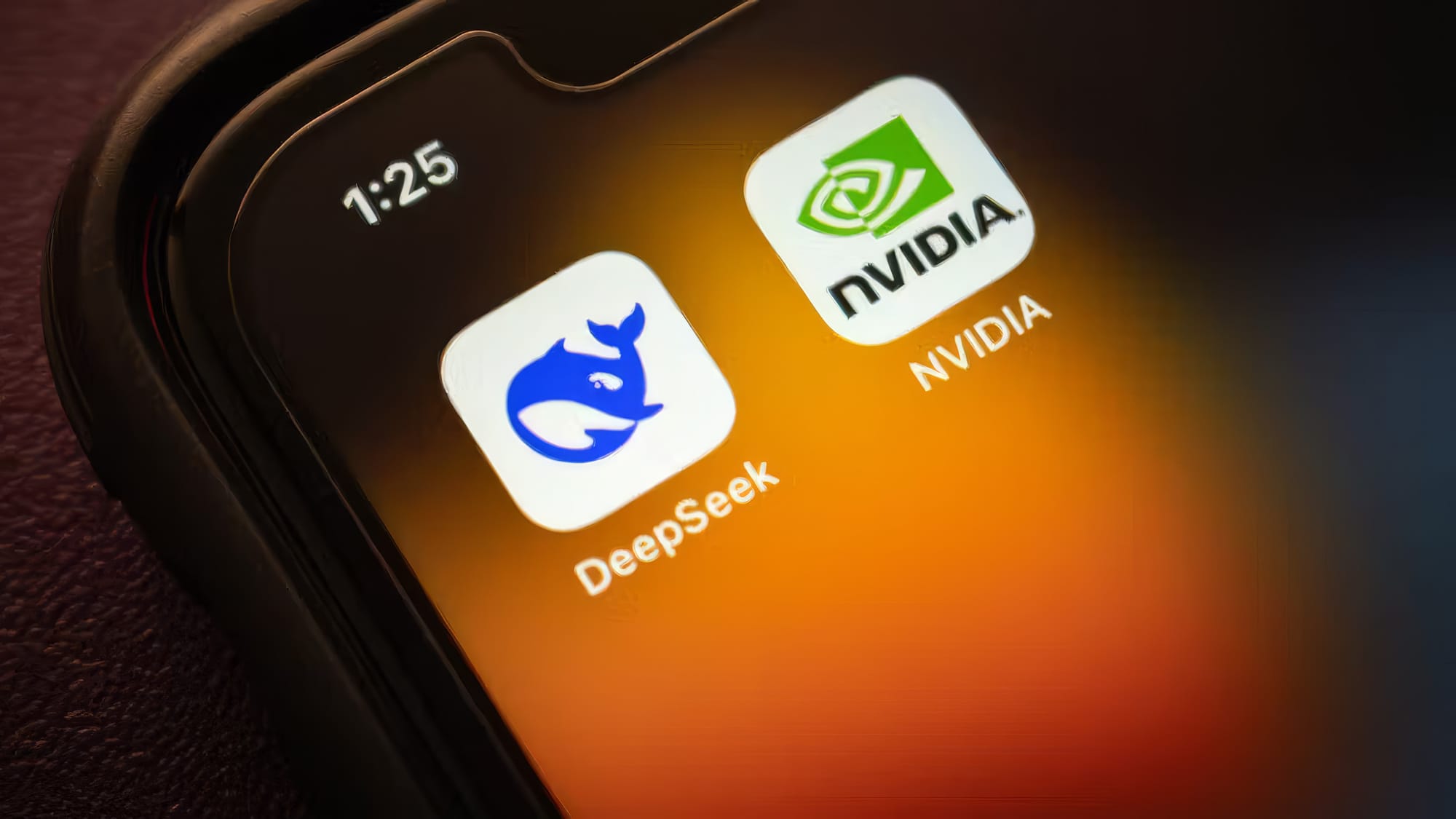
👀 What’s happening: The Information says DeepSeek is training its next model on thousands of Nvidia Blackwell GPUs, which are chips the U.S. explicitly banned from China. Investigators call it smuggling, engineers call it survival. Nvidia denies wrongdoing, but the silence from everyone else is louder: no one builds frontier AI on wishful silicon.
🔥 How this hits reality: Let’s be honest. Without Nvidia, there is no “competitive” AI model. Google’s TPUs can hold the line for a bit, but the rest of the silicon scene might as well be decorative art installations. For teams, it means the moat isn’t data or algorithms anymore, it’s who can actually get GPUs through the border. As for the compliance deck, that’s not even the hard part.
🛎️ Our take: Forget “AI model sovereignty.” The frontier still runs on Nvidia chips.
👀 What’s happening: The Information says DeepSeek is training its next model on thousands of Nvidia Blackwell GPUs, which are chips the U.S. explicitly banned from China. Investigators call it smuggling, engineers call it survival. Nvidia denies wrongdoing, but the silence from everyone else is louder: no one builds frontier AI on wishful silicon.
Google’s TPUs can hold the line for a bit, but the rest of the silicon scene might as well be decorative art installations. For teams, it means the moat isn’t data or algorithms anymore, it’s who can actually get GPUs through the border. As for the compliance deck, that’s not even the hard part.
👀 What’s happening: The Information says DeepSeek is training its next model on thousands of Nvidia Blackwell GPUs, which are chips the U.S. explicitly banned from China. Investigators call it smuggling, engineers call it survival. Nvidia denies wrongdoing, but the silence from everyone else is louder: no one builds frontier AI on wishful silicon.
TOGETHER WITH FELO
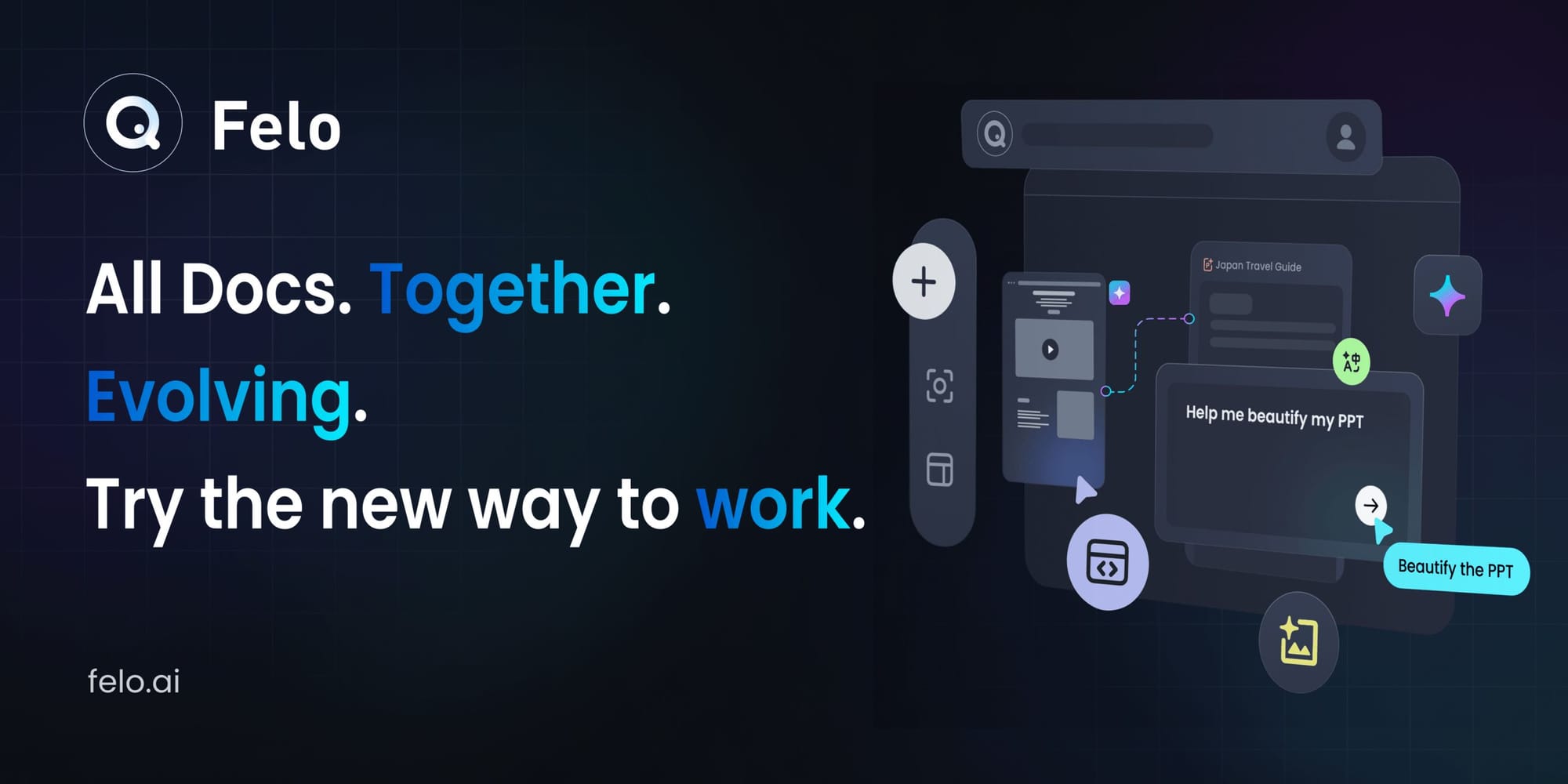
The 10x knowledge worker isn't typing faster—they're directing AI agents while competitors drown in copy-paste hell. Right now, someone just translated a 50-page deck in 3 minutes while you're still reformatting slide 12. Felo LiveDoc is the world's first Agent Workspace where documents don't just sit there—they evolve, analyze, and update themselves. Imagine a phantom team of designers, translators, and analysts inside your docs, unifying scattered PDFs, videos, and spreadsheets into one intelligent system that grows smarter with every task.
Here's what makes you look like a genius: While legacy tools treat you like a glorified typist, LiveDoc's multi-agent system operates autonomously. Design agents polish your layouts. Data agents extract insights across PDFs, videos, and web pages simultaneously. Translation agents speak every language your customers do—all working 24/7 inside one living workspace. This isn't productivity theater—it's the death of document drudgery. You're not just saving time; you're unlocking a superpower your competitors don't know exists yet.
And it's not just you—it's your entire team: Think of your best team collaboration tool—now add tireless AI teammates who never sleep, never forget context, and execute instantly. LiveDoc expands collaboration from human-to-human to human-plus-AI: team members direct, AI agents execute, all on the same canvas in real time. No more "latest_final_v3" nightmares. While your competitors coordinate between people, you're coordinating an entire hybrid workforce.
The insider move? Early adopters are already 10x-ing their output while the rest of the market is still toggling between twelve tabs. Every day you wait is another day spent manually updating slides like it's 2015. The knowledge workers who win aren't the ones who work harder—they're the ones who stopped editing and started directing.
🚀 Join the revolution: Get early access to Felo LiveDoc and become the person everyone asks, "How did you finish that so fast?" The age of manual document labor just ended. Are you evolving, or still typing?
NEW LAUNCH
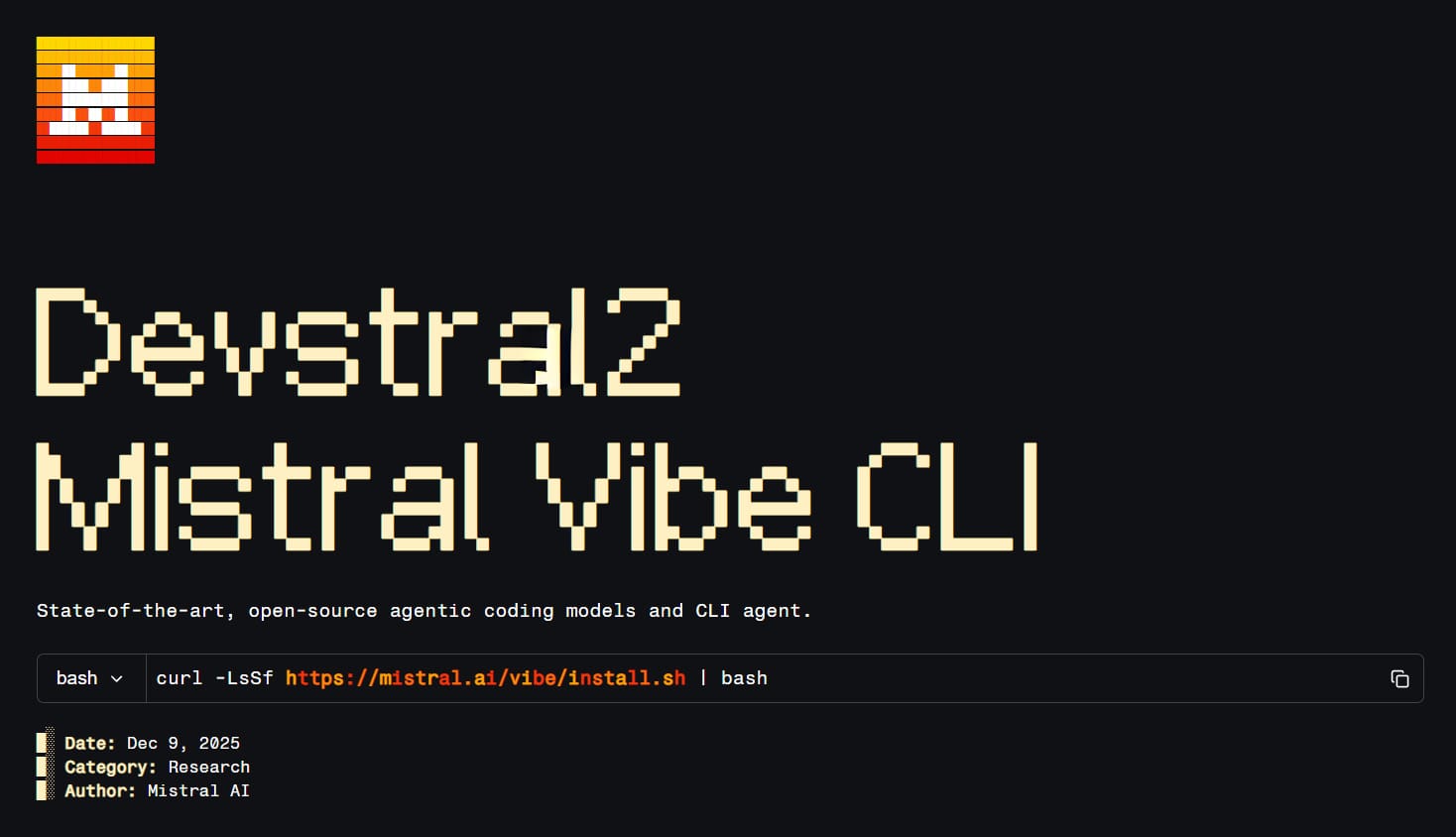
👀 What’s happening: Mistral unveiled Devstral 2, a new generation of code models built on a shared architecture: the 123B flagship for high-end agentic development, and a 24B “Small” version that runs offline on a single GPU or even a laptop. Both feature 256K context windows and top-tier SWE-Bench results, with the smaller model outperforming many 70B systems. Together with the Vibe CLI—a terminal-native interface for real-time project orchestration—Mistral’s lineup is built to live directly inside developers’ workflows.
🔥 How this hits reality: The release shifts AI coding from the cloud to the desk. Devstral Small 2’s local inference and edge efficiency open up AI-assisted programming for teams under strict data or latency constraints, while the full model pushes long-context reasoning closer to production scale. For enterprises, it means realistic on-prem AI coding; for independent developers, a self-contained, privacy-safe co-pilot that actually fits their hardware.
🛎️ Our take: Mistral just made frontier-grade coding intelligence portable, turning AI-assisted development from a service you call into a tool you own.
👀 What’s happening: Mistral unveiled Devstral 2, a new generation of code models built on a shared architecture: the 123B flagship for high-end agentic development, and a 24B “Small” version that runs offline on a single GPU or even a laptop. Both feature 256K context windows and top-tier SWE-Bench results, with the smaller model outperforming many 70B systems.
PREVIEW

👀 What’s happening: Google just previewed its Android XR smart glasses powered by Gemini, marking its first real comeback since the Glass collapse a decade ago. The two models — one voice-only, one with a built-in display — use Gemini’s multimodal brain to see, hear, and understand your surroundings. Users can ask it to translate a sign, recognize a landmark, or recall what they photographed earlier. Developer previews arrive in 2025, with a full commercial launch set for 2026.
🔥 How this hits reality: After Gemini 3 proved Google could finally build an AI that reasons rather than reacts, the company seems to have found the hardware form to match that brain. Android XR ties Gemini’s cognition directly to sensors, cameras, and real-world context, turning glasses into a live interface for spatial computing.
🛎️ Our take: Gemini gave Google intelligence; XR gives it embodiment. Together they hint at the first real successor to the smartphone.
👀 What’s happening: Google just previewed its Android XR smart glasses powered by Gemini, marking its first real comeback since the Glass collapse a decade ago. The two models — one voice-only, one with a built-in display — use Gemini’s multimodal brain to see, hear, and understand your surroundings.
QUICK HITS
TRENDING
TOGETHER WITH US
AI Secret Media Group is the world’s #1 AI & Tech Newsletter Group, reaching over 2 million leaders across the global innovation ecosystem, from OpenAI, Anthropic, Google, and Microsoft to top AI labs, VCs, and fast-growing startups.
We operate the industry’s most influential portfolio of newsletters, each shaping a different frontier of the AI & Tech revolution:
Be Smarter in 5 Minutes
Discover the Future Products
We've helped promote over 500 Tech Brands. Will yours be the next?
Email our co-founder Mark directly at [email protected] if the button fails.
Plus: Reddit Runs On What It Hates, DeepSeek Is Cornered Into Silicon
Read the storyPlus: Tesla Now Sells the Pick, Frontier Labs Can't Find Profit
Plus: The Blockade Backfired, Robotaxi Can’t “Cross” Water, Starship Did Half Its Job
Plus: DeepSeek V4 Preview, New AI Search Console
Plus: A Corporate Guillotine, DeepSeek Finally Needs Money
Plus: OpenAI Credibility Crisis Deepens, Musk Pulls Intel Into TeraFab
Plus: OpenAI Accuses DeepSeek, IBM Reverses AI Hiring Freeze
Plus: DeepSeek Launches Engram, Walmart bets agents
Plus: Visual authenticity collapsed, Meta Games Transparency
Plus: Local AI Coding, Google Finds Next Lens