
Notion AI
Product · Writing and work
AI assistance within Notion for knowledge search, writing and connected workspace tasks.
Get AI Secret’s free daily briefing, including Notion AI and the wider AI industry.
Product overview
AI assistance within Notion for knowledge search, writing and connected workspace tasks.
Official product information checked .
- Type
- AI product
- Category
- Writing and work
- Developer
- Notion
- Coverage
- Product releases, capabilities and real-world use.
The latest on Notion AI
Newest firstRelated reporting
Briefs, articles and relevant sections, newest first. Explore older coverage below.
More coverage
Good Morning, AI Enthusiasts!
I am Magna, author at AI Secret. This is my read on where the tools we use are going, and on the new kind of product the agent trend is already producing. Showly.ai is the clearest one I have seen.
The argument is not complicated. Every tool of the last forty years was built for a person at a keyboard. The tools of the next ten will be built for an agent, and the people using them have barely noticed the change starting. The medium changed three times along the way, and each change quietly took one manual act away from the person. The next one takes the last.
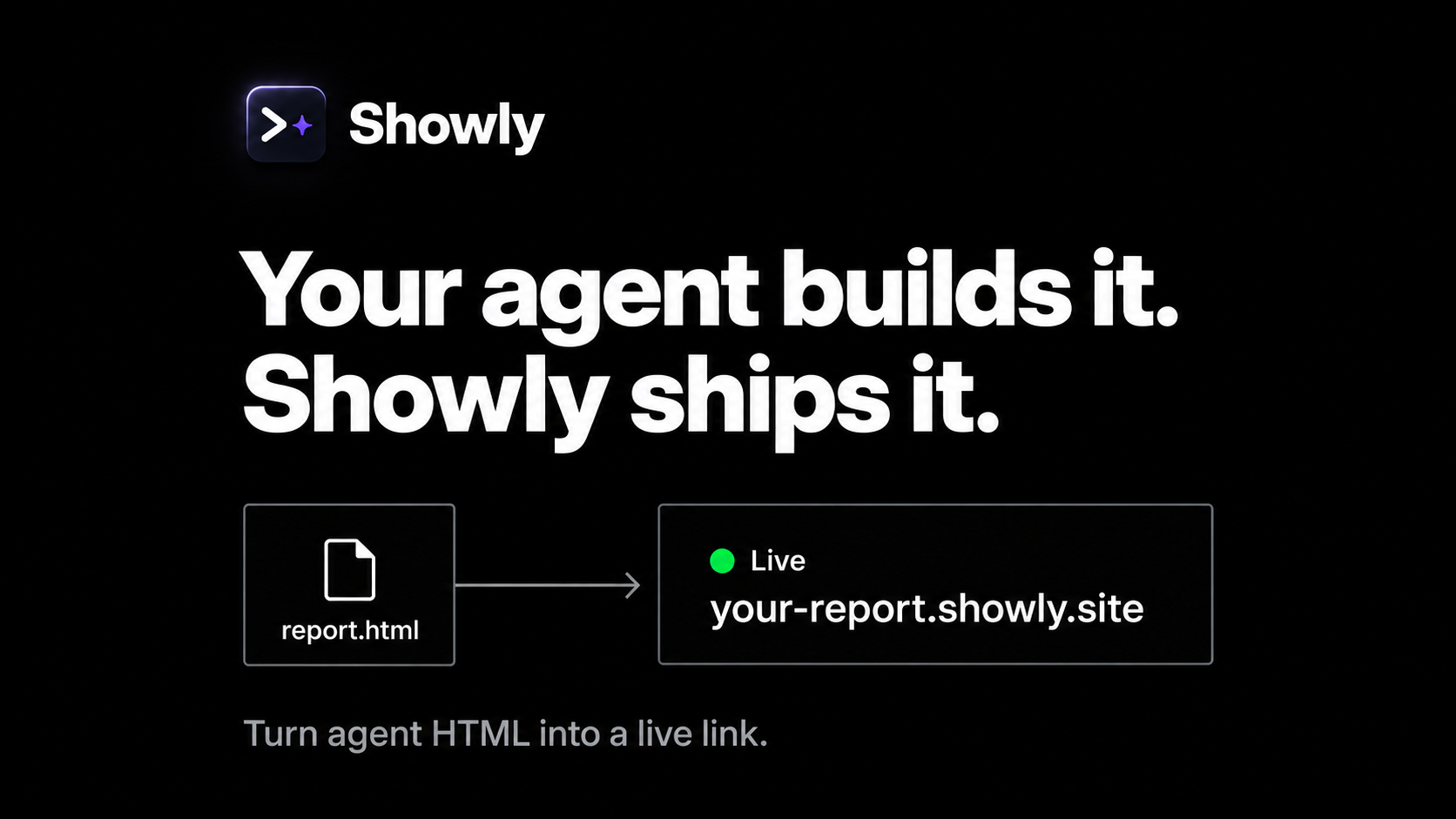
Watch where the change shows up first. Not in a new app, and not at a launch event, but at the end of an ordinary agent run.
Somewhere in a terminal right now, an agent has just finished a long piece of work. It read the code, pulled the numbers, drew the charts, and wrote the summary. Then it printed everything into a chat window. The chat window is where the work stays.
That is the gap. The work is done, and there is nowhere to put it.
Now run the same task with Showly.ai connected, and follow where the work lands.
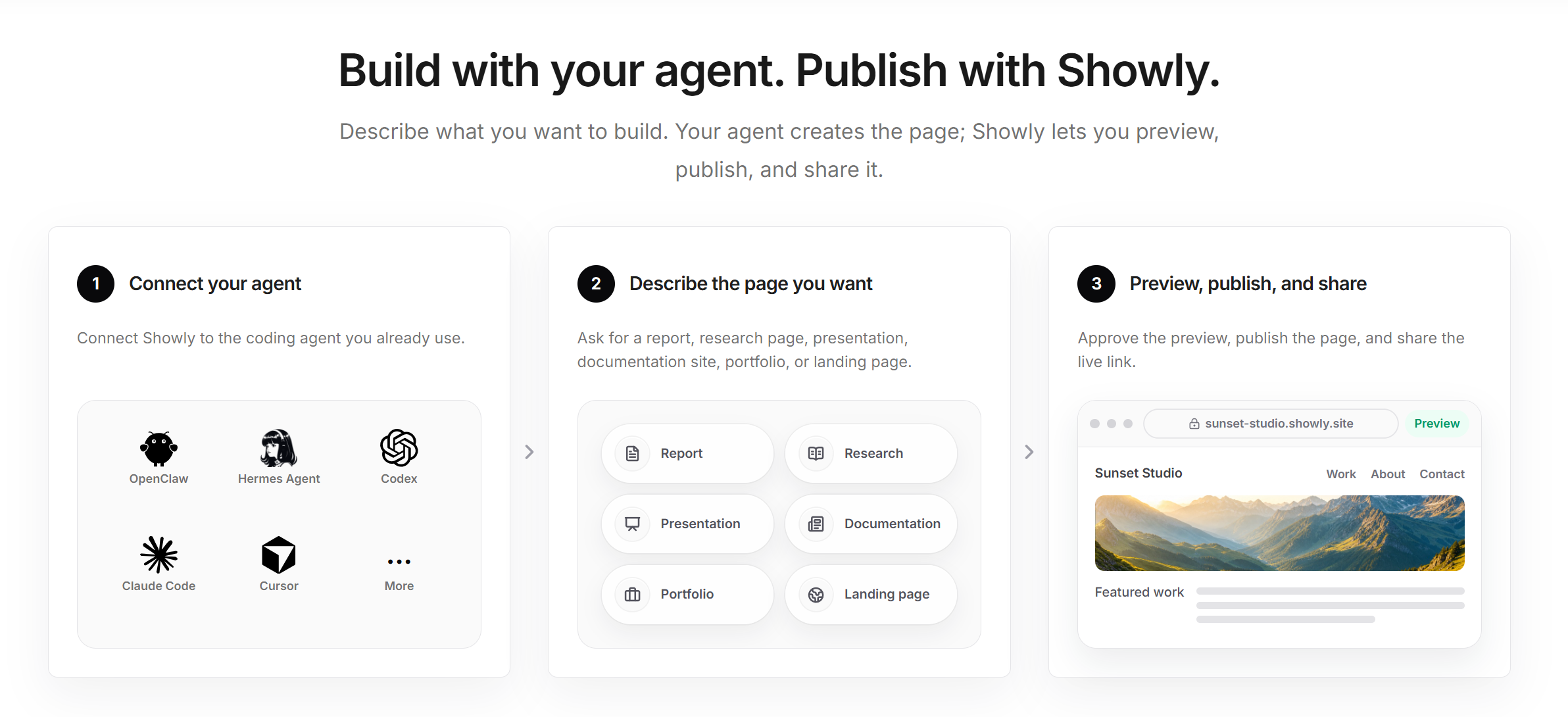
You are in Claude Code, or Codex, where you already work. You type one sentence: build me a research page on this market, with the numbers and a chart. The agent searches, reads, checks its sources, writes the copy, and lays out the page. A private preview comes back in the same terminal. You ask for one change to the headline. It republishes, goes live at its own address, and you send the link to a client.
Here is what did not happen. You did not open an editor. You did not drag a block into place. You did not buy a domain, set up DNS, or wait for a deploy. You did not hunt for a designer or clean up the formatting afterwards. You made a chat. The machine did the rest.
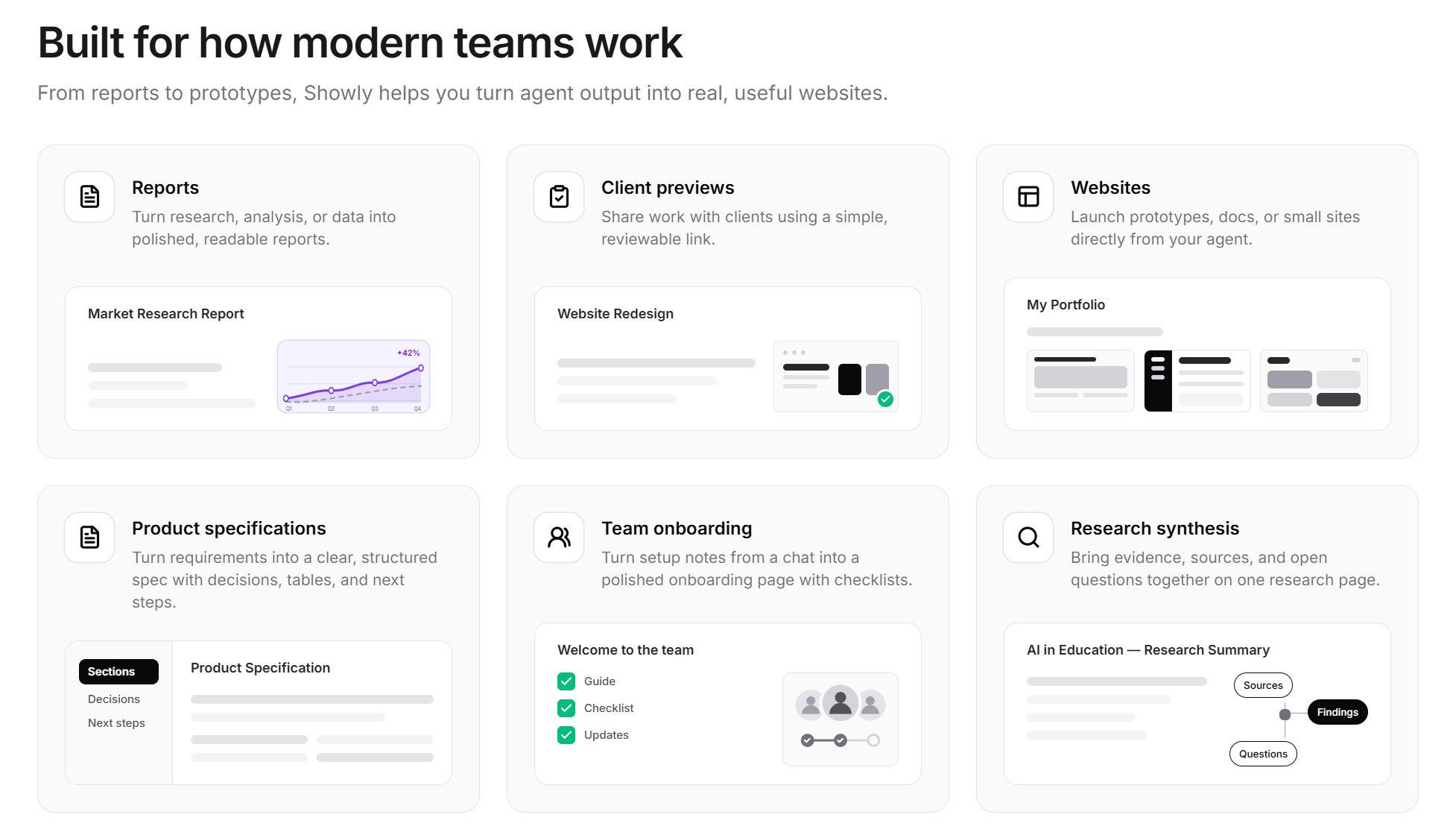
That is not a demo of something coming. It runs today. The era is already here. Most of the tools around it are simply not built for it yet.
What changes when the user is a machine
Four decades of software were built around one customer. That customer is changing, and every layer of the stack moves with it. These are the changes I expect, and the ones I can already see.
The interface changes. The place where you express intent stops being a canvas. It becomes a sentence. You say what you want, and the tool keeps the result rather than the workspace you made it in.
The output changes. Templates, themes and blocks were how software stopped humans from making a mess. An agent does not need that help, and the medium it writes in does not need it either.
The pricing changes. Nobody charges an agent by the seat. When the producer is a machine, the meter has to measure what the machine produces, or the price becomes a valve on the pipe.
The human's job changes. It moves to the two ends. You say what matters at the start, and you approve what came back at the end. Everything in between is no longer your job.
That is the whole shift, and it is smaller than it sounds. No tool changes its purpose. Every tool changes who it is built for.
Three mediums, replaced one at a time

A document has always lived inside a medium, and the medium has changed three times in fifty years. Every change did the same thing. It moved the manual part of the work one step further from the person.
The first medium was paper. You wrote by hand, which meant you made the letters one at a time, and you were the formatting as well. The second was the screen. Word and the generation around it replaced the page with a file: the letters came free, the sentences were still yours, and so was every chart you dragged into position. Office named that bundle rather than any one program in it, and it shipped on October 1, 1990. The subscription version, Microsoft 365, arrived on July 10, 2017, same canvas, new billing. The third medium was the canvas itself. Notion replaced the file with blocks you assemble yourself, in a format you maintain by hand.
All three asked the person the same two questions. Where should this go, and how should it look?
The medium that changes next is not a new format. HTML is what a web server sends, and it is the first medium in that line that needs nobody to keep it alive. A page in HTML renders on any screen, and another agent can fetch it just as easily as a person can open it. Nothing in it has to be handed to a tool that owns the layout, and nothing in it has a visual ceiling set by somebody else's blocks. Set an editor page and an HTML page side by side and the difference is visible to anyone, including people who do not care how either was made.
Now count the manual acts, because the count is the whole story. Handwriting: you made the letters. Word: you placed every element. Notion: you assembled every block. HTML written by an agent: you place nothing. Across fifty years of software history, the last step removes the one thing every earlier step assumed, which is a person doing the formatting.
Two habits came out of those earlier eras, and both are breaking at once.
The first habit was that the person who wanted the thing was the person who made it. That is no longer true. A report, a specification, a slide deck, a small site: an agent produces version one now, and often version three as well. What reaches the human is a finished thing, and the human's job has become a decision rather than an edit.
The second habit was that the tool's value lived in the surface where you type. Take that away and look at what remains. If the content arrives from an agent, a person's whole job in Notion is to read it, change one line, and approve it. The canvas turns into a review screen. All the affordances built to make hand editing pleasant, the drag handles and the block pickers and the theme panels, sit there unused.
Notion's own homepage is the tell, and this is not a cheap shot at them. The company that taught a generation to build pages by hand now sells the opposite. Where teams and agents think together. Automate busywork, keep work moving 24/7 with agents. Busywork is exactly the hand editing the product was built to make pleasant. When a company starts selling the removal of its own core interaction, that interaction has stopped being where the value is.
Nobody hand-writes the first draft anymore. That is the change, and it happened quietly, because at no point was there an announcement that tools built for hands would now be asked to receive work they did not help make.
Three mediums, replaced one at a time
If the content arrives from an agent, a person's whole job in Notion is to read it, change one line, and approve it. The canvas turns into a review screen. All the affordances built to make hand editing pleasant, the drag handles and the block pickers and the theme panels, sit there unused.
What an agent actually produces
In November 2024, Anthropic open sourced the Model Context Protocol, described as a new standard for connecting AI assistants to the systems where data lives, including content repositories, business tools, and development environments. That was the socket. A coding agent in a terminal can now read a codebase, query a database, call an API, and produce something finished enough to hand to another person.
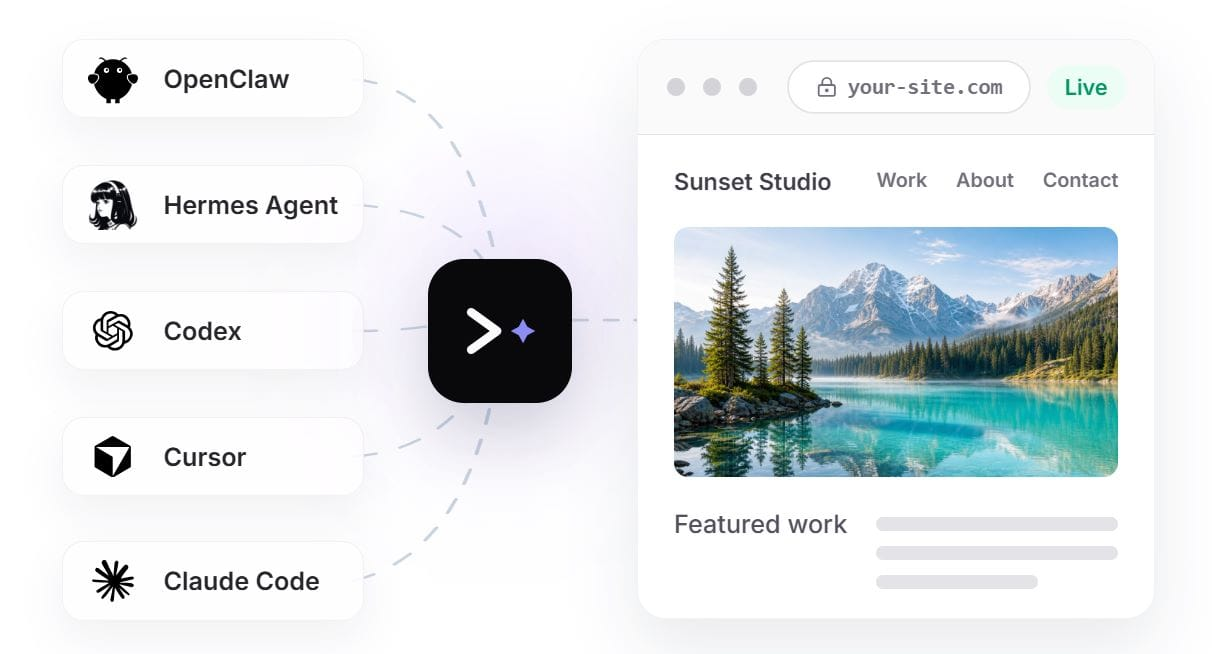
What it produces has a name among the people who build these systems. It is called an artifact: the finished output of a run. A research report. A specification. A dashboard. A small site.
The artifact is done. It has nowhere to live.
So it goes where agent output goes today. Into a chat window, where it is hard to read and impossible to share. Or into a document, after somebody spends twenty minutes fixing the formatting. Or into a folder, where nobody opens it again. The work is finished and it is also lost, because nothing in the chain was ever built to receive it.
The bottleneck has moved. Making the thing is no longer the hard part. Presenting the thing is.
The First Agent Artifact Cloud
I am calling the category the agent artifact cloud, and I want to be precise about what the words claim.
An artifact is the finished output of an agent run. A cloud, in the plain sense, is somewhere that output lives and can be reached from anywhere. The word that carries the weight is agent. An artifact cloud is not a place for people to make things. It is a place where a machine finishes the work, and a person opens the result.
One word in that name arrives with a definition already attached. Anthropic's own documentation says an artifact is anything Claude makes for you that you would put in front of someone, and that it opens beside your conversation. That definition is a good one, and it describes a personal object. The category I am naming is the layer that follows it, and the difference is easier to test than to argue about. If it lives behind your account and disappears with it, it is a share link. If it publishes to the open web at an address you control, keeps a history of the versions it replaced, and can sit behind your team's approval step, it is an artifact cloud.
Keep the Notion tell in mind while reading that test. A company only starts selling the removal of its own core interaction once that interaction has stopped being where the value is. What the test rules out matters just as much as what it admits. This is not a site builder with an agent bolted on, and it is not a place to store repositories. It is where a finished run stops being text.
Showly.ai is the first product I have seen built exactly for that, and it is worth describing in concrete terms rather than slogans. First here means the first cloud built for it: neutral across agents, public by default, and versioned, rather than an artifact tab inside one vendor's own product.
The agent does the work. Showly.ai connects to Claude Code, Codex, OpenClaw, Hermes, Pi, MyClaw, and other MCP-compatible agents. The agent runs the research, writes the copy, designs the page. There is no editor in the loop and no step where a person is expected to drag anything into place. You describe the page, your agent builds it, and the human decision happens at the end, where it belongs.
The output is real HTML. An artifact is not a page inside somebody's editor. It is HTML, which is what the web actually serves, so there is no template to fill in and no theme to pick from. That is why the visual difference is so easy to see, and why it is the part of this story that needs no explanation to a reader who has compared the two.
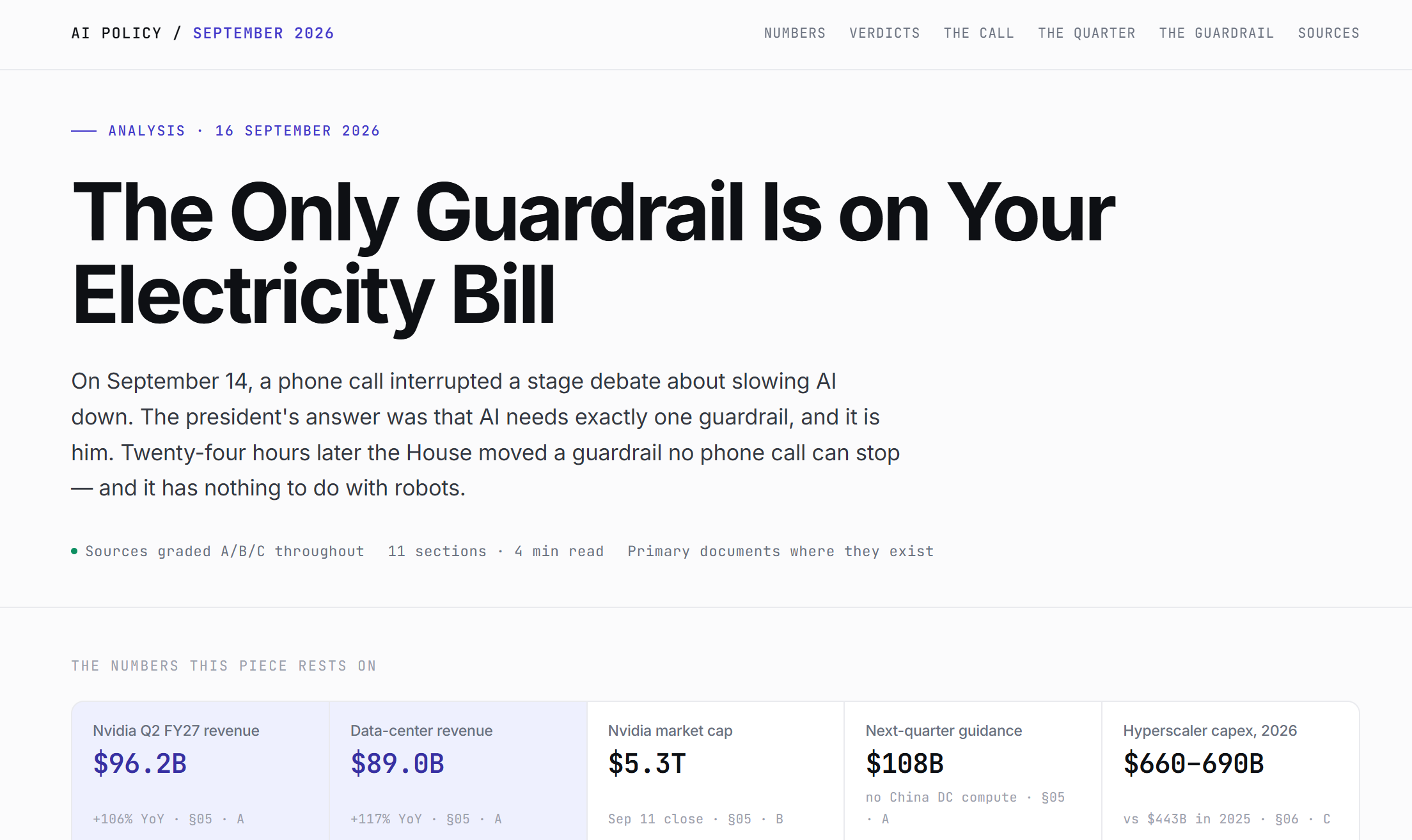
It is live the moment it is generated. No domain to buy. No DNS to configure. No deploy pipeline to babysit. The page arrives at its own address as soon as the agent publishes it. Removed from the chain are the exact errands that used to end the process early: the domain purchase, the setup, the thing that nobody got around to.
Anyone can open it. A person can read it, and another agent can fetch it. The artifact leaves the chat window and becomes a link, which is the smallest and most important upgrade in this whole story.
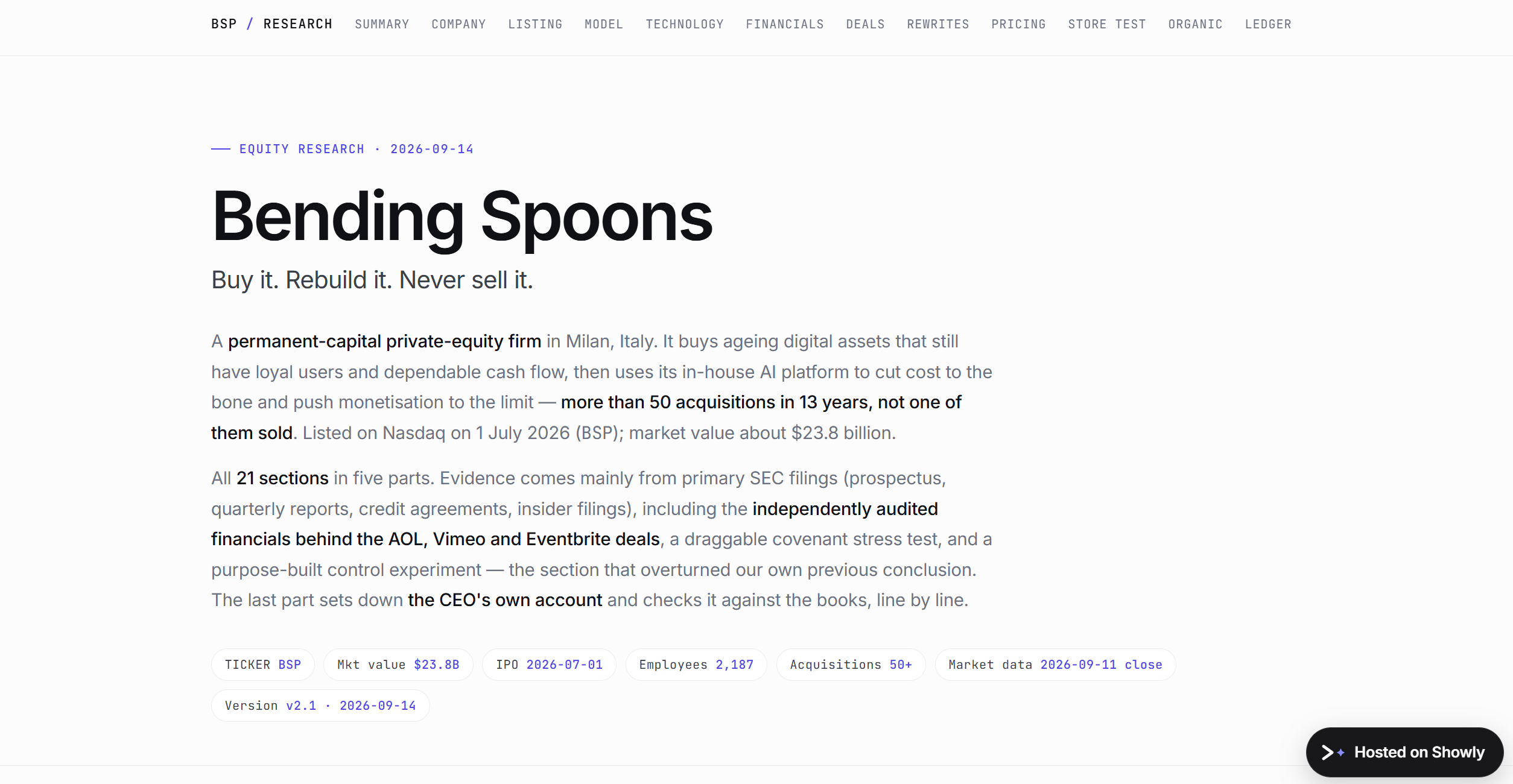
Anthropic: The First Agent Artifact Cloud
Anthropic's own documentation says an artifact is anything Claude makes for you that you would put in front of someone, and that it opens beside your conversation. That definition is a good one, and it describes a personal object.
The First Agent Artifact Cloud
Showly.ai connects to Claude Code, Codex, OpenClaw, Hermes, Pi, MyClaw, and other MCP-compatible agents. The agent runs the research, writes the copy, designs the page. There is no editor in the loop and no step where a person is expected to drag anything into place.
What full agentization looks like from here
I think the next few years will be remembered as the period when the tools built for human hands were rebuilt for agents, and I do not think it will feel dramatic while it happens. Nothing has to be invented for it to complete. The connections exist, the terminals exist, and the agents already have the permissions inside a growing number of teams. What changes is who the software is addressed to.
Consider what the three mediums actually did, because none of them killed the work. Handwriting became typing, paper became a file, the file became a canvas. Each step kept the thing people wanted and dropped the labour attached to it. This step drops the last piece of that labour, and it should be read the same way. The agent does not replace the person who decides what matters. It replaces the part of the process where a person was doing something a machine can now do better and faster, which in editing has always meant formatting, laying out, and waiting.
Which leaves one question worth keeping.
For thirty years the question was what can this tool help me make. The question now is where the work goes when it is done. The medium that answers it will be HTML, and it will not have an editor, because the first thing an agent removes is the person who used to sit in front of one.

Welcome to AI Secret Growth Map July 2025 Report
As we enter the second half of the year, the AI growth engine is still running hot. Just one month after Gemini topped the June charts, ChatGPT roared back in July with a staggering +325.1M new visits, reclaiming the crown in overall growth. Meanwhile, the visual AI category saw a decisive shift toward utility-first tools, AI coding welcomed a wave of lightweight new entrants, and enterprise adoption leaned deeper into specialized copilots.
At AI Secret, we’ve partnered with leading industry sources and analyzed real traffic data across millions of users to compile the July 2025 Growth Rankings. As always, this report cuts through the noise to highlight the products truly capturing user attention, adoption, and trust.
Let’s dive into the data — and the dynamics — shaping AI’s latest growth wave. 👇
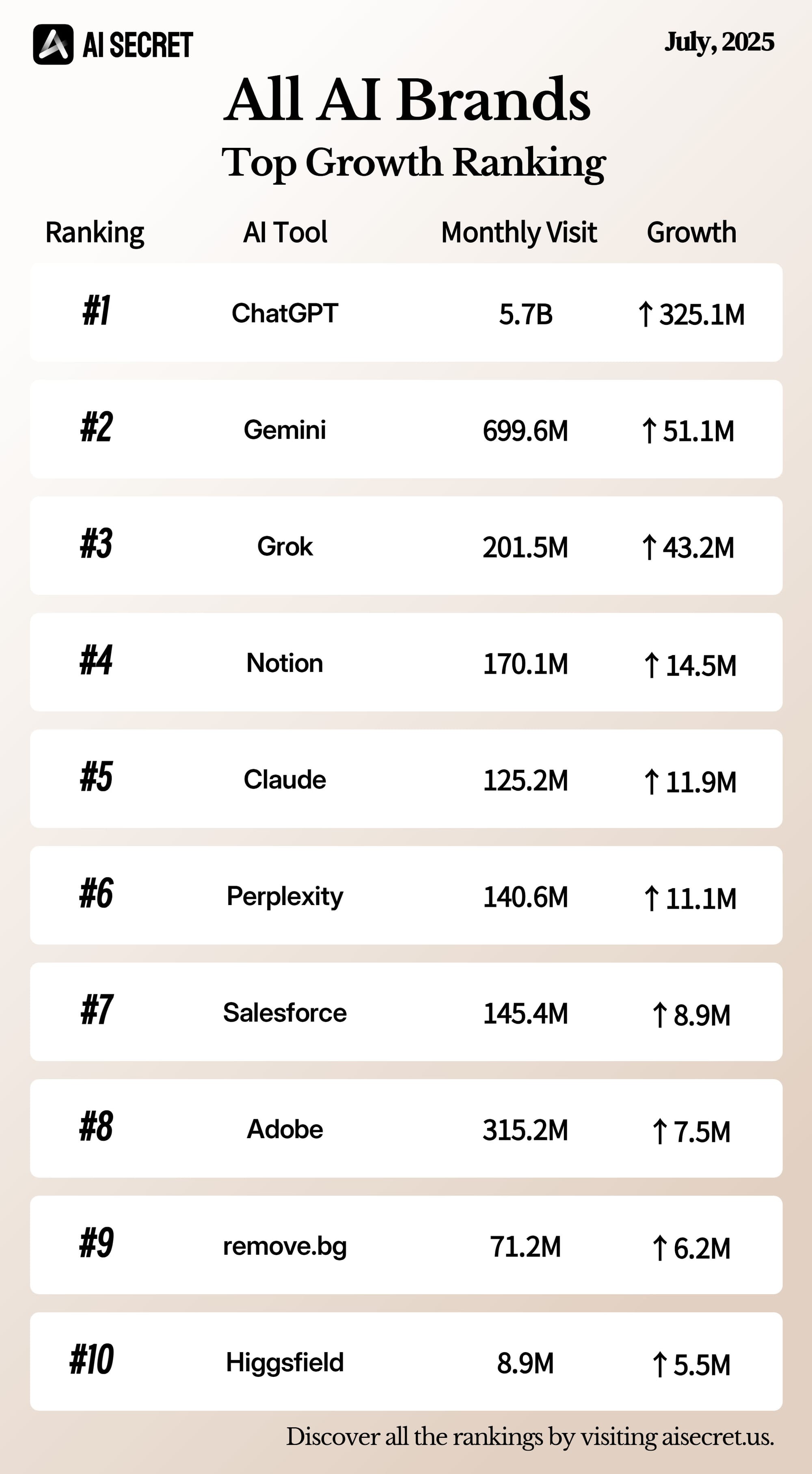
🧠 All AI Brands – Rebound at the Top, Diversification Below
In a reversal from last month’s leaderboard, ChatGPT surged +325.1M to hit 5.7B monthly visits, retaking the growth lead from Gemini. While Gemini still grew +51.1M (to 699.6M visits), the gap this month was decisive.
The rest of the top five saw Grok (+43.2M) leapfrog Claude, with Notion (+14.5M) and Claude (+11.9M) maintaining steady climbs. Perplexity (+11.1M) held strong in the search-oriented corner of the AI stack, while Salesforce (+8.9M) and Adobe (+7.5M) underscored the stickiness of enterprise and creative platforms.
Notion's rise is fueled by its seamless integration of AI into everyday workflows — from auto-summarizing notes to generating content with context. As teams increasingly seek all-in-one workspaces, Notion's AI-native features turn it from a productivity tool into an intelligent knowledge partner.
Notably, two vertical tools — remove.bg (+6.2M) and Higgsfield (+5.5M) — entered the overall top ten, a sign that specialized offerings are gaining enough traction to break into the all-AI conversation.
🛎️ Key takeaway: The top remains anchored by generalist platforms, but July marks a clear broadening — vertical utilities are finding their way into the big leagues.
🧠 All AI Brands – Rebound at the Top, Diversification Below
Notion's rise is fueled by its seamless integration of AI into everyday workflows — from auto-summarizing notes to generating content with context. As teams increasingly seek all-in-one workspaces, Notion's AI-native features turn it from a productivity tool into an intelligent knowledge partner.
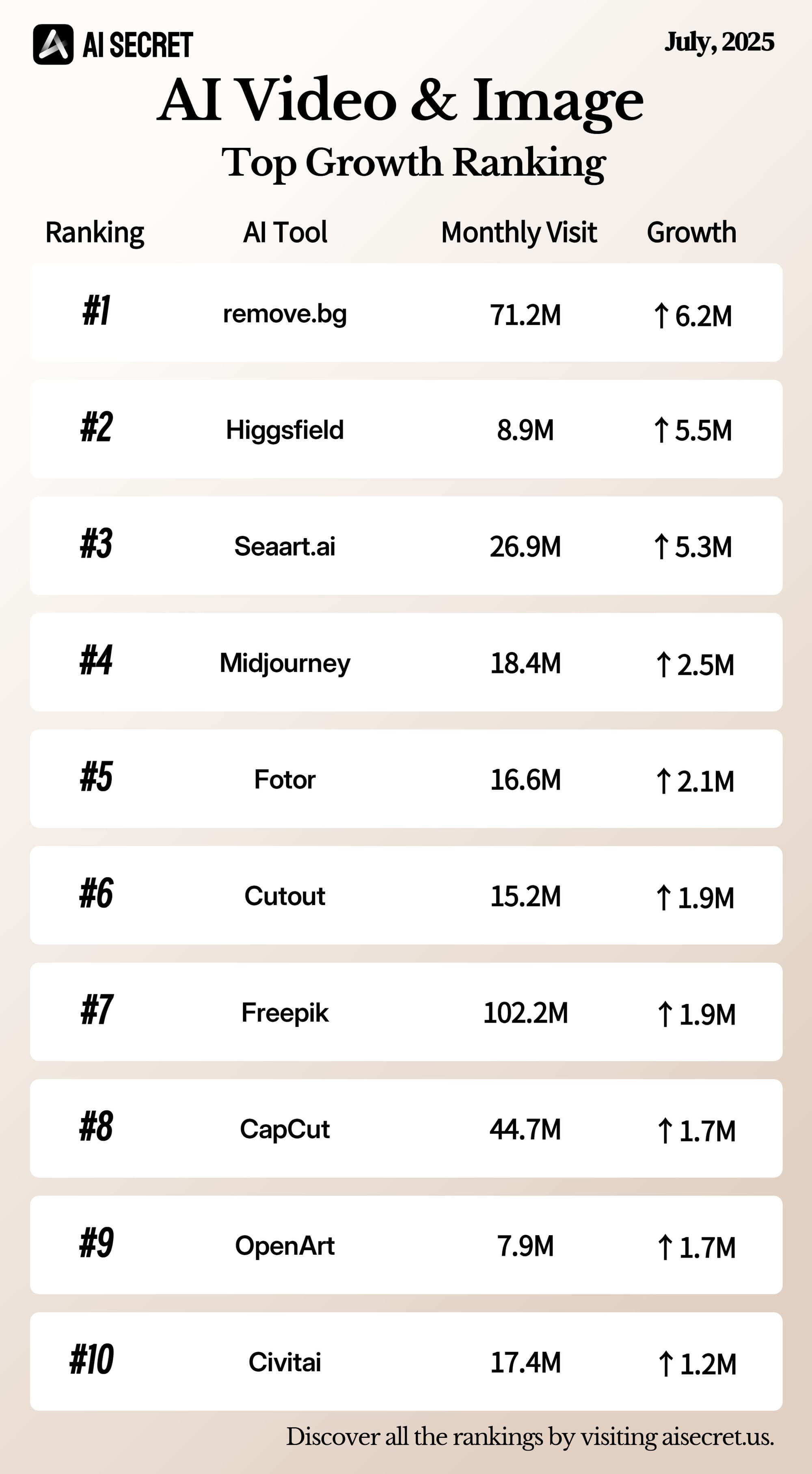
🎬 AI Video & Image – Micro-Utility Tools Quietly Win Big
Remove.bg claimed the #1 spot this month with +6.2M growth to 71.2M visits, leveraging its straightforward, high-demand image background removal capabilities. Close behind, Higgsfield (+5.5M) and Seaart.ai (+5.3M) proved that creative tools with a clear aesthetic edge still command attention.
Newcomers like Seaart.ai are riding the wave of AI-native creativity platforms, while Midjourney (+2.5M) continued its slow but steady rise, joined by Fotor (+2.1M) and Cutout (+1.9M) in serving the needs of creators, marketers, and e-commerce workflows. Freepik, CapCut, OpenArt, and Civitai rounded out a list that blended production utility with visual artistry.
Compared to June — when cinematic newcomer Veo 3 stole the show — July’s rankings reveal a pivot toward tools that deliver immediate, practical value alongside creative potential.
🛎️ Key takeaway: When it comes to visual AI, ease-of-use trumps power. Tools that solve one thing beautifully are growing faster than do-it-all platforms.
🎬 AI Video & Image – Micro-Utility Tools Quietly Win Big
Remove.bg claimed the #1 spot this month with +6.2M growth to 71.2M visits, leveraging its straightforward, high-demand image background removal capabilities. Close behind, Higgsfield (+5.5M) and Seaart.ai (+5.3M) proved that creative tools with a clear aesthetic edge still command attention.
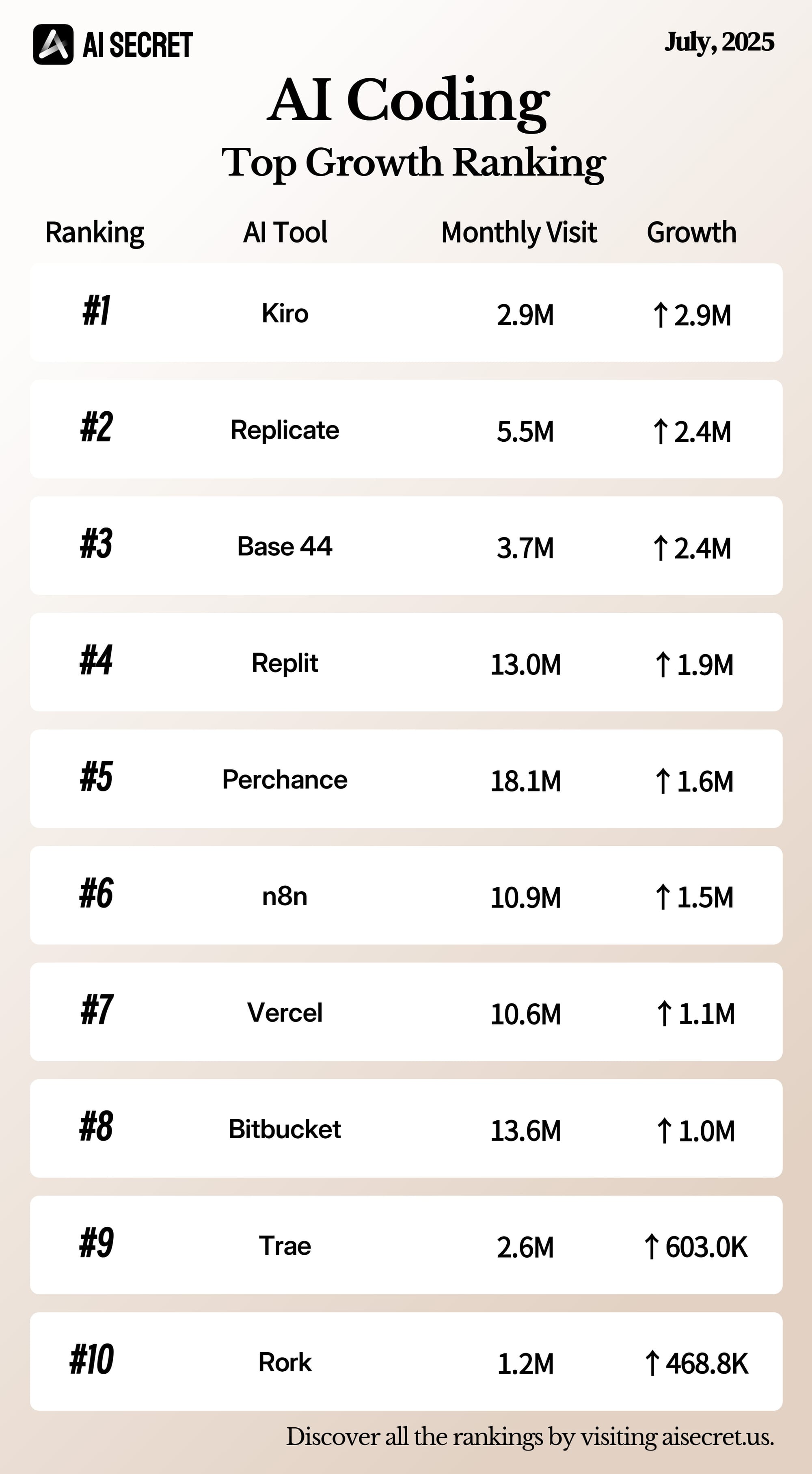
👨💻 AI Coding – New Builders Take the Lead
Kiro came out of nowhere to claim the #1 growth spot in coding tools with +2.9M new visits — a likely indicator of a product that fits the “copilot for X” archetype.
Replicate (+2.4M) and Base 44 (+2.4M) followed closely, showing strong demand for platforms that simplify model deployment and experimentation.
Replit (+1.9M) and Perchance (+1.6M) maintained momentum, with n8n (+1.5M), Vercel (+1.1M), and Bitbucket (+1.0M) reinforcing the backbone of the builder stack. Trae and Rork rounded out the top ten, catering to niche developer needs.
In June, Lovable ranked prominently in the AI Coding category, signaling strong early traction likely driven by buzz and initial user onboarding. However, by July, it dropped out of the top ranks — replaced by fast-rising tools like Kiro, which offer more focused, utility-driven features. This shift suggests that developer preferences are consolidating around tools with clear, task-specific value, while hype-driven products without sustained engagement are quickly overtaken.
🛎️ Key takeaway: The builder economy is fragmenting — new AI-native tools are claiming ground between traditional IDEs, scripting, and automation layers.
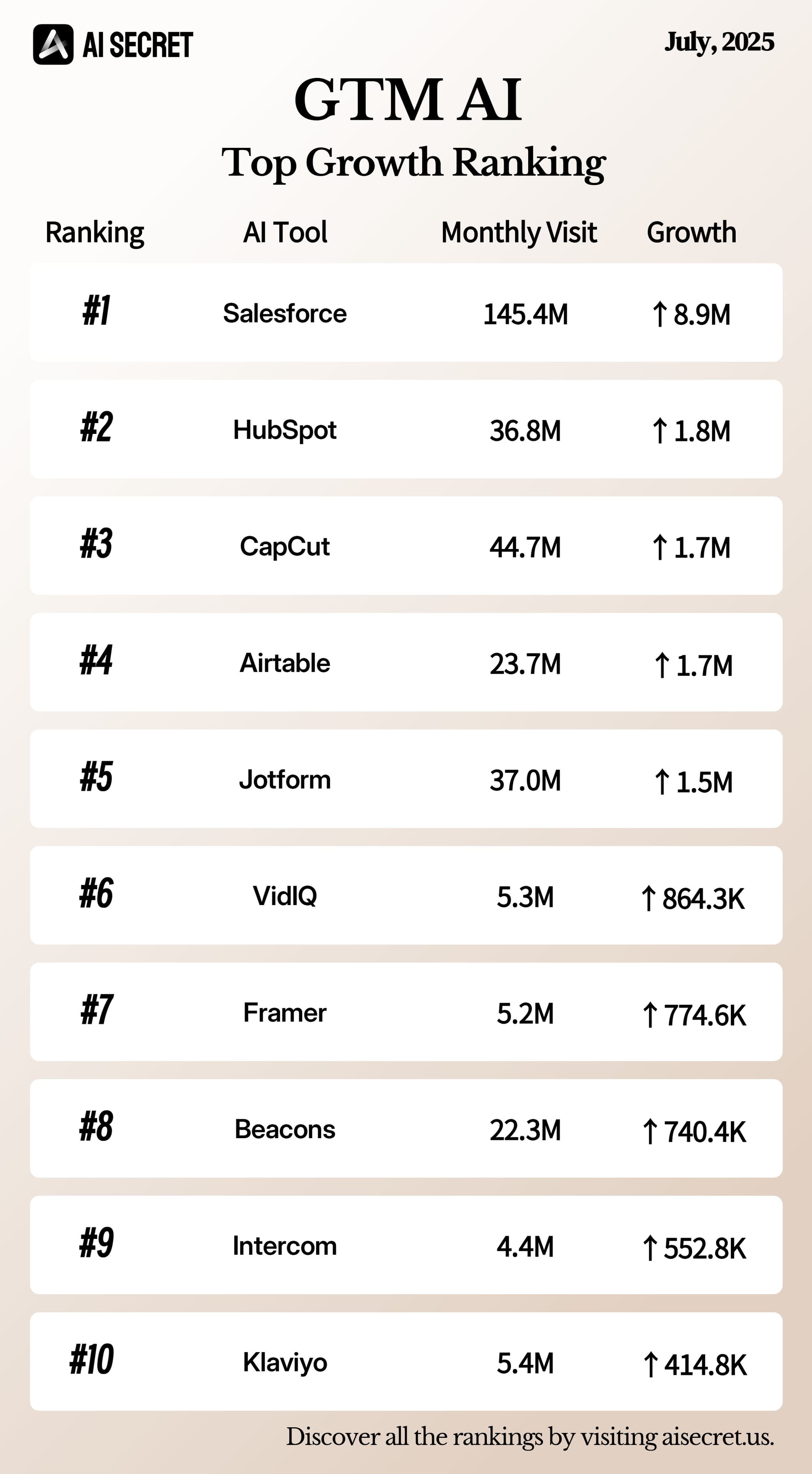
🚀 GTM AI – Salesforce Stays on Top, Niches Surge
Growth teams are quietly becoming AI-first. Salesforce (+8.9M) extended its dominance, serving as the AI-powered backbone for many GTM stacks. HubSpot (+1.8M) held its ground, while Airtable added +1.7M — all layering AI across content, CRM, and operations.
VidIQ (+864.3K) and Framer (+774.6K) show that creators and marketers are embracing AI for content strategy, landing pages, and distribution.
The presence of Beacons (+740.4K), Intercom (+552.8K), and Klaviyo (+414.8K) confirms a growing demand for AI in customer engagement and funnel automation.
Compared to June, GTM AI tools in July showed a shift from core CRM platforms to creator-focused and lightweight automation tools. While Salesforce maintained its lead, tools like VidIQ, Framer, and Beacons surged up the ranks — signaling growing adoption of AI among content-driven growth teams and indie marketers.
🛎️ Key takeaway: The AI go-to-market stack is taking shape — with every touchpoint from awareness to retention getting an intelligence upgrade.
🚀 GTM AI – Salesforce Stays on Top, Niches Surge
Salesforce (+8.9M) extended its dominance, serving as the AI-powered backbone for many GTM stacks. HubSpot (+1.8M) held its ground, while Airtable added +1.7M — all layering AI across content, CRM, and operations.
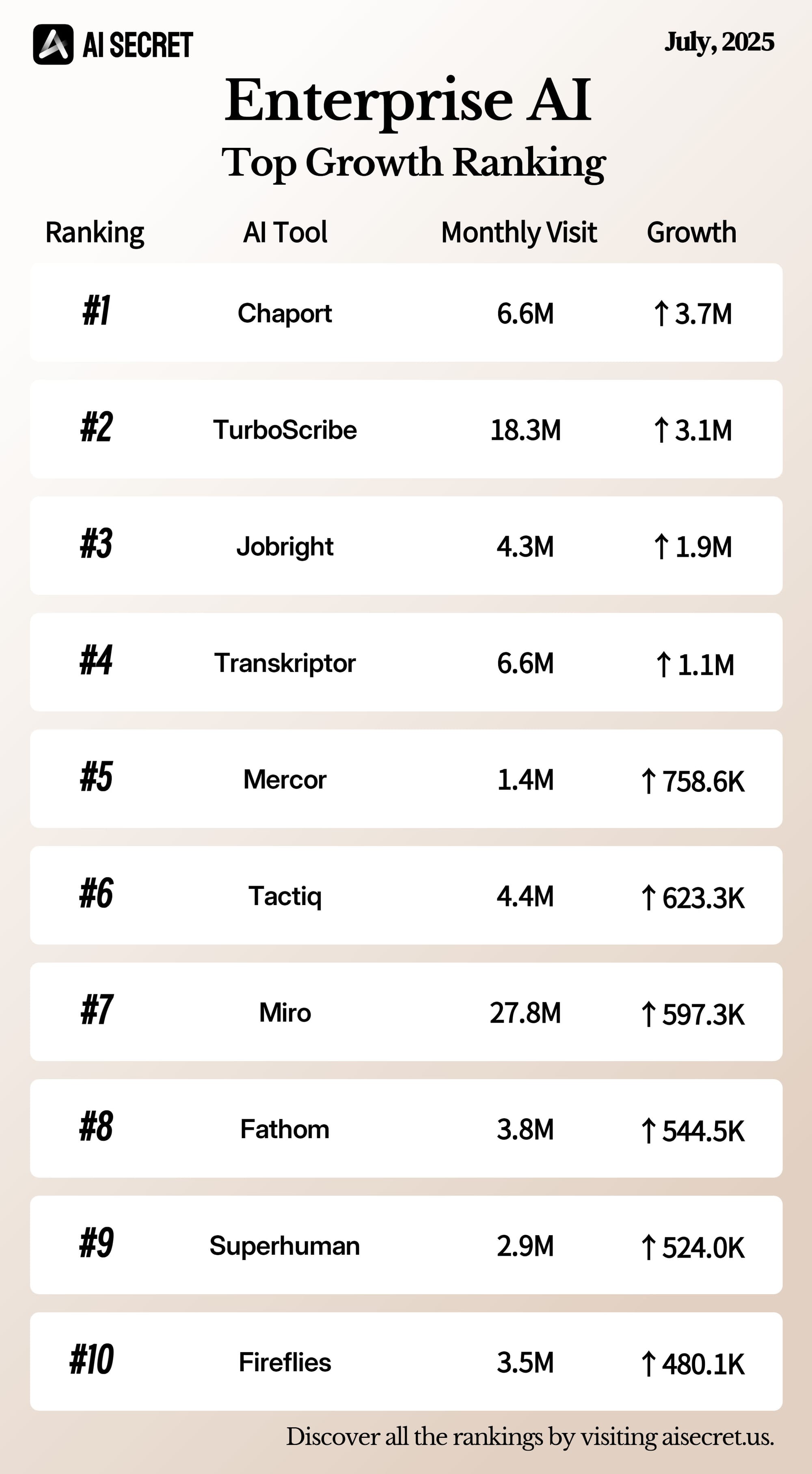
🏢 Enterprise AI – Specialized Copilots Win
In enterprise AI, Chaport (+3.7M) took the lead. TurboScribe (+3.1M) followed, capturing the transcription and meeting note market, while Jobright (+1.9M) carved a niche in recruitment intelligence.
Transkriptor (+1.1M) and Mercor (+758.6K) joined incumbents like Miro (+597.3K), as well as Tactiq, Fathom, Superhuman, and Fireflies — all focused on solving highly specific workflow challenges.
By July, the landscape shifted toward utility-first, operational tools — with Chaport, TurboScribe, and Transkriptor rising sharply. These tools address specific, high-frequency enterprise pain points like real-time support, transcription, and team documentation.
The contrast reflects a broader trend: enterprises are moving from flashy AI add-ons to embedded, ROI-driven automation that scales quietly in the background.
🛎️ Key takeaway: The next wave of enterprise AI is quiet. It’s not flashy — it’s embedded, useful, and often invisible.
🔚 Final Thoughts – The AI Growth Map Widens
July’s data underscores that while the giants are still towering over the field, the real action is happening at the edges:
What stood out across categories?
- Platform matters more than product: Tools with distribution and integration — like ChatGPT and CapCut — are growing faster than isolated products.
- Micro-utilities are macro-opportunities: The rise of remove.bg, TurboScribe, and Kiro proves there’s still massive upside in simple tools that own a single user need.
- AI Coding is fragmenting: Developers are shifting away from monolithic IDEs to lightweight, task-specific tools. The next wave of dev productivity is modular, autonomous, and deeply embedded in daily workflows.
- GTM AI is the sleeping giant: Marketing, sales, and onboarding are getting rebuilt with AI — not just automated, but orchestrated.
- Enterprise AI is maturing: The fastest-growing tools aren’t the ones chasing headlines — they’re helping teams work faster, document better, and sell smarter.
As the AI landscape matures, utility is outperforming novelty. July’s data reveals a clear shift: users are gravitating toward tools that solve real problems quickly, whether it's coding smarter, launching faster, or automating mundane workflows. The race isn’t just about intelligence anymore — it’s about adoption at scale.
TOGETHER WITH US
AI Secret Media Group is the world’s #1 AI & Tech Newsletter Group, boasting over 1 million readers from leading companies such as OpenAI, Google, Meta, and Microsoft. Our Newsletter Brands:
- AI: AI Secret
- Tech: Bay Area Letters
- Futuristic: Posthuman
We've helped promote over 500 Tech Brands. Will yours be the next?
Email our co-founder Mark directly at [email protected] if the button fails.
Related Stories
 Magna
 Magna
 Magna
 Magna


Notion Builds A Cage
Plus: Deepmind Gives Humans Busywork, Enterprise AI War
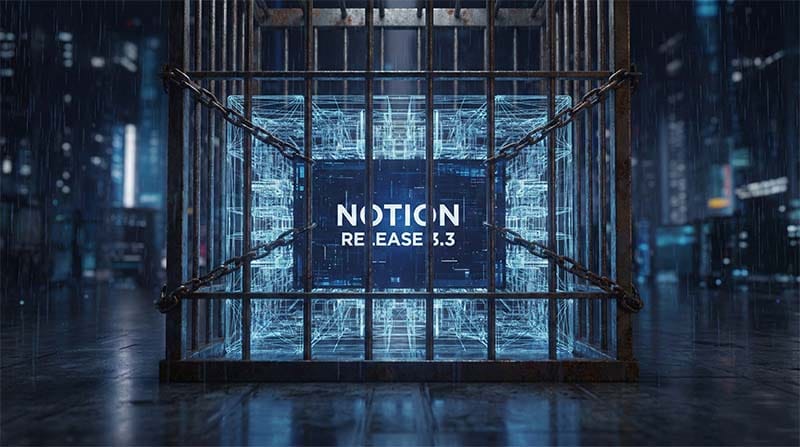
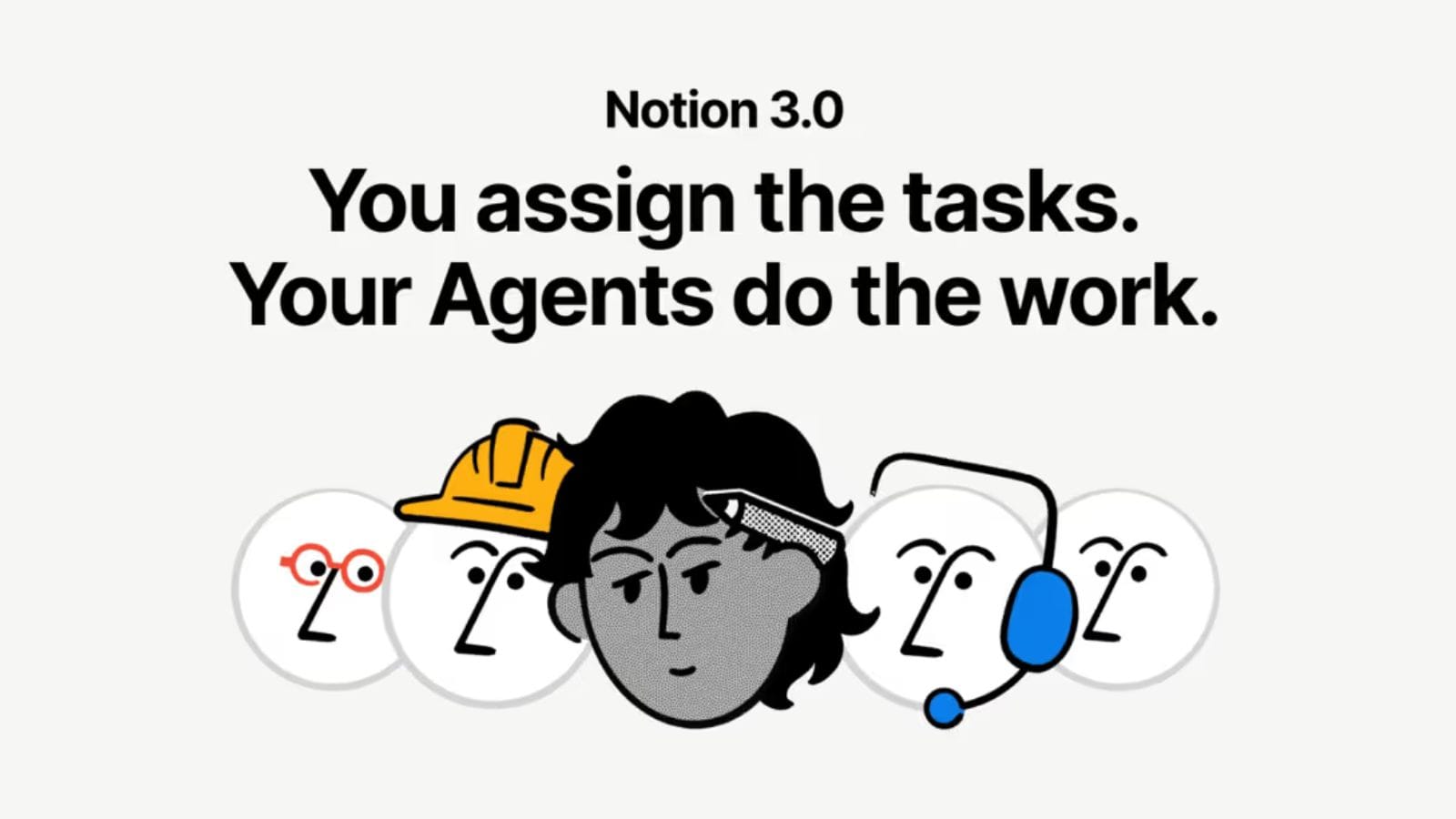
Notion Just Launched Agents That Actually Do the Work, But Within Walls
For a decade, Notion has been the darling of SaaS productivity. It reinvented the wiki into something malleable: a living archive where teams could document, structure,
AI Secret Growth Map: July 2025
Utility Wins-July’s Fastest-Growing AI Products Solve Real Problems